Donald Trump’s stance on the Greenland issue has undergone a sharp reversal, shifting rapidly from threats of military intervention and economic sanctions to a NATO-brokered “diplomatic compromise.” This sudden 180-degree turn has temporarily averted an imminent transatlantic trade war but has left European leaders bewildered and unsettled by the sheer unpredictability of his policies.
On January 21, local time, Trump posted on his social media platform, Truth Social, stating that following his meeting with NATO Secretary General Mark Rutte, they had reached an agreement on a framework for future cooperation regarding Greenland and the entire Arctic region. Trump announced that he would not implement the tariff measures against Europe originally scheduled to take effect on February 1. While the specifics of the agreement remain unclear, the statement marks a stunning turning point in the ongoing controversy over Trump’s insistence on acquiring Greenland for the United States.
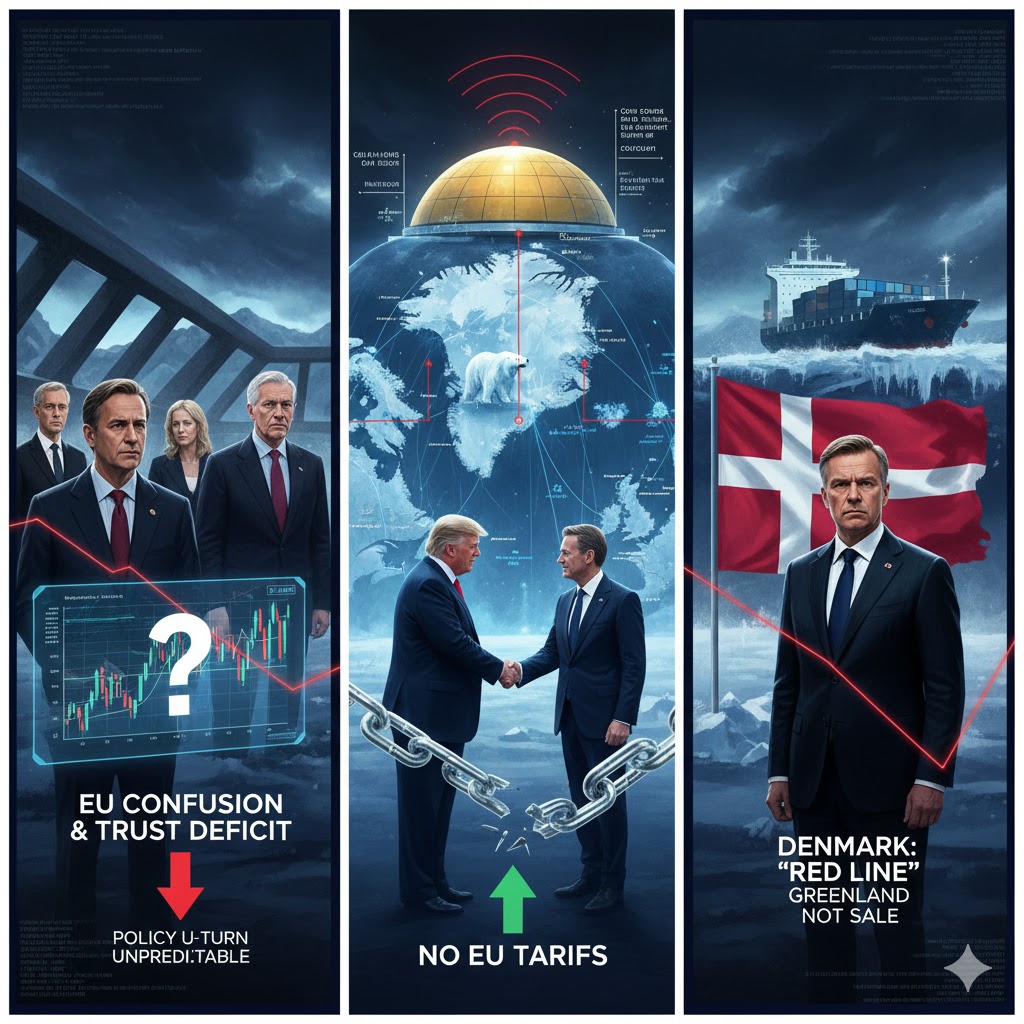
This unexpected move disrupted the agenda of an emergency summit of EU leaders planned in Brussels. The meeting was originally intended to build a united front against Trump’s “economic coercion” and his ambitions toward European territory. Although the immediate risk of tariffs has been lifted, it has not entirely dispelled market concerns. EU officials noted that Trump’s seemingly flexible strategy could actually jeopardize EU unity and raised serious doubts about the credibility of U.S. commitments.
Europe’s Confusion and Trust Deficit
The core of this reversal lies in shifting the focus from simple territorial acquisition to security cooperation.
Trump described the Greenland framework in media interviews as a “concept of a deal” and suggested it involves U.S. mineral extraction rights in Greenland, as well as plans for the deployment of the “Golden Dome” missile defense system. When asked for more details on the proposal, Trump stated: “It’s a little bit complex; we’ll explain it down the line.”
While the removal of the tariff threat brought a sigh of relief to the markets, Trump’s volatility has left European capitals at a loss. Three EU officials revealed that this sudden development upended summit plans designed to counter Trump’s “desire to conquer European territory.” The central question now is: How long can the U.S. President’s promise last?
An official involved in the summit preparations stated bluntly: “He [Trump] is acting more flexibly, which is dangerous for EU unity because he is clearly catering to the differing perspectives among member states.” This strategy exacerbates conflicts between competing national interests within the EU, whether regarding trade, the issue of Ukraine, or transatlantic alliance relations.
Skepticism remains widespread within the EU, with many believing that Trump’s shift toward a diplomatic solution may not be permanent. “He is clearly mentally unstable,” one official remarked. “He could come back tomorrow and decide to impose tariffs on every EU country, or decide that he actually can use force to invade. I hope [EU leaders] don’t fall for it.”
Denmark’s Red Line and Pragmatic Negotiations
Denmark and Greenland have cautiously welcomed the de-escalation while reiterating their core positions. Since Trump first expressed interest in a purchase in 2019, Denmark has been explicit: the territory is not for sale.
Danish Foreign Minister Lars Løkke Rasmussen, following a brief communication with Rutte, insisted: “U.S. ownership of Greenland is an impossibility. That is a red line.”
However, Rasmussen also signaled a willingness to negotiate, stating that Denmark is prepared to engage in talks regarding U.S. security concerns along the lines agreed upon last week with Vice President JD Vance and Secretary of State Marco Rubio.
Despite this, Danish left-wing lawmaker Pelle Dragsted issued a warning: “This is not something we can negotiate. Greenland belongs to the Greenlanders; you cannot buy and sell people and countries.”