AMD Stock Price

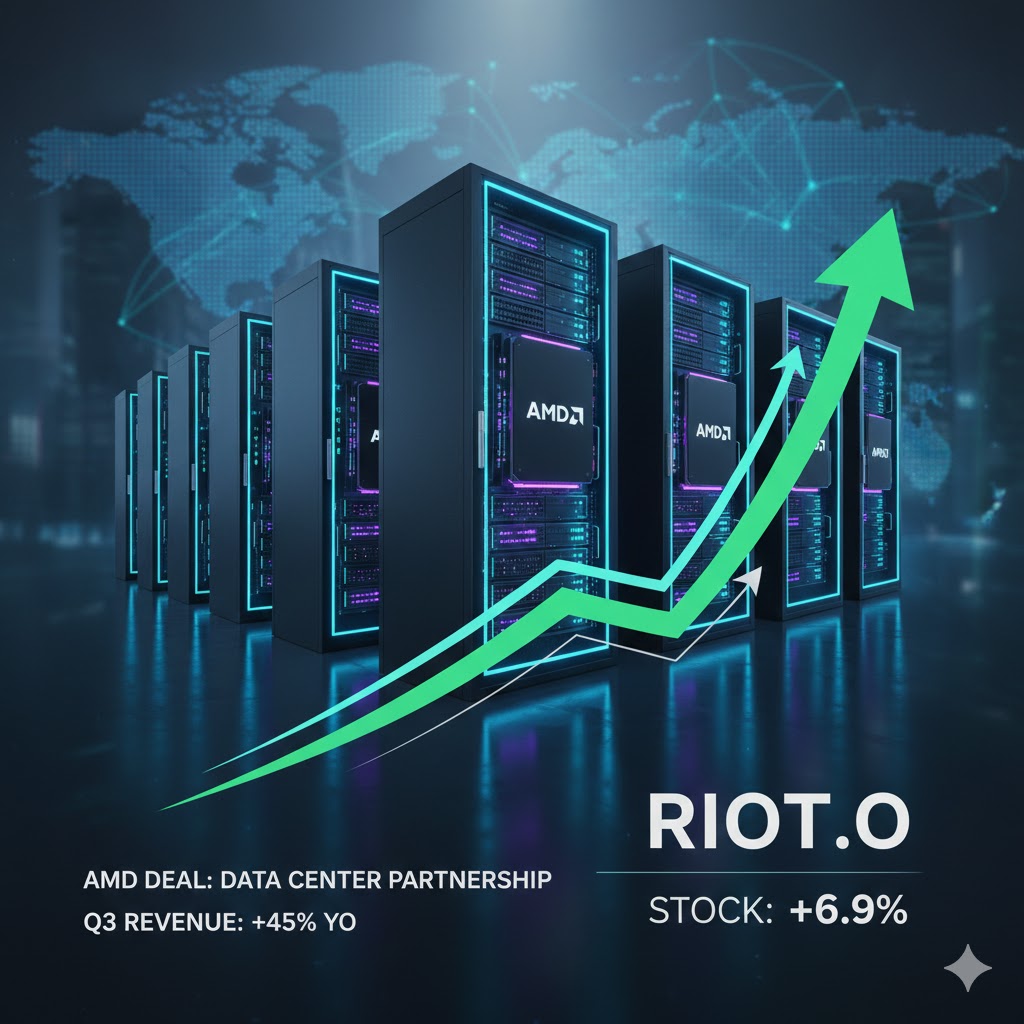
Riot’s Strategic Leap: Why RIOT (RIOT) Stock Surged Nearly 7% on AMD Data Center Deal

On January 16, 2026, Riot Platforms, Inc. (RIOT) saw its stock RIOT stock climb sharply in pre-market trading, rallying nearly 7% after the company announced a significant data center lease agreement with Advanced Micro Devices, Inc. (AMD) that promises both immediate and long-term revenue streams and marks a strategic pivot in Riot’s business model. This development has captured investors’ attention, not only because of the strength of the initial deal but also due to its implications for Riot’s financial profile, growth strategy, and broader market positioning in both the data center and blockchain infrastructure sectors.

Under the agreement, AMD has committed to leasing an initial 25 megawatts (MW) of critical IT load capacity at Riot’s Rockdale, Texas site, with expansion rights up to 200 MW — a near-eightfold potential increase — which could add transformative scale to Riot’s digital infrastructure business. The base lease is expected to generate approximately $311 million in contract revenue over a 10-year initial term, and if AMD exercises all three five-year extension options, total contract revenue could reach about $1 billion.

This milestone marks a pivotal evolution for Riot, historically known as a leading Bitcoin mining company, as it deepens its footprint in hyperscale data centers and high-performance computing (HPC) infrastructure — sectors experiencing robust demand tied to artificial intelligence (AI) and cloud-era compute requirements.


A Paradigm Shift: Enhancing Riot’s Business Model

For much of its corporate history, Riot has derived the majority of its revenue from Bitcoin mining operations, producing and holding significant amounts of the digital currency while optimizing power and hashing efficiency across sites in Texas and Kentucky. For instance, Riot’s recent monthly production updates indicate a strong operational base, with Bitcoin mined in the hundreds each month and hash rate growth demonstrating sustained mining capacity.

However, the AMD data center lease represents a fundamental broadening of Riot’s revenue base — from mining-centric operations into infrastructure leasing for enterprise compute workloads. This diversification responds to two high-growth global trends: the ongoing demand for data center capacity driven by AI and HPC workloads, and the continued evolution of digital infrastructure markets that value stable, long-term contractual income over the variable economics of mining.

The Rockdale site plays a central role in this new phase. Riot recently acquired 200 acres of land at Rockdale outright (fee simple), spending $96 million funded by the sale of approximately 1,080 Bitcoin. This acquisition grants Riot expanded control over its infrastructure footprint and enables more aggressive data center development without land-use encumbrances.

Critically, Riot now manages 1.7 gigawatts (GW) of fully approved power capacity across its Texas facilities, positioning it as a significant player in data center power provisioning — a critical competitive advantage in a landscape where access to reliable, low-cost power is a limiting factor for hyperscale compute deployments.


Investment Thesis: Why the Market Reacted

Several key factors explain why RIOT stock price surged sharply on this news:

1. Predictable, Contracted Revenue:
The AMD lease introduces a stable, long-duration revenue stream that is atypical for a company historically tied to volatile Bitcoin pricing and hash-rate economics. With an initial contract value of about $311 million and potential upside to approximately $1 billion, Riot gains a degree of revenue predictability that can enhance earnings visibility.

2. Strategic Diversification:
Investors have long viewed Riot’s pure mining model as subject to the vagaries of Bitcoin market cycles. The AMD deal signals diversification into enterprise-grade infrastructure services, which could reduce earnings volatility and broaden Riot’s valuation narrative from a crypto miner to a digital infrastructure provider.

3. Expansion Potential:
The embedded expansion rights (up to 200 MW) in the AMD agreement give Riot flexibility to scale capacity as demand warrants, with potential contract value multiples of the base case — a factor that aligns well with growth-oriented investor expectations.

4. Competitive Positioning:
Riot’s expanded land ownership and 1.7 GW approval level create a moat in a key U.S. data center market — the “Texas Triangle,” which includes the major population and business corridors between Austin, Dallas, Houston, and San Antonio. Many competitors lack such extensive power capacity in a region where power access is increasingly constrained.

Taken together, these elements illustrate why the market responded positively: they address both short-term revenue expansion and long-term strategic repositioning.

Financial Health and Operational Evolution

Looking at Riot’s recent performance and strategic trajectory provides further context:

Revenue and Cost Dynamics: Riot’s monthly operational updates show that Bitcoin production has remained robust, with steady production and hash rate expansion. For example, in October and November 2025, Riot produced several hundred Bitcoin while strengthening its hash rate year-over-year, a core component of its mining revenues.

Nevertheless, Bitcoin production alone exposes Riot to price swings in the crypto markets and shifting energy cost dynamics. The data center lease, by contrast, introduces a fee structure with annual escalators and net operating income contributions, potentially averaging roughly $25 million per year once stabilized — a meaningful augmentation to Riot’s traditional revenue mix.

Balance Sheet and Capital Strategy: Riot has demonstrated strategic use of its balance sheet: funding the Rockdale land purchase by selling Bitcoin frees up land ownership without incurring traditional debt, while past initiatives — such as **upsizing its credit facility to $200 million with Coinbase — show proactive financial management to support growth initiatives.

Operational Footprint: Riot’s operational expansion includes engineering and fabrication capabilities as well as mining facilities in multiple states. The company has invested significantly in enhancing its power infrastructure to support both mining and data center workloads — a dual-track strategy that could mitigate sector-specific risks while exploiting broader digital infrastructure demand.


Strategic Implications: Data Centers and Digital Infrastructure

The AMD agreement does more than diversify Riot’s revenue; it signals Riot’s commitment to becoming a data center platform of choice for high-performance compute tenants. AMD’s decision to deploy initial capacity at Rockdale reflects confidence in Riot’s power availability, connectivity, and development execution — attributes that are highly prized in a market where hyperscale customers compete fiercely for quality infrastructure.

This is especially relevant in the context of increasing AI workloads and cloud services expansion, where demand for critical IT load capacity is growing rapidly. Riot’s ability to monetize its vast power capacity by hosting compute tenants positions it to capture a portion of this structural demand trend.

From a competitive standpoint, Riot’s 1.7 GW power inventory — anchored by its Rockdale and Corsicana sites — places it among the more substantial independent power holders in the U.S. data center space. As companies like AMD seek scalable infrastructure partners, Riot’s land ownership and grid connectivity — combined with its mining operations — create a compelling integrated offering.


Risk Considerations and Execution Challenges

While the AMD deal is a clear positive catalyst, several execution risks remain relevant:

Infrastructure Conversion Costs: Riot’s plan requires retrofitting existing infrastructure for data center use, with initial retrofit capex estimated at roughly $89.8 million for the first 25 MW phase. This investment must be managed efficiently to ensure the expected net operating income materializes.

Dependency on Expansion Options: The full economic potential of the AMD relationship depends in part on AMD’s exercise of expansion rights to scale up to 200 MW. Should AMD scale more modestly, Riot’s total leveraged revenue opportunity would be correspondingly lower than the potential $1 billion scenario.

Competitive Pressures: The data center market is intensely competitive, and while Riot’s power capacity is a differentiator, it will need to sustain execution excellence to convert additional tenants at favorable lease terms.

Even with these considerations, the AMD deal underscores Riot’s proactive repositioning strategy, blending traditional mining with high-value infrastructure leasing.


Conclusion: A Strategic Inflection Point

The near 7% surge in RIOT stock reflects more than a simple earnings beat or production update; it marks the market’s positive reaction to a strategic transformation in Riot’s business model. The AMD data center lease, combined with Riot’s expanded power capacity and land ownership, signals a clear pivot toward infrastructure services that align with broader digital economy growth trends.

Keywords like RIOT stock, Riot Platforms stock price, and RIOT stock surged sharply will likely trend in financial search and investor discussions as the market digests this new chapter in Riot’s evolution — one that blends Bitcoin mining heritage with scalable data center infrastructure growth.

By expanding into long-term, contracted infrastructure revenue while continuing to optimize core mining operations, Riot is positioning itself to capture a broader slice of the multi-trillion-dollar digital infrastructure market. The AMD deal is a significant step in that journey, and the market’s response reflects the heightened expectations it engenders.

Semiconductor Stocks Rally Pre-Market: MU Stock Climbs Over 3% on Insider Buying, AMD, MRVL, TSM, ARM, INTC See Gains – A Deep Dive into Catalysts and Fundamentals

The U.S. semiconductor sector is signaling a strong open, with several key players advancing in pre-market trading. This early activity is headlined by Micron Technology Inc. (MU), surging more than 3% following the disclosure of share purchases by a company director. The bullish sentiment appears broad-based, with Advanced Micro Devices, Inc. (AMD) gaining over 2%, and notable upticks in Marvell Technology, Inc. (MRVL)Taiwan Semiconductor Manufacturing Company Ltd. (TSM)Arm Holdings plc (ARM), and Intel Corporation (INTC), each rising more than 1%. This collective movement underscores a rejuvenated investor confidence in the semiconductor space, driven by a confluence of strategic, fundamental, and cyclical factors. This analysis will delve into the specific catalysts for each mentioned company, examining the implications of the reported events, and anchoring the discussion in their financial health, strategic initiatives, product roadmaps, and market positioning.

The pre-market surge in MU stock price is directly linked to a clear vote of confidence from within the company. According to regulatory filings, a member of Micron’s board of directors acquired a significant number of shares of the company’s common stock. Such insider buying is often interpreted by the market as a strong signal that those with the deepest understanding of the business believe the stock is undervalued and that prospects are bright. This action amplifies the already positive narrative surrounding Micron’s business trajectory. The company is at the forefront of a critical memory market recovery. After a prolonged downturn characterized by inventory corrections and weak pricing, demand dynamics are improving sharply, particularly for High Bandwidth Memory (HBM) used in artificial intelligence servers. Micron’s latest HBM3E product has been sampled to key partners like NVIDIA and is on track for volume production in early calendar 2024. Financially, Micron’s recent quarterly report for Q2 Fiscal 2024 showcased a dramatic turnaround, with revenue soaring 58% quarter-over-quarter and a significantly reduced net loss, far exceeding analyst expectations. The guidance for Q3 points to revenue of $6.6 billion, a figure that would represent substantial year-over-year growth. This combination of insider confidence, a pivotal role in the AI supply chain through HBM, and clear financial inflection makes the rise in MU stock a move underpinned by solid fundamentals rather than mere speculation. The company’s execution in transitioning more capacity to leading-edge nodes and HBM production will be crucial for maintaining this momentum.

Similarly, the over 2% gain in AMD stock reflects its entrenched position as a central player in the AI acceleration race. While NVIDIA currently dominates the market for AI GPUs, AMD’s strategic execution with its Instinct MI300 series data center accelerators is beginning to capture significant market mindshare and, more importantly, design wins. The company has consistently stated that its AI GPU revenue pipeline has grown to over $4 billion, driven by the MI300X and the MI300A APU. This is not just a future promise; revenue from the Data Center segment, which includes these accelerators, grew a remarkable 80% year-over-year in Q1 2024 to $2.3 billion. The pre-market movement in AMD stock price likely factors in both this strong execution and the broader market realization that the AI infrastructure build-out is a multi-year, multi-vendor opportunity. Beyond AI, AMD continues to gain share in the traditional server CPU market with its EPYC processors and is navigating the softer PC market adeptly with its Ryzen 8000 series featuring dedicated AI engines (NPUs). The company’s product development cadence remains aggressive, with roadmaps for next-generation CPUs (Zen 5) and GPUs (RDNA 4) clearly laid out. Therefore, the rise in AMD stock can be seen as a continuous re-rating based on its successful transformation from a PC-centric company to a diversified computing powerhouse with a credible and growing stake in the most lucrative segment of technology today.

The positive movement extends to other key enablers of the global tech ecosystem. Marvell Technology , also up over 1%, plays a vital though less flashy role. The company is a leader in data infrastructure semiconductor solutions, with particular strength in custom-designed chips for cloud data centers, enterprise networking, and carrier infrastructure. Its growth is increasingly tied to AI, as it provides critical electro-optics (optical interconnect components) and custom compute ASICs that are essential for scaling AI clusters. Marvell’s recent quarterly results exceeded expectations, with management highlighting that AI-related revenue has become a multi-billion-dollar annual run-rate business and is projected to at least double in the current fiscal year. The market is rewarding this clear correlation to AI capital expenditure. Meanwhile, Taiwan Semiconductor Manufacturing Company is the foundational bedrock for the entire sector. As the world’s preeminent pure-play semiconductor foundry, its advanced manufacturing capabilities (3nm and upcoming 2nm) are the physical manifestation of innovations from companies like AMD, NVIDIA, and Apple. The strength in TSM stock price is a bet on the overall health of semiconductor demand, especially for leading-edge nodes. TSMC’s own guidance points to a robust 2024, with revenue growth in the low-to-mid 20% range in U.S. dollar terms, fueled by the insatiable demand for high-performance computing. Its strategic expansion outside of Taiwan, with new fabs in Japan, Arizona, and potential ventures in Europe, also mitigates long-standing geopolitical concerns, making TSM stock a relatively lower-risk proxy for semiconductor growth.

The rise in ARM stock and INTC stock, while more modest in this pre-market snapshot, tells its own part of the story. Arm Holdings represents the architectural heart of the mobile and increasingly the data center world. Its recent financial performance has been stellar, with royalty revenue growing 37% year-over-year in its last reported quarter, driven by the adoption of its higher-value v9 architecture and market share gains in cloud servers and automotive. The pre-market uptick for ARM stock suggests investors see the company as a long-term beneficiary of the proliferation of computing, from AI-enabled smartphones to energy-efficient server CPUs. Its business model, based on licensing and royalties, provides high-margin, recurring revenue that is less capital-intensive than manufacturing. For Intel Corporation, the gain reflects the market’s cautious optimism about its multi-year turnaround plan. Intel is simultaneously attempting to regain process technology leadership through its “5 nodes in 4 years” roadmap and build a world-class external foundry business (IFS). The road is undoubtedly challenging, as evidenced by significant operating losses in the IFS segment. However, recent milestones, such as the announcement that its 18A (1.8nm equivalent) process is on track and has secured a major external customer, provide glimmers of hope. The launch of its Gaudi 3 AI accelerator also positions it, however distantly, in the competitive AI accelerator market. The movement in INTC stock price is thus a tentative bet on the success of one of the most complex corporate transformations in the industry, where the potential reward is high but the execution risk remains substantial.

In synthesizing the collective pre-market action, it becomes clear that this is not a uniform, sector-wide rally based on a single macro factor. Instead, it is a nuanced movement where each company’s stock is reacting to its unique alignment with the dominant technological megatrends of our time: artificial intelligence and the pervasive need for more advanced, efficient computing. The insider buying at Micron provides a potent, company-specific catalyst that underscores the memory sector’s strategic importance in AI. AMD’s rise reflects its successful competitive positioning and tangible financial progress in capturing AI and data center share. The gains in Marvell, TSMC, Arm, and Intel highlight the broad-based and multi-layered nature of this technological build-out, encompassing specialized semiconductors, manufacturing, intellectual property, and legacy players fighting to reinvent themselves.

Financially, the sector is emerging from its cyclical trough with strong balance sheets and renewed pricing power, particularly in cutting-edge segments. From a business development and planning perspective, capital expenditures are intensely focused on AI-driven capacity and R&D. Product development cycles are accelerating, with HBM, AI accelerators, next-generation CPUs, and advanced process nodes being the key battlegrounds. Market expansion is no longer just about unit volumes but about penetrating new, high-value domains like AI inference at the edge, custom silicon for hyperscalers, and next-generation automotive and industrial applications. The pre-market moves documented in this news, therefore, are likely a precursor to sustained investor focus on semiconductor stocks, where differentiation will be determined by execution on these critical fronts. While the immediate trigger may be a headline about director purchases or broad sector momentum, the underlying investment thesis for each of these companies—MU stockAMD stockMRVL stockTSM stockARM stock, and INTC stock—is deeply rooted in their specific strategies to power the future of global technology. The coming quarters will be pivotal in determining which of these narratives translate into lasting financial performance and shareholder value.