In a decisive move citing national security, the Trump administration has formally proclaimed new tariffs on specific advanced semiconductors and laid the groundwork for potentially sweeping future tariffs on the sector.
Full Text of Key Proclamation Directives
On January 14, President Donald J. Trump signed a proclamation “to address the threat to the national security posed by imports of semiconductors, semiconductor manufacturing equipment, and derivatives.” The action is taken under Section 232 of the Trade Expansion Act of 1962.
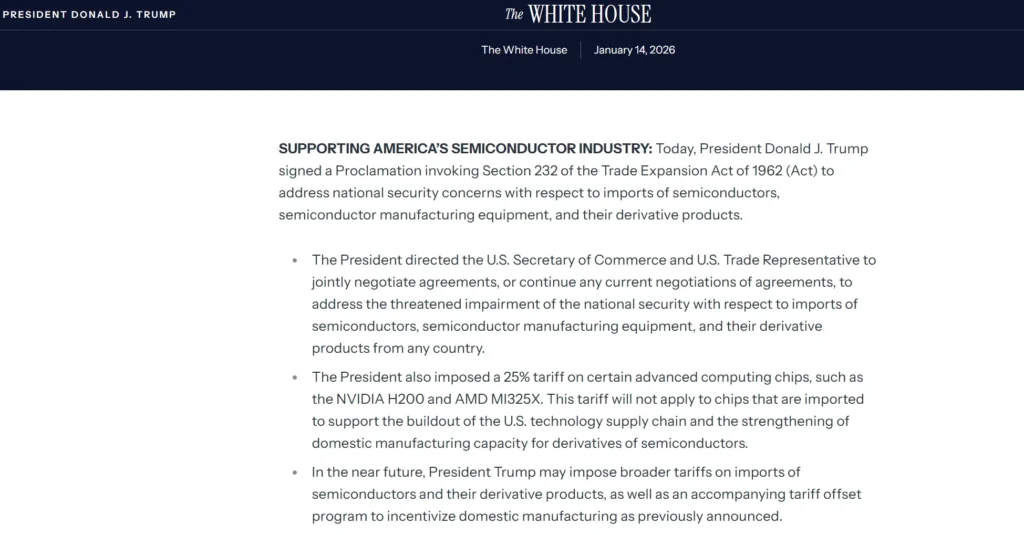
SUPPORTING AMERICA’S SEMICONDUCTOR INDUSTRY: Today, President Donald J. Trumpsigned a Proclamation invoking Section232of the Trade Expansion Act of 1962(Act) toaddress national security concerns with respect to imports of semiconductors,semiconductor manufacturing equipment, and their derivative products.
- The President directed the U.S. Secretary of Commerce and U.S. Trade Representative tojointly negotiate agreements, or continue any current negotiations of agreements, toaddress the threatened impairment of the national security with respect to imports ofsemiconductors, semiconductor manufacturing equipment, and their derivativeproducts from any country.
- The President alsoimposed a25% tariff on certain advanced computing chips, such asthe NVIDIA H200 and AMD Ml325X. This tariff will not apply to chips that are importedto support the buildout of the U.S. technology supply chain and the strengthening ofdomestic manufacturing capacity for derivatives of semiconductors.
- In the near future, President Trump may impose broader tariffs on imports ofsemiconductors and their derivative products, as well as an accompanying tariff offsetprogram to incentivize domestic manufacturing as previously announced.
National Security Rationale and Policy Foundation
The proclamation is rooted in a completed Department of Commerce Section 232 investigation, which “found that the quantities and circumstances of imports of semiconductors, semiconductor manufacturing equipment, and derivatives threaten to impair the national security.”
It elaborates on this finding, stating: “The capacity of the United States to produce semiconductors, certain semiconductor manufacturing equipment (such as advanced lithography and etch tools), and derivatives is inadequate to meet domestic demand. This results in the United States relying on foreign resources to meet domestic demand. Semiconductors are essential to the United States’ economic, industrial, and military strength, and supply chain disruptions from import dependency could undermine U.S. industrial and military capabilities.”
The administration frames this action as part of a consistent “America First” trade policy. The proclamation notes, “President Trump has used Section 232 tariffs on numerous occasions to guard against threats to our national security and strengthen manufacturing sectors vital to our national and economic security, including steel, aluminum, copper, automobiles, and lumber.”
Analysis: Targeted Impact and Market Implications for Nvidia(NVDA) and AMD(AMD)
The immediate market impact is precisely targeted by the proclamation’s text.
- Direct Tariff Application: The explicit 25% tariff on specific flagship data center/AI chips (Nvidia H200, AMD MI325X) creates a direct cost barrier for imports of these finished products for end-users in the U.S. market. This could pressure the gross margins for Nvidia and AMD on sales of these specific SKUs into the United States if they cannot fully pass the cost to customers.
- Critical Exemption Clause: The exemption for chips “imported for the purpose of supporting the construction of the U.S. technical supply chain and strengthening domestic manufacturing capacity” is a pivotal detail. It suggests that major U.S. cloud hyperscalers (e.g., Google, Amazon, Microsoft) or AI companies importing these chips to build and operate U.S.-based data center infrastructure may qualify for exemption, potentially shielding a significant portion of core demand.
- Uncertainty from Broader Threat: The signaled intent for “broader tariffs on imports of semiconductors and derivatives in the near future” introduces a layer of strategic uncertainty that outweighs the current targeted measure. Investors will be highly sensitive to any signals regarding the scope and rate of potential future tariffs, which could affect a much wider range of products and significantly disrupt complex global semiconductor supply chains.
- Stock-Specific Outlook: In the near term, the targeted nature of the current tariff and the key supply chain exemption may limit severe financial impact. However, both companies’ stocks (NVDA, AMD) will likely face heightened volatility and investor scrutiny based on perceptions of their ability to navigate the policy shift, leverage the exemption, and manage potential escalations. The long-term thesis now inextricably includes a new variable: the cost and strategic shape of U.S.-centric versus globalized supply chains.
The ultimate financial impact hinges on the interpretation of the exemption and the scale of any future tariffs, making close monitoring of U.S. Customs guidance and subsequent administration announcements critical.