AVGO Stock Price

One Year into Trump’s Return: S&P 500 Gains Nearly 16%. Amidst a Midterm Election Year, How Should Investors Hedge and Position Themselves?

A 16% rise in one year—this is the gain recorded by the S&P 500 Index (.SPX) during Donald Trump’s first year back in the Oval Office.

However, behind this seemingly stellar figure lies a “rollercoaster” journey for Wall Street, characterized by sharp corrections intertwined with historic highs. This past year has proven one thing to investors: even in the face of sweeping policy shifts, the market possesses a powerful ability to digest change. But as we enter a volatile 2026, the market’s resilience will face even sterner tests.

As the “Trump 2.0” era enters a Midterm Election year, what should investors watch for? Which sectors are poised to benefit? This article provides an in-depth breakdown.

A Bull Market Amidst Turmoil: The Quality of the 16% Gain

Since Donald Trump was sworn in as the 47th President of the United States on January 20, 2025, the U.S. stock market has demonstrated remarkable pressure resistance. Although Trump announced his “Liberation Day” tariff policies on April 2, triggering market tremors, investors were quick to adopt a “buy the dip” strategy. This pattern, dubbed “The TACO Trade” by some market participants, reflects a new consensus: the administration’s aggressive policy proclamations may not necessarily translate into lasting market damage.

From a historical perspective, a 16% gain is impressive, outperforming the historical median of 9% for a president’s first year since 1929. However, it is not the “strongest in history.” In comparison, the S&P 500 rose 16.4% during President Biden’s first year, while Trump’s own first term in 2017 saw a surge of 23.7%.
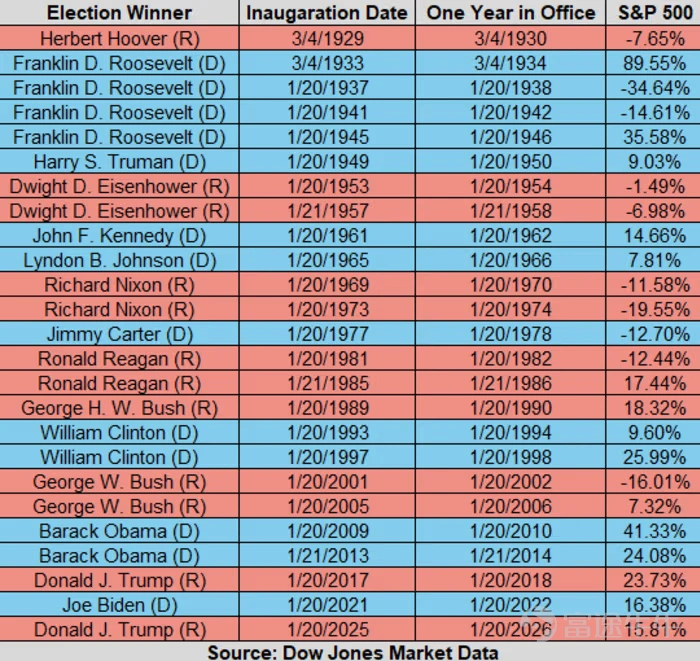
For those who originally expected Trump’s second term to be “extremely bullish” for the markets, this year has been full of challenges.

Chris Maxey, Managing Director and Chief Market Strategist at Wealthspire Advisors, described it this way: “The first year of Trump’s return has seen news coming at us like water from a firehose.” He noted that the most important lesson investors have learned over the past year is to “stay patient.” Overinterpreting political headlines often leads to portfolio errors rather than gains.

There were widespread fears that Trump’s volatile tariff policies would ignite a global trade war, reignite inflation, or push the economy into recession. To date, these worst-case scenarios have not materialized. While some tariff policies still await a final ruling from the Supreme Court, the S&P 500 has set 42 record closing highs since last January, while the Dow Jones and Nasdaq have refreshed their records 23 and 36 times, respectively.


2026 Outlook: The Shadows of Midterm Elections and Geopolitics

As the calendar turns to 2026, investors may find it difficult to maintain their high levels of optimism. The market is entering a “Midterm Election Year,” which is traditionally the weakest performing year of a presidential term. Historical data shows that since 1948, the S&P 500 has averaged a gain of only 4.6% in the second year of a presidency.

Adding to the concern, the start of 2026 has been anything but peaceful. In the first half of January alone, the market faced a series of geopolitical and policy shocks:

  • Venezuela Turmoil: U.S. military action led to the arrest of Venezuelan leader Nicolás Maduro.
  • Greenland Controversy: Trump reiterated threats to take over or purchase Greenland.
  • U.S.-Iran Tensions: Relations between the two nations have tightened once again.
  • Federal Reserve Crisis: A criminal investigation targeting current Fed Chair Jerome Powell has raised serious concerns regarding central bank independence.

Particularly noteworthy are Trump’s actions last week, which dominated investment circles—specifically regarding tariff policies and the selection of the next Fed Chair.

  • Tariff Policies: According to CCTV reports, on Saturday (Jan 17), President Trump announced that effective February 1, 2026, a 10% tariff will be imposed on all goods exported to the U.S. from Denmark, Norway, Sweden, France, Germany, the UK, the Netherlands, and Finland. Effective June 1, 2026, this rate will increase to 25%. The stated reason for these tariffs is the opposition of these nations to U.S. control of Greenland, further escalating the dispute over the island’s future.
  • Fed Chair Uncertainty: Trump hinted last Friday that Kevin Hassett might not become the new Fed Chair, following Hassett’s repeated calls for the Fed to cut interest rates aggressively. As Hassett likely remains Director of the National Economic Council (NEC), the race has essentially narrowed to a “three-way battle”: BlackRock’s Rick Rieder vs. former Fed Governor Kevin Warsh and current Governor Christopher Waller. The latter two possess extensive central banking experience and represent more traditional choices compared to Rieder’s market-oriented background.
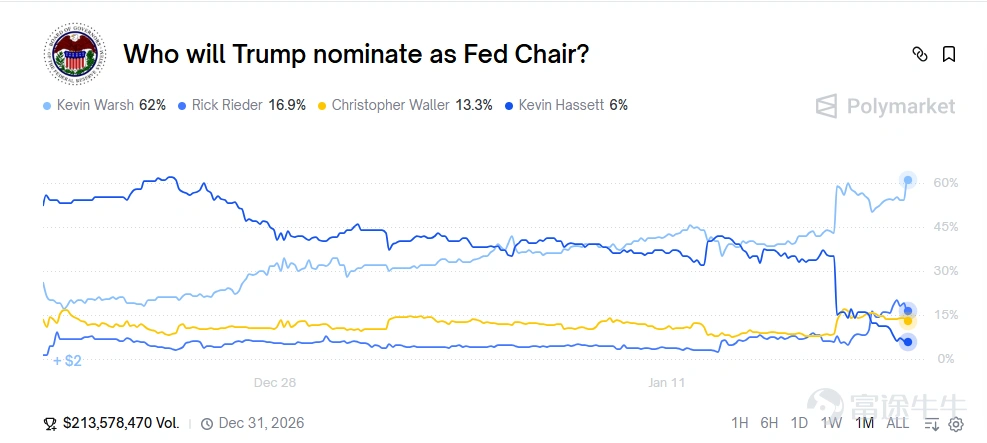
Soochow Securities suggests that in 2026, Trump will exhaust all available political resources—including trade policy under White House authority, fiscal policy under Congressional power, and monetary policy via the Fed—to prepare for the final “exam” of his political career: the Midterm Elections.

Trump’s strategy for the midterms consists of three complementary pillars that form the primary trading theme for 2026:

  1. Trade Policy: Trump may escalate tariff conflicts to divert domestic tension, gain votes, pressure the Fed to cut rates, and generate fiscal revenue.
  2. Monetary Policy: A new Fed Chair is expected to take office in May 2026. Markets anticipate “oversized” rate cuts that exceed economic necessity. This “Fed Put” is expected to replace “TACO” as a hedge against tariff shocks, with loose monetary policy boosting the economy and stocks.
  3. Fiscal Policy: Rate cuts and tariffs will provide funding for fiscal expansion. In the second half of 2026, Trump is expected to introduce broad fiscal policies to build momentum for the midterms.

For capital markets, these three policies will weave a combination of recurring tariffs and “double easing” (fiscal and monetary). This may shift the U.S. economy from a soft landing back into expansion, but it also carries significant upside risks for inflation in late 2026 and beyond.

Market Implications:

  • Tariff Volatility: Risk appetite will likely follow a mean-reversion, “sell high, buy low” strategy.
  • Double Easing: Global equities, commodities, and other risk assets will benefit from the dual tailwinds of liquidity and fundamentals on an annual basis.
  • Fed Leadership Change: Excessive rate cuts may lead to lower U.S. interest rates and weakened credit, favoring Gold while putting downward pressure on the US Dollar Index and 2-year Treasury yields. Combined with fiscal expansion, the 10-year Treasury yield is expected to remain volatile.

Which Opportunities Deserve Close Attention in the Trump Era?

Since taking office, Trump’s every word and action has deeply influenced the U.S. market. Insight into and alignment with government investment logic is not just about capturing opportunities—it is a necessary strategy for risk mitigation.

Market consensus suggests that the following four sectors—Resources, Power/Energy, Space Exploration, and Semiconductors—are most likely to benefit from the “Trump 2.0” era.

Specific Companies to Watch:

  • Semiconductors: Nvidia (NVDA), Broadcom (AVGO), AMD (AMD), Micron (MU).
  • Rare Earths: MP Materials (MP), TMC the metals (TMC), USA Rare Earth (USAR), Critical Metals (CRML).
  • Lithium: Rio Tinto (RIO), SQM (SQM), Albemarle (ALB), Lithium Americas (LAC).
  • Uranium: Cameco (CCJ), Uranium Energy (UEC), Centrus Energy (LEU), Energy Fuels (UUUU).
  • Copper: Southern Copper (SCCO), Freeport-McMoRan (FCX).
  • Graphite: NOVONIX (NVX), Nouveau Monde Graphite (NMG), Westwater Resources (WWR).
  • Antimony/Beryllium: Nova Minerals (NVA), United States Antimony (UAMY), Materion (MTRN).
  • Space Exploration: Rocket Lab (RKLB), AST SpaceMobile (ASTS), EchoStar (SATS.US), GE Aerospace (GE), RTX Corp (RTX), Boeing (BA), Lockheed Martin (LMT).
  • Nuclear Power: Oklo Inc (OKLO), BWX Technologies (BWXT), NuScale Power (SMR), NANO Nuclear Energy (NNE).
  • Batteries/Storage: Tesla (TSLA), Bloom Energy (BE), QuantumScape (QS), Eos Energy (EOSE).
  • Grid & Storage: GE Vernova (GEV), Vistra Energy (VST.), AES Corp (AES), Fluence Energy (FLNC).

Additionally, Morgan Stanley released a “National Security Index” focusing on four key areas: Rare Earths & Strategic Metals, Batteries & Energy Storage, Lithium, and Nuclear & Uranium. These companies are the core drivers of the currently trending “Trump Trade.”
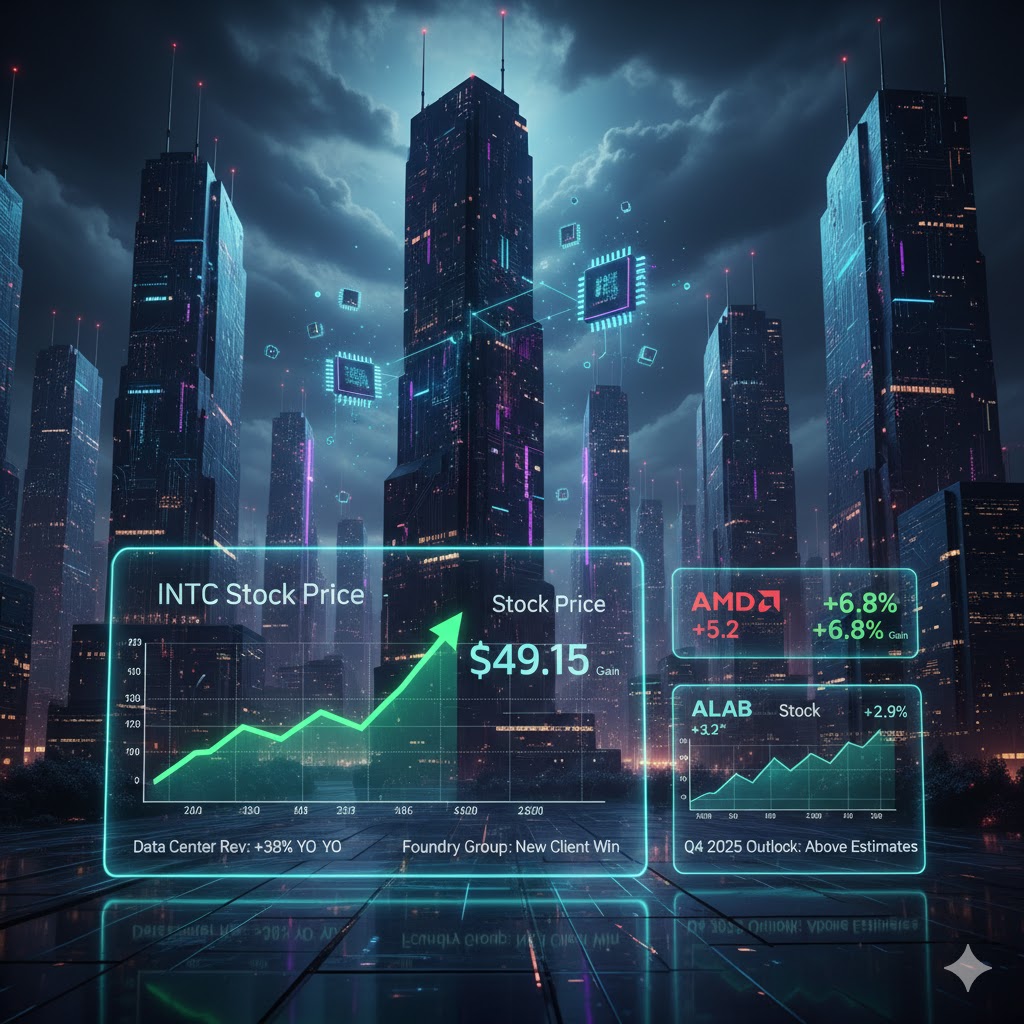
Silicon Revival: Why Intel (INTC), AMD, NVIDIA (NVDA), and the Semiconductor Sector Surged on January 13, 2026

The U.S. stock market witnessed a powerful resurgence in the semiconductor sector on January 13, 2026, as several key players saw their valuations climb significantly. Intel Corporation (INTC) led the charge, gaining nearly 7% by midday. Not far behind, Advanced Micro Devices (AMD) and the data center interconnect specialist Astera Labs (ALAB) both surged over 5%. Credo Technology (CRDO) also saw robust gains of nearly 3%, while the diversified giant Broadcom Inc. (AVGO) added over 1.5%. Even NVIDIA (NVDA), after a volatile start to the session, turned positive, cementing a broad-based rally that underscored renewed investor confidence in the foundational technology powering the AI revolution.

This widespread upward movement was not an isolated event but rather the confluence of several powerful macroeconomic tailwinds, specific company catalysts, and an overall shift in market sentiment towards growth-oriented, technologically advanced sectors. For investors closely tracking Intel stock price, AMD stock price, and the broader semiconductor stock landscape, January 13th was a clear signal that the cyclical downturn of 2024-2025 might finally be over, replaced by an optimistic outlook for 2026 and beyond. This analysis delves into the intricate factors driving these gains, examining financial reports, strategic roadmaps, and market positioning that fueled the day’s impressive performance.


Macroeconomic Tailwinds: The AI Supercycle and Rate Expectations

The fundamental force underpinning the semiconductor rally on January 13th was the sustained enthusiasm for Artificial Intelligence (AI) and evolving expectations regarding interest rates.

  1. The Enduring AI Supercycle: The insatiable demand for processing power, memory, and high-bandwidth interconnects required by AI models continues to drive massive capital expenditure by cloud providers and enterprises. Every company in the semiconductor value chain—from chip designers like NVIDIA and AMD to manufacturing equipment suppliers and specialized connectivity firms like Astera Labs and Credo—benefits from this secular trend. News reports from earlier in the week, hinting at even faster-than-expected AI adoption in enterprise software, likely buoyed investor sentiment.
  2. Dovish Fed Signals (Soft Landing Hopes): While not directly tied to any single company, broader market sentiment was lifted by dovish interpretations of recent Federal Reserve commentary. Signals suggesting a potential “soft landing” for the economy and the possibility of earlier-than-expected rate cuts provided a favorable backdrop for growth stocks, particularly those in the capital-intensive technology sector. Lower interest rates generally reduce the cost of capital for R&D and expansion, benefiting companies like Intel and AMD that are investing heavily in new fabrication plants and design centers.

These macro factors created a buoyant environment, but specific company-level news and developments were crucial in translating this optimism into substantial stock price gains for individual semiconductor players.


Intel (INTC): The Turnaround Gathers Momentum

Intel stock‘s nearly 7% surge was arguably the most significant move of the day, reflecting growing confidence in CEO Pat Gelsinger’s ambitious turnaround strategy. For years, Intel stock price lagged behind its peers due to manufacturing delays and market share losses. However, the narrative has shifted dramatically.

Financial Resilience and Revenue Diversification:

Intel’s Q4 2025 earnings, released in late January, surprised analysts with stronger-than-expected guidance for Q1 2026. While full details are pending, preliminary indications suggest:

  • PC Segment Stabilization: After a prolonged slump, the PC market is showing signs of recovery, with Intel’s latest Meteor Lake (Core Ultra) processors gaining traction.
  • Data Center Rebound: Intel’s Gaudi AI accelerators and Xeon server CPUs are starting to claw back market share, particularly in the mainstream enterprise and government sectors where cost-effectiveness and trusted supply chains are paramount.
  • Foundry Group (IFS) Growth: Intel’s audacious plan to become a leading foundry for third-party chips (Intel Foundry Services) is gaining credibility. Reports from Digitimes on January 12 indicated that Intel secured a significant new client for its 18A process technology, signaling strong external validation for its manufacturing prowess. This diversification of revenue streams away from traditional PC and server CPUs is a key driver for Intel stock.

Strategic Partnerships and Technology Roadmaps:

The market cheered Intel’s aggressive roadmap for 2026, including the ramp-up of its 20A and 18A process nodes. Furthermore, a strategic partnership announced at the beginning of the year with a major defense contractor to produce specialized AI chips for secure networks highlights Intel’s ability to leverage its U.S.-based manufacturing advantage. This news, combined with the positive Q4 outlook, caused Intel stock to surge sharply.


AMD (AMD): AI Dominance Beyond GPUs

Advanced Micro Devices (AMD stock)’s over 5% gain further solidified its position as a fierce competitor in the AI and data center markets. While NVIDIA often grabs headlines for its GPUs, AMD’s comprehensive portfolio positions it uniquely.

Instinct MI300X and Enterprise Adoption:

The primary driver for AMD stock price was continued positive momentum surrounding its Instinct MI300X AI accelerator. Analyst reports from firms like Wedbush and Citi, published just prior to January 13th, indicated strong early adoption rates for the MI300X, particularly among Tier 2 cloud providers and large enterprises looking for an alternative to NVIDIA’s dominant H200/B200.

  • Q3 2025 Financials: AMD’s Q3 2025 earnings showed Data Center revenue up 38% year-over-year, driven largely by early MI300 shipments. The company guided for continued double-digit sequential growth in its Data Center segment for Q4.
  • Software Ecosystem: AMD’s investment in its ROCm software platform is beginning to pay off, making it easier for developers to migrate AI workloads from NVIDIA’s CUDA. This growing ecosystem is critical for long-term MI300X success and a key reason why AMD stock is seeing renewed interest.

Client and Gaming Resilience:

Beyond AI, AMD also saw a rebound in its client (PC CPUs) and gaming segments. The launch of its next-generation Ryzen processors and Radeon GPUs for laptops and desktops is expected to capture market share in a recovering PC market, providing a diversified revenue base that insulates AMD stock from single-segment fluctuations.


Astera Labs (ALAB) & Credo Technology (CRDO): The Interconnect Powerhouses

The strong performance of Astera Labs stock (up over 5%) and Credo Technology stock (up nearly 3%) highlights the critical, yet often overlooked, role of interconnect solutions in the AI revolution. As AI models grow larger, the ability to move vast amounts of data quickly and reliably between GPUs, CPUs, and memory is paramount.

Astera Labs (ALAB) – CXL and Retimers:

Astera Labs specializes in connectivity solutions like CXL (Compute Express Link) and high-speed retimers for AI and cloud infrastructure. Its recent IPO in late 2025 was met with strong demand, and the January 13th surge indicates that investors are keenly aware of its vital role.

  • CXL Market Leadership: Astera is a leader in CXL technology, which allows for memory pooling and sharing between different components, vastly improving AI workload efficiency.
  • Hyperscaler Adoption: The company confirmed during its Q3 2025 earnings call that it is seeing strong adoption of its CXL and PCIe 5.0/6.0 retimers by major hyperscalers, validating its technology as essential for next-gen data centers.

Credo Technology (CRDO) – High-Speed Ethernet:

Credo Technology focuses on high-speed connectivity solutions, particularly for 400G and 800G Ethernet applications in data centers. Its products are crucial for linking the vast networks of AI accelerators.

  • Next-Gen Data Center Builds: Credo’s technology is embedded in the next wave of data center build-outs, particularly those optimized for AI training and inference. The ongoing expansion of AI infrastructure directly benefits Credo Technology stock.
  • Design Wins: Positive analyst notes from Needham and KeyBanc on January 12 highlighted recent design wins for Credo’s 800G optical DSPs and SerDes (Serializer/Deserializer) solutions, indicating strong market penetration.

Broadcom (AVGO) and NVIDIA (NVDA): Diversified Giants and Continued AI Leadership

Broadcom stock‘s over 1.5% gain and NVIDIA stock‘s rebound to positive territory underscore the continued demand for both diversified semiconductor portfolios and pure-play AI leadership.

Broadcom (AVGO): Software and Custom Silicon Synergies:

Broadcom’s strength lies in its dual engines of semiconductor solutions (networking, broadband, storage) and enterprise software.

  • AI Networking: Broadcom’s Tomahawk and Jericho switches are essential for the high-speed Ethernet networks underpinning AI clusters.
  • Custom Silicon: Broadcom’s custom silicon division continues to secure significant design wins with hyperscalers, developing specialized chips for AI workloads.
  • Software Integration: The successful integration of VMware into its enterprise software portfolio provides predictable, recurring revenue, creating a more stable foundation for Broadcom stock.

NVIDIA (NVDA): The Unstoppable AI Train:

Despite earlier volatility on January 13th, NVIDIA stock ultimately turning positive reaffirmed its position as the undisputed leader in AI GPUs. While recent headlines about China’s H200 restrictions created some short-term jitters (as analyzed in a previous report), the underlying demand for NVIDIA’s H100, H200, and upcoming Blackwell (B200) architectures remains astronomical. The positive sentiment in the broader semiconductor sector likely pulled NVIDIA stock higher, as investors remembered its long-term AI dominance.


Conclusion: A Resilient Sector Poised for Growth

The strong performance of Intel (INTC stock), AMD (AMD stock), Astera Labs (ALAB stock), Credo Technology (CRDO stock), Broadcom (AVGO stock), and NVIDIA (NVDA stock) on January 13, 2026, paints a clear picture: the semiconductor sector is not merely recovering but is entering a new phase of robust growth. This growth is driven by the relentless expansion of AI, a stabilizing macroeconomic environment, and individual companies executing on strong product roadmaps and strategic initiatives.

For investors, the key takeaway is diversification within the sector. While NVIDIA remains the AI pure-play, Intel’s turnaround, AMD’s full-stack prowess, and the critical enabling technologies from Astera Labs and Credo all represent compelling opportunities. The semiconductor stock landscape remains dynamic, but January 13th was a powerful reminder of its fundamental importance to the global economy and its continued potential for significant returns.