PFE Stock Price

Strong Q4 Earnings Beat Expectations for Amgen, Toyota, and Pfizer

Amgen(AMGN) Surges Over 8% After Beating Q4 Expectations, Launches Phase 3 Trials for Type 2 Diabetes Drug

Amgen reported a 9% year-over-year increase in Q4 revenue to $9.87 billion, surpassing analysts’ average estimate of $9.47 billion. Net profit soared more than 112% to $1.33 billion, with adjusted earnings per share reaching $5.29, well above the forecasted $4.73. Looking ahead, Amgen expects its 2026 revenue to be between $37 billion and $38.4 billion, with adjusted earnings per share ranging from $21.6 to $23, compared to analysts’ estimates of $37.19 billion and $20.63 per share.
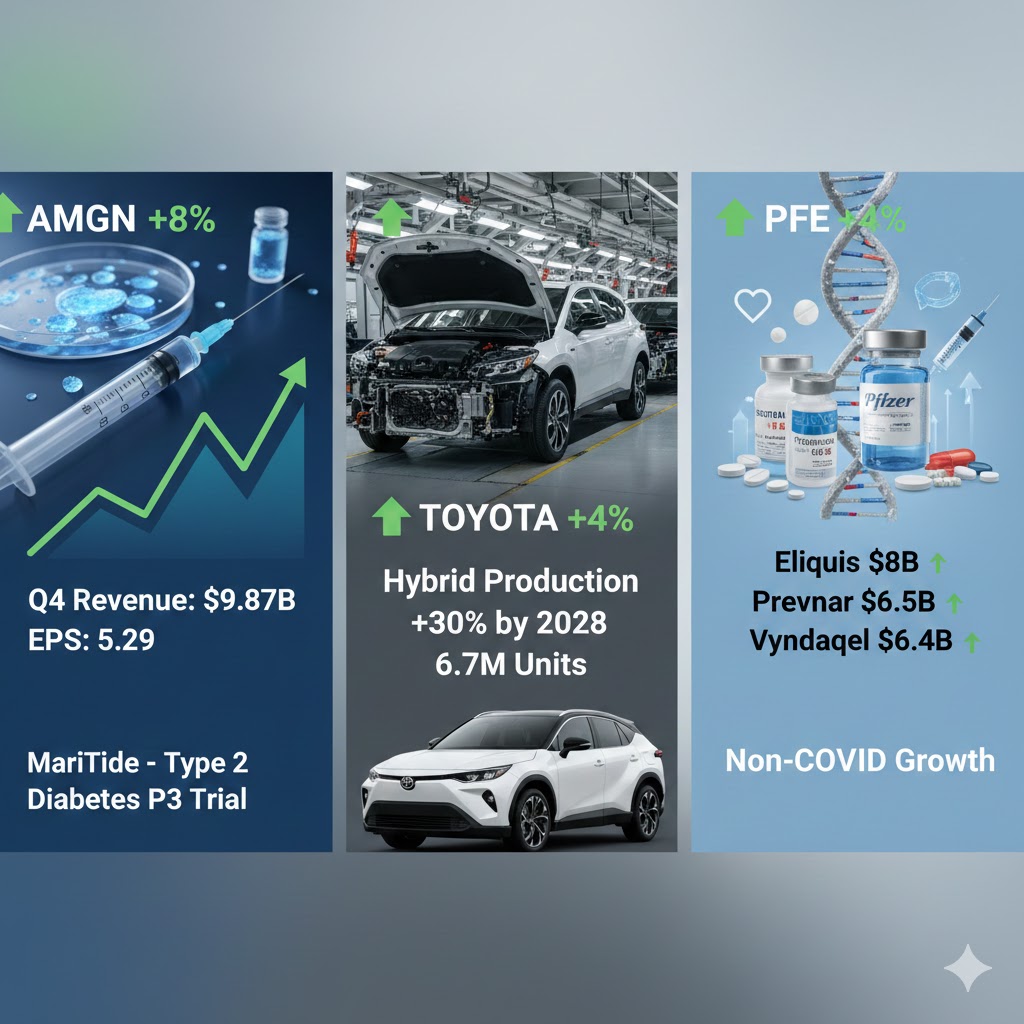
Additionally, Amgen is conducting six Phase 3 trials for its experimental drug MariTide, targeting obesity and related diseases such as heart disease and sleep apnea. The company also plans to initiate a Phase 3 clinical trial for Type 2 diabetes patients later this year.

Toyota(TM) to Increase Hybrid Production by 30% by 2028, Shares Up Over 4%

Toyota plans to increase its production of hybrid and plug-in hybrid vehicles to approximately 6.7 million units by 2028, a 30% increase from its estimated 2026 production target of about 5 million units.

In terms of overall production, Toyota expects its global car output to reach around 11.3 million vehicles by 2028, a 10% increase from its 2026 forecast. This means that hybrid vehicles will account for nearly 60% of the company’s total production, becoming the core driver of its growth in both production and sales. Analysts suggest that this large-scale production expansion not only addresses increasingly stringent carbon emissions regulations but also seeks the best profit balance in the EV competition by leveraging its well-established technology moat.

Currently, Toyota has begun in-depth discussions with major suppliers to ensure that its supply chain for critical components and raw materials can keep pace with the planned production expansion. The company emphasized that these numbers are for reference only and are not part of its official production or sales plans.

Pfizer(PFE) Jumps Nearly 4% as Non-COVID Products Show Strong Growth

In its full-year 2025 performance, Pfizer’s non-COVID product portfolio demonstrated strong structural growth. Despite a significant drop in COVID-related revenues, the company successfully shifted its focus toward innovative treatments by continuously optimizing its product mix and increasing market share.

Cardiovascular and vaccine segments led the way in growth. The anticoagulant drug Eliquis generated $8 billion in revenue for the year, an 8% increase, solidifying its position as the company’s second-largest product. The growth was mainly driven by improved Medicare payment conditions in the U.S. and steady global demand.

The Prevnar vaccine series achieved $6.5 billion in revenue, a 1% increase, with particularly strong performance in international markets for adult indications. The heart disease treatment Vyndaqel family was a key performer, with revenues rising by 17% to $6.4 billion, primarily driven by increased diagnosis rates and improved payment conditions in the U.S. Despite facing some pressure from Medicare pricing in Q4, Vyndaqel still generated $1.7 billion in revenue for the quarter, a 9% year-over-year increase, maintaining strong growth momentum.
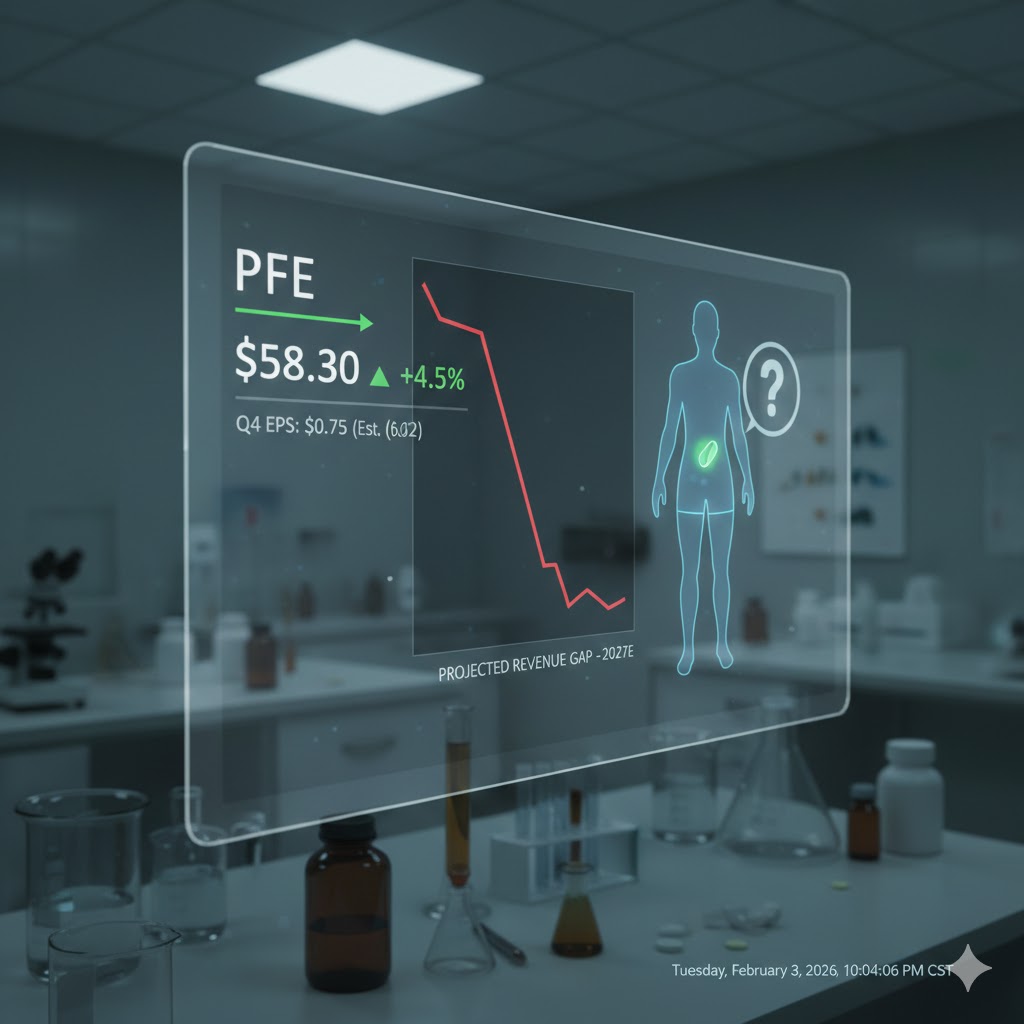
Pfizer Q4 Earnings Beat Expectations, But Doubts Remain Over Whether New Weight Loss Drug Can Fill Revenue Gap

On Tuesday, Pfizer (NYSE:PFE) announced its fourth-quarter earnings. Despite a continued decline in demand for COVID-related products, the company reported revenues and profits that surpassed market expectations. The company also reiterated its cautious guidance for 2026— a forecast that had raised investor concerns when it was released in December last year. Additionally, Pfizer disclosed initial data on its new weight loss therapy, though the information provided was limited.

According to the earnings report, Pfizer’s Q4 revenue stood at $17.56 billion, a slight decline of about 1% year-over-year. The drop in revenue was primarily attributed to the lower demand for its COVID-19 vaccine and the Paxlovid oral antiviral: COVID-19 vaccine sales reached $2.3 billion, exceeding expectations of $2 billion, but still representing a one-third decline compared to last year; Paxlovid sales were only $218 million, far below the expected $589 million, plummeting more than two-thirds from the previous year.

However, the total revenue exceeded the market expectations of $16.95 billion, driven by the strong performance of several of Pfizer’s blockbuster drugs, which met forecasts. Despite competition from Merck’s (NYSE:MRK) new products, its pneumonia vaccine, Prevnar, still achieved $1.7 billion in sales, slightly surpassing the $1.6 billion expectation. The blood-thinning drug Eliquis generated $2 billion in sales, and the heart disease drug Vyndaqel achieved $1.7 billion in sales, both in line with market projections.

During the quarter, Pfizer recorded a net loss of $1.65 billion, or a loss of $0.29 per share, compared to a net profit of $410 million, or earnings of $0.07 per share, in the same period last year. Excluding restructuring charges and costs related to intangible assets, the company’s adjusted earnings per share for Q4 were $0.66, beating the market consensus of $0.57.

Looking ahead, Pfizer maintained its 2026 earnings guidance, with adjusted earnings per share expected to be between $2.80 and $3.00, and revenue projected to range from $59.5 billion to $62.5 billion, largely flat compared to 2025.

The company previously indicated that the 2026 revenue outlook remains subdued, partly due to the continued decline in sales of its COVID vaccine and Paxlovid. It is expected that these two products will contribute about $1.5 billion less in revenue for the year, totaling $5 billion.

In addition to COVID products, Pfizer also faces revenue losses from drugs losing market exclusivity, which is expected to further reduce the company’s revenue by approximately $1.5 billion. Several products, including Prevnar, are facing increasingly fierce market competition.

Pfizer’s CFO, Dave Denton, told investors in December that the 2026 guidance had fully accounted for the impact of price compression and narrowing margins. As part of a landmark drug pricing agreement with former U.S. President Trump, Pfizer plans to offer larger discounts in the Medicaid business.

Under this agreement, Pfizer will supply existing drugs to Medicaid patients at the lowest prices seen in other developed countries, while also offering the same “most favored nation” drug prices to Medicare, Medicaid, and commercial insurers. In exchange, Pfizer will receive a three-year tariff exemption.

In January, Pfizer’s rheumatoid arthritis drugs Xeljanz and Xeljanz XR were included in the third round of Medicare drug price negotiations, with new prices set to take effect in 2028.

Can the New Weight Loss Drug Fill the Revenue Gap?

To offset the decline in COVID product sales and the shrinking revenue from older drugs, the pharmaceutical giant is looking to long-term investments in its pipeline products, including the $10 billion acquisition of obesity biotech company Metsera. In the earnings release, Pfizer also disclosed Phase 2 clinical data for a Metsera obesity injection, which is administered monthly and shows significant weight loss effects for patients. This has generated optimism about the potential value of the acquisition.

However, despite the positive data, Pfizer’s stock fell by more than 5% in pre-market trading following the earnings report. Investors remain cautious, as the clinical trial details were sparse. There are doubts about whether the high-priced acquisition of Metsera will be able to fill the revenue gap created by the declining sales of the COVID vaccine and oral antiviral products.

The clinical data showed that after 28 weeks of treatment, participants lost up to 12.3% of their body weight compared to a placebo group. Analysts have pointed out that more detailed information is needed to accurately assess where this drug fits in the rapidly evolving market dominated by Novo Nordisk (NYSE:NVO) and Eli Lilly (NYSE:LLY).

Mizuho Healthcare Analyst Jared Holz stated, “The current market is firmly controlled by two well-established companies.” He believes that Pfizer needs a product that significantly outperforms existing ones in terms of efficacy or safety in order to establish a foothold in this field.