ASML Stock Price

Market Focus on Stock Movements: Micron, Zoom, ASML, Novartis, and Baker Hughes

Zoom Communications (NASDAQ: ZM) Stock Surges Over 11%, Potential Profit from Anthropic Investment Exceeds $2 Billion

Zoom Communications has become a focal point in the market due to its 2023 investment in AI model developer Anthropic, with the book value of this early-stage investment potentially rising to $2 billion to $4 billion.

Zoom’s stock price surged 11.28% to $95.46 on Monday, marking its highest closing price since August 22, 2022. Baird analyst William V. Power highlighted in a report that while the market primarily focuses on Zoom’s revenue growth and AI business opportunities, the potential profit from its $51 million investment in Anthropic should not be overlooked. The valuation of Anthropic has skyrocketed. According to a Wall Street Journal report earlier this month, Anthropic, the developer of the ClaudeAI model, plans to raise $10 billion in a new funding round at a $350 billion valuation. At this valuation, Zoom’s stake could be worth $2 billion to $4 billion.

Beyond financial returns, the investment in Anthropic provides Zoom with a strategic advantage in its AI product development. Zoom is continuously building and commercializing AI tools to assist customers with tasks such as meeting notes and summaries. “Zoom has a powerful R&D engine and has been exploring AI for years,” Power noted, emphasizing the company’s partnership with Anthropic. “We see future potential for Zoom’s platform to add more AI capabilities.” This collaboration gives Zoom a differentiated edge in the highly competitive enterprise communications market, directly benefiting from Anthropic’s breakthroughs in generative AI.


Morgan Stanley Forecasts ASML (NASDAQ: ASML) Q4 2025 Revenue Growth of 4%, Stock Hits Record High

Morgan Stanley predicts that ASML will report Q4 2025 revenue of €9.68 billion, a 4% increase year-over-year, and at the high end of its guidance range of €9.2 billion to €9.8 billion. According to an earnings preview report released on January 23, the Dutch semiconductor equipment manufacturer expects its full-year revenue to grow 15% year-over-year to €32.6 billion.

Morgan Stanley anticipates that ASML will report a double-digit revenue growth in fiscal year 2026 (12% year-over-year growth), with a forecasted revenue of approximately €36.5 billion. The company expects DUV (Deep Ultraviolet) sales to remain stable, while EUV (Extreme Ultraviolet) demand remains robust. The firm believes that ASML’s management will continue to note the decline in sales to China, but with a less conservative outlook, suggesting the decrease will be smaller than the previously expected 15-20% year-over-year decline.

ASML will report its earnings on January 28, and analysts expect the company to achieve €9.584 billion in revenue for Q4 2025, a 3.47% year-over-year increase, with earnings per share forecasted to reach €7.577, a 10.78% increase. These figures are based on US-GAAP accounting standards, and the stock has been rated overweight ahead of the company’s earnings release.


Novartis (NYSE: NVS) Strategizes U.S. Expansion to Counter Rising Tariffs, Stock Hits Record High

Novartis CEO Vas Narasimhan stated that the Swiss pharmaceutical company’s expanding U.S. manufacturing base and its agreement with the U.S. government in December are likely to shield the company from potential tariffs threatened by the Trump administration. Speaking at the World Economic Forum in Davos, Narasimhan emphasized the strategic importance of Novartis’s $23 billion U.S. investment announced last year, which will enable the company to primarily supply the U.S. market from domestic facilities. He also added that existing inventories will further buffer the company’s ability to cope with recent trade disruptions.

Trump’s proposed tariffs on imports from several European countries, starting February 1, would initially impose a 10% tax, increasing to 25% by June. CNBC reported that the European pharmaceutical industry is particularly vulnerable to these tariffs, with U.S. shipments in the first three quarters of 2025 totaling €84.4 billion ($98.1 billion). Under the agreement with Washington, Novartis supports the government’s drug pricing goals and has pledged to launch new medicines in high-income countries at comparable prices.

Narasimhan stated that these initiatives, along with expanded U.S. production, effectively “prevent” the risks posed by trade tensions and prepare the company for other possible outcomes should tariff exemptions not materialize. By ensuring additional supply and planning for new U.S. production capacity, Novartis is working to weather tariff pressures in the short term while strengthening the long-term resilience of its U.S. business. Novartis raised its growth expectations for several key drugs and outlined a pipeline strategy that it believes will drive momentum over the next decade. The company forecasts a compound annual sales growth rate of 5% to 6% from 2025 to 2030, based on constant exchange rates.


Baker Hughes (NYSE: BKR) CEO Projects $3 Billion Data Center Orders by 2027, Stock Up Over 4%

Baker Hughes CEO Lorenzo Simonelli stated on Monday that the company expects to secure approximately $3 billion in data center-related orders between 2025 and 2027. Speaking on a Q4 earnings call, he said, “Resilient power supply has become a critical bottleneck, creating significant opportunities for Baker Hughes, as the expansion of data centers increases demand for back-end power solutions that offer speed, reliability, and scalability,” according to meeting records provided by FactSet.

The company also expects to surpass its 2024-2026 liquefied natural gas (LNG) final investment decision outlook, with an annual production target of 100 million tons. By 2030, Baker Hughes aims to achieve an installed capacity of 800 million tons, reaching 950 million tons by 2035.

Baker Hughes secured $2.3 billion in LNG equipment orders in 2025 and expects similar orders in 2026, including projects outside the U.S. Simonelli also mentioned that the company has reserved 1 gigawatt of NovaLT turbines for data center applications in Q4, anticipating to convert them into firm orders by 2026. Baker Hughes targets $2.4 billion to $2.6 billion in new energy orders by 2026.
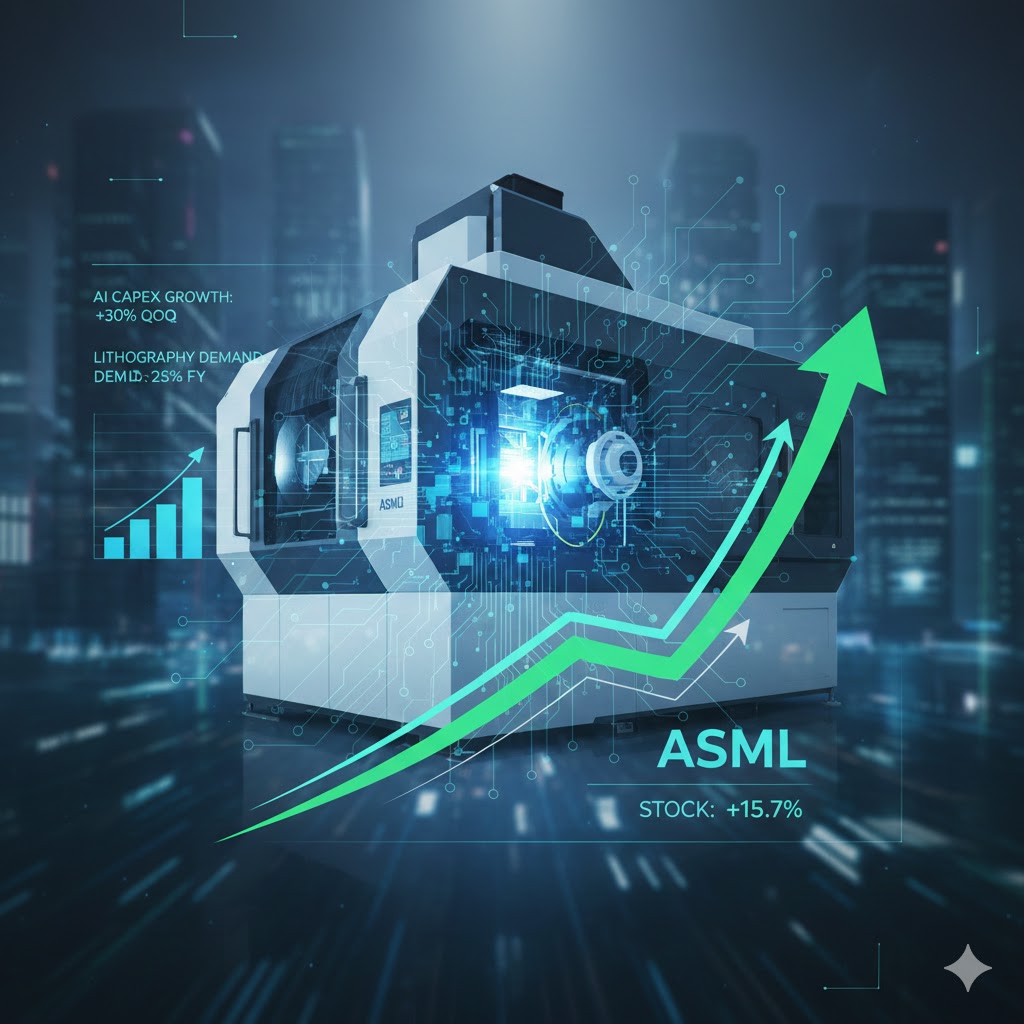
ASML’s AI-Fueled Ascent: ASML (ASML) Stock Surges as AI Capex Boom Ignites Lithography Demand

In early 2026, ASML Holding N.V. (ASML) stock has become one of the most watched names in global technology markets, captivating investors with its dramatic rise and fundamental underpinnings. On the back of a blockbuster earnings report from its largest customer, Taiwan Semiconductor Manufacturing Company (TSMC), and accelerating capital expenditure to support artificial intelligence (AI) chip production, ASML’s share price has not only climbed sharply but also pushed the company’s market capitalization past a symbolic $500 billion milestone — making it one of Europe’s most valuable publicly traded companies.

At the core of this remarkable performance is ASML’s unrivaled position in the semiconductor equipment sector. As the world’s exclusive supplier of Extreme Ultraviolet (EUV) lithography machines, the firm has become indispensable to the advanced chipmaking process required for state-of-the-art AI, high-performance computing, and next-generation logic and memory chips. EUV lithography tools etch the tiny features on silicon wafers that make cutting-edge chips possible; without them, the path to smaller, faster, and more efficient transistors would be dramatically slower or nearly impossible.

Stock Performance & Market Reaction
ASML’s stock has been a standout among semiconductor equities in 2026, up roughly 24 % year-to-date, with shares reaching record highs above €1,160 in Amsterdam trading. This surge has been directly tied to renewed optimism around global chip demand, especially after TSMC reported strong quarterly profits and a significant increase in capital expenditure guidance for 2026 — with plans to spend between $52 billion and $56 billion on fab expansion. That figure notably exceeded expectations and suggests that investment in advanced manufacturing will remain robust, reinforcing demand for ASML’s high-end lithography systems.

For the search-savvy investor, this momentum is reflected in terms increasingly searched for online: ASML stock, ASML stock price, and even ASML stock surged sharply have all trended in financial media and search engines as equity watchers seek insight on this European tech juggernaut’s remarkable trajectory.

Financial Foundations: Revenue Growth & Profitability
ASML’s financial performance through 2025 paints a picture of sustained profitability and healthy growth, even amid broader industry cyclicality. In Q3 2025, the company reported total net sales of approximately €7.5 billion and net income around €2.1 billion, underpinned by a gross margin above 51 %. For the full year, management guided for total net sales growth of around 15 % over 2024, with gross margins in the low-50 % range — strong results in an environment where capex can vary by cycle and external demand is uneven.

The revenue mix is important. ASML’s Installed Base Management segment — which includes services, upgrades, and maintenance — provides a steady, high-margin recurring revenue stream that complements sales of new systems. That business is crucial because lithography systems are long-lived, high-value assets that require regular servicing and upgrades to remain competitive in fabs worldwide.

Yet even as revenue and profitability stay solid, the industry environment remains complex. Recent financial commentary highlighted that while EUV demand remains firm, traditional semiconductor market segments such as mobile and PC chips have been softer, potentially tempering near-term growth and leading some customers to postpone orders. ASML management has acknowledged this cautious dynamic while still emphasizing the long-term opportunity.

Technological Leadership & Product Roadmap
ASML’s dominance rests on deep technological moats built through decades of investment in lithography innovation. The company’s product lineup ranges from Deep Ultraviolet (DUV) systems, used for more mature process nodes, to EUV and next-generation High-NA EUV systems, designed to push nodes below 2 nm. The High-NA EUV platform, still early in commercial deployment, boasts a significantly higher numerical aperture and greater resolution — a leap that can enable denser, faster, and more power-efficient chips. Analysts widely view these systems as a critical technology for future logic and advanced DRAM nodes.

This technological leadership underpins ASML’s pricing power and strong gross margins. EUV lithography machines are among the most expensive pieces of chipmaking equipment ever sold — costing hundreds of millions of euros per unit — and are a high-priority item for leading foundries such as TSMC, Samsung, and Intel. With no direct competitors capable of producing production-ready EUV systems, ASML enjoys a unique quasi-monopolistic position that supports both sales and long-term strategic importance across the semiconductor supply chain.

Strategic Market Expansion & Geopolitical Considerations
ASML’s market spread is global, with significant share from Taiwan, Korea, the U.S., and China. Chinese demand has historically been a meaningful contributor — in some quarters accounting for around a quarter of total sales — though recent geopolitical export controls and shifting regulatory landscapes have introduced uncertainty. While management does not expect near-term Chinese sales to match previous peaks, investments spurred by U.S. and European initiatives — such as the CHIPS Act and the European Chips Act — are creating new opportunities in localized manufacturing clusters. These developments partially offset geopolitical headwinds and illustrate the strategic importance of ASML’s technology in diversified global supply chains.

Beyond raw sales, ASML has also pursued share buybacks and dividends, returning capital to shareholders while signaling confidence in its long-term cash generation capability. These programs, combined with robust R&D investments, reinforce ASML’s dual focus on shareholder value and technological leadership.

Macro & Industry Drivers
The broader macroeconomic environment has alternately challenged and buoyed ASML’s performance. While cyclical downturns in certain chip segments — such as traditional consumer electronics — have weighed on overall orders at times, the so-called AI supercycle has become the defining theme of recent years. Demand for AI hardware — including GPUs, AI accelerators, and the broader data center ecosystem — has driven foundries to expand capacity for advanced nodes faster than many anticipated. ASML, as the primary supplier of lithography tools needed for these nodes, is squarely at the center of this capital expenditure wave.

This dynamic is evident in the interplay between TSMC’s aggressive capex plans and ASML’s valuation. When leading foundries accelerate spending on advanced toolsets to meet AI demand, the ripple effect boosts demand for lithography systems — and in turn supports sustained revenue and backlog for ASML well into the medium term.

Conclusion: A Structural Story with Cyclical Nuances
ASML’s recent surge reflects both structural technological demand and cyclical dynamics. On the one hand, the company’s near-monopoly on EUV lithography, strong financial performance, and strategic roadmap centered on High-NA systems position it as a central player in the future of semiconductor manufacturing. On the other hand, short-term variability in customer capex timing and geopolitical factors underscore the cyclical nature of capital-intensive industries.