CVX Stock Price

The Venezuelan Pivot: Assessing Chevron (CVX) Stock Prospects Amid Regulatory Shifts and Regional Transition

The landscape of South American energy is witnessing a profound recalibration as 2026 begins. Following recent shifts in regional leadership, the United States government is aggressively moving to re-integrate Venezuelan crude into the global marketplace through established corporate channels. At the heart of this strategy is Chevron Corporation (CVX), the sole U.S. oil major that has maintained a continuous, albeit restricted, presence in the country. On Friday, January 16, 2026, U.S. Energy Secretary Chris Wright confirmed that the federal government is moving “as fast as it can” to authorize an expanded production license for the energy giant.

This latest regulatory update is far from a mere administrative formality. According to Secretary Wright, the new licensing framework will permit Chevron to pay the Venezuelan government in cash for its operations, a departure from the “crude-in-kind” debt-settlement model that has defined the relationship for years. This adjustment effectively unlocks the company’s ability to market 100% of its joint-venture production, providing a level of commercial flexibility not seen in decades. For investors and analysts tracking CVX stock, the implications of this policy shift are being weighed against a broader backdrop of commodity price volatility and massive infrastructure requirements.

Chevron (CVX) Stock Market Performance and Financial Health

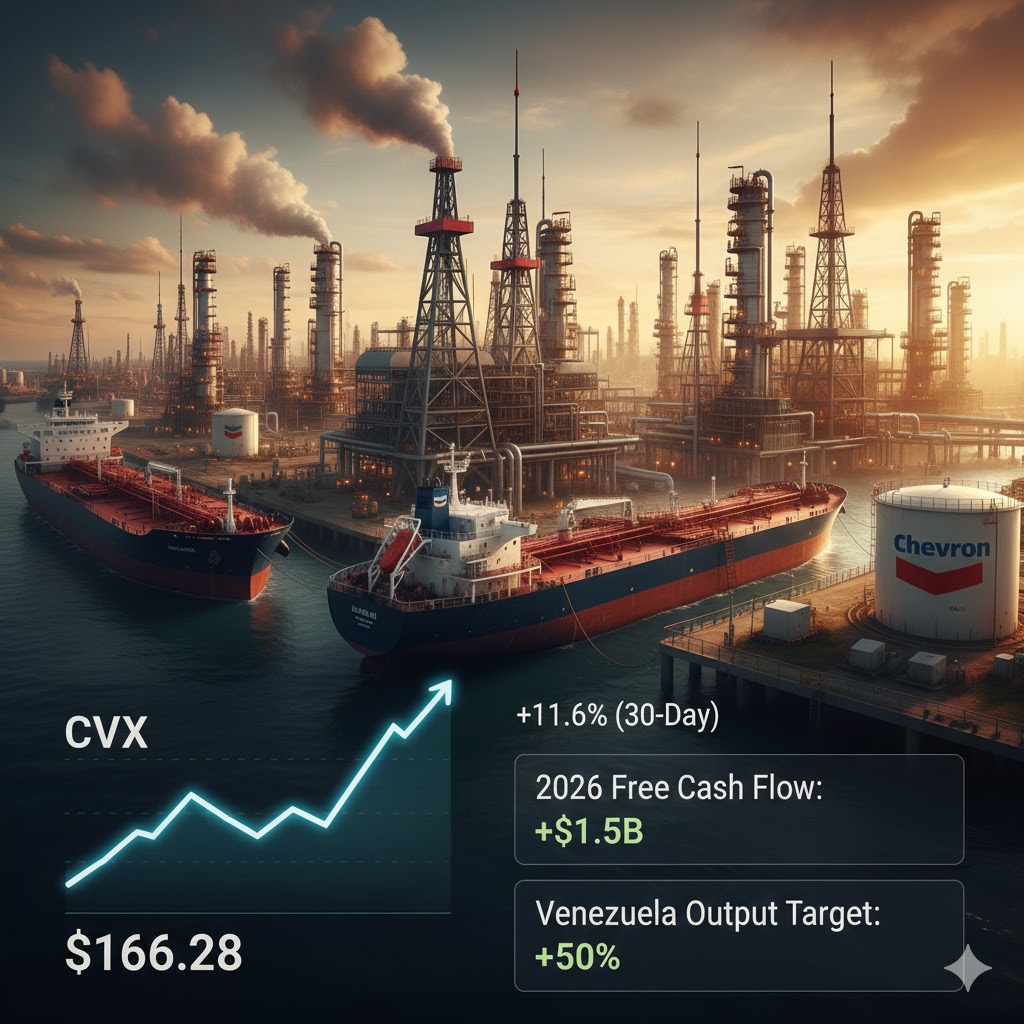
As of the market close on January 16, 2026, the CVX stock price settled at $166.28. While broader market narratives in early January hinted at explosive growth, the actual price action has been one of steady, calculated gains. The CVX stock recently hit a 52-week high of $169.37, representing a solid 11.6% increase over the trailing 30 days. This performance outpaces many of its peers in the energy sector, which saw an average decline of roughly 1.2% during the same period.

Key Market DataChevron (CVX) as of Jan 16, 2026
Current Stock Price$166.28
52-Week Range$132.04 – $169.37
Market Capitalization$332.41 Billion
Forward P/E Ratio21.14
Dividend Yield4.11%
Average Volume9 Million Shares

Financially, Chevron entered 2026 on a stable foundation, though not without headwinds. The company’s 2025 earnings estimate is pegged at approximately $7.34 per share, a figure that reflects the reality of lower average crude prices compared to the previous year. However, its cash flow remains a pillar of strength. Chevron reported a significant free cash flow expansion of approximately $12.5 billion projected for the full year 2026, driven largely by its leaner operating model and the ramp-up of the Tengiz Future Growth Project in Kazakhstan. The company’s net debt ratio remains low at 8.8%, providing the “dry powder” necessary to fund the anticipated rehabilitation of Venezuelan assets.
The Venezuelan License: From Debt Recovery to Cash Expansion

The transition from a “debt-settlement” model to a “cash-payment” model is the most significant development in the U.S.-Venezuela energy relationship. Under the previous General License 41, Chevron was essentially acting as a debt collector, exporting oil to the U.S. Gulf Coast primarily to satisfy billions in unpaid debts owed by PDVSA (Petróleos de Venezuela, S.A.). Under this regime, the CVX stock price was often insulated from Venezuelan growth because the revenue wasn’t “new” cash; it was the recovery of old assets.

The proposed new license changes the calculus entirely. Secretary Wright’s comments suggest that Chevron will now function as a standard commercial operator. By allowing cash payments for royalties and taxes, Chevron can now justify aggressive capital allocation to its four main joint ventures: Petropiar, Petroboscan, Petroindependencia, and Petroindependiente. This “commercial flexibility” allows the company to sell its crude not just to its own refineries in Mississippi and Texas, but to any global third-party buyer willing to pay market rates.

Analysts at UBS and Wells Fargo have noted that this move could catalyze a production surge. Chevron currently accounts for roughly 200,000 barrels per day (bpd) of Venezuela’s output. Secretary Wright explicitly stated that the company sees a pathway to increase this production by 50% over the next 18 to 24 months. If successful, this would add 100,000 bpd of high-margin heavy crude to Chevron’s upstream portfolio, a volume that would be material to its bottom line.

Infrastructure Realities and the 2026 Capital Budget

While the policy tailwinds are strong, the operational reality on the ground in Venezuela presents a steep climb. Decades of underinvestment have left the local power grid and pipeline networks in a state of severe disrepair. In its 2026 capital expenditure budget, Chevron outlined a total organic spend of $18 billion to $19 billion. More than half of this is dedicated to U.S. upstream projects, specifically in the Permian Basin, where production recently topped 1 million barrels of oil equivalent per day.

However, the “Affiliate Capex” segment—which includes joint ventures like those in Venezuela and Tengiz—is slated for $1.3 billion to $1.7 billion in 2026. A significant portion of any “extra things” Chevron does in Venezuela, as Wright put it, will likely be funneled through these affiliate channels. The company is focusing on “highest-return opportunities,” and the low lifting costs of Venezuelan heavy oil make it an attractive target for capital, provided the political and regulatory environment remains “fantastic,” a term Wright used to describe the current level of interaction between Washington and Caracas.

Beyond the upstream sector, Chevron’s downstream business is also a strategic beneficiary. Its refineries on the U.S. Gulf Coast are specifically designed to process the heavy, high-sulfur crude that Venezuela produces. Increased supply from Chevron’s own Venezuelan ventures could lower feedstock costs for its refining segment, improving “cracking margins” and contributing to the company’s goal of $3 billion to $4 billion in structural cost reductions by the end of 2026.

Geopolitical Risk and Competitive Landscape

While Chevron stock has been the primary beneficiary of these developments, the broader sector is watching closely. Following the capture of former leader Nicolás Maduro in early January 2026, market optimism has spread to other players. Exxon Mobil (XOM) and ConocoPhillips (COP) have also seen moderate gains as investors speculate on a broader opening of the Venezuelan energy sector.

Even so, Chevron remains in “pole position.” Unlike Exxon or Conoco, who have spent years in legal battles over expropriated assets, Chevron never left. This “first-mover” advantage means Chevron has the staff, the local partnerships, and the existing infrastructure already in place to ramp up production “quickly,” as Wright expects.

The administration’s strategy of maintaining “indefinite control” over Venezuelan oil revenues through U.S.-overseen trustees adds a layer of security for American firms. This “conditional licensing” model allows the U.S. to ensure that oil proceeds fund American goods and humanitarian needs in Venezuela, rather than being diverted. For the CVX stock surged sharply narrative to maintain momentum, the market will need to see these “permissions and approvals” translate into actual barrels in the coming quarters.

Conclusion: A Strategic High-Wire Act

As we move deeper into 2026, Chevron (CVX) stock represents a unique hybrid of traditional U.S. shale dominance and high-stakes international expansion. The transition of the Venezuelan license to a cash-based commercial arrangement is a watershed moment that significantly enhances the company’s “commercial flexibility.”

For investors monitoring the CVX stock price, the focus will shift from the halls of Washington to the oil fields of the Orinoco Belt. The company’s ability to navigate the physical decay of the Venezuelan oil industry while maintaining its strict capital discipline will be the ultimate test of its 2026 growth strategy. While the stock has not seen a “sudden” vertical spike comparable to a tech startup, its steady ascent and outperformance of the energy sector suggest that the market is beginning to price in a long-term, high-margin recovery of South American production.

The story of Chevron in 2026 is no longer just about recovering old debts; it is about reclaiming a leading role in the global heavy crude market, backed by a favorable U.S. energy policy and a resilient financial profile.
Black Gold’s Resurgence: Analyzing the Surge in DVN, COP, CVX, XOM, and OXY Stocks Amid Oil Price Rally

The energy sector experienced a robust upswing in recent trading sessions, closely mirroring a notable intraday rally in global crude oil benchmarks, West Texas Intermediate (WTI) and Brent. This bullish momentum translated into widespread gains across U.S. oil and gas equities, with Devon Energy stock leading the charge, climbing over 4%. ConocoPhillips stock followed with a gain exceeding 3%, while industry behemoths Chevron stock, Exxon Mobil stock, and Occidental Petroleum stock each advanced more than 2%. This synchronized movement underscores the sector’s continued sensitivity to underlying commodity price fluctuations, but also invites a deeper examination of the individual company fundamentals, strategic trajectories, and unique value propositions that distinguish these players within the broader rally. A closer analysis of the financials, strategic priorities, and operational developments of Devon Energy (DVN), ConocoPhillips (COP), Chevron (CVX), Exxon Mobil (XOM), and Occidental Petroleum (OXY) reveals a nuanced landscape where disciplined capital allocation, strategic acquisitions, and energy transition positioning are as critical to investor sentiment as the day’s move in oil prices.

Devon Energy Corp. (DVN): A Focused Operator Capitalizing on Shareholder Returns
The impressive surge of over 4% in Devon Energy stock highlights its appeal as a pure-play on U.S. onshore production coupled with a highly shareholder-friendly capital return policy. Devon’s financial strategy has been a model of discipline in the post-pandemic era. The company utilizes a fixed-plus-variable dividend framework, directly linking a portion of its shareholder returns to quarterly cash flow generation. This means that in periods of strong oil and gas prices and operational efficiency, as witnessed recently, investors can expect substantial variable dividend payouts alongside the base dividend. Analyzing its latest quarterly report reveals a financial profile geared towards high-margin production. Devon has actively streamlined its portfolio, focusing on its high-return core assets in the Delaware Basin, Eagle Ford, and Anadarko Basin. This focus is evident in its strong operating cash flow margins. For instance, in a recent quarter, Devon might report operating cash flow surpassing $2 billion, enabling significant debt reduction, robust capital expenditures within cash flow, and the distribution of its variable dividend. The rise in the DVN stock price is a direct reflection of the market rewarding this transparent and return-focused financial model, especially when commodity prices provide a tailwind.

From a business development and planning perspective, Devon’s strategy is decidedly conservative and returns-oriented. The company has emphasized a “maintenance-plus” capital expenditure program, aiming to keep production relatively flat or growing modestly while prioritizing free cash flow generation over aggressive volume growth. This restraint is a key differentiator and is positively received by investors seeking exposure to oil prices without the associated risks of unchecked capital spending. There is minimal talk of large-scale, transformative M&A; instead, the focus is on small, bolt-on acquisitions within its core operating areas to enhance scale and operational efficiency. On the product and development front, Devon is not engaged in “new product” development in a traditional sense but is continuously advancing its operational techniques. This includes optimizing well completion designs, implementing advanced data analytics for drilling, and improving midstream logistics to reduce costs and enhance recovery rates. Its market expansion is geographic only in the context of deepening its hold within its existing premier basins. The company’s commitment to its dividend framework and a strong balance sheet (evidenced by a declining net debt-to-EBITDA ratio) are the central pillars of its investment case. The recent upward move in Devon Energy stock signals confidence that the company will continue to be a premier vehicle for returning capital to shareholders during a strong commodity cycle, making its stock performance a leveraged play on both oil prices and operational execution.

ConocoPhillips (COP): The Disciplined Giant with a Global Portfolio
The gain of over 3% for ConocoPhillips stock reflects its status as a large, diversified, and meticulously managed independent exploration and production (E&P) company. ConocoPhillips runs a global portfolio spanning the Lower 48 states, Alaska, Canada, Europe, Asia-Pacific, and the Middle East. This geographic diversification provides a natural hedge against regional price or operational disruptions. Financially, COP is a cash flow powerhouse. Its strategy, dubbed the “Triple Mandate,” focuses on generating strong returns on capital employed, achieving a low cost of supply, and delivering a compelling shareholder return. Its quarterly financials consistently demonstrate this: robust operating cash flow (often exceeding $5 billion in strong quarters), disciplined capital spending aligned with a moderate growth profile, and substantial returns to shareholders through a growing base dividend and a sizable share repurchase program. The increase in the COP stock price is a testament to the market’s appreciation for this predictable, financially resilient model. The company’s breakeven price is among the lowest in the industry, thanks to its high-quality asset base, which includes massive, low-decline projects like the Alaska North Slope and the Montney and Surmont assets in Canada, alongside its tier-one U.S. shale position in the Permian and Eagle Ford.

ConocoPhillips’s business development has been characterized by strategic, transformative acquisitions that immediately enhance scale and economics. The landmark acquisition of Concho Resources in 2021 solidified its dominance in the Permian Basin. More recently, the acquisition of Shell’s Permian assets further cemented this position. Its plan is to integrate these acquisitions efficiently, realize synergies, and high-grade the combined portfolio. Unlike some peers, COP has been clear that it sees its future firmly in oil and gas, leveraging its scale and efficiency to be a last-standing low-cost producer even in a decarbonizing world. Its “energy transition” plan is pragmatic, focusing on projects to reduce the emissions intensity of its operations (like methane monitoring and electrification) and investing in early-stage low-carbon technologies, such as hydrogen and carbon capture, through its venture capital arm. However, its core investment and growth capital remain overwhelmingly directed towards its hydrocarbon portfolio. Product development is centered on optimizing its vast resource base, including advancing major projects like Willow in Alaska. Market expansion is primarily about maximizing value from its existing global footprint and leveraging its trading and marketing arm to capture arbitrage opportunities. The strength in ConocoPhillips stock indicates investor confidence in its disciplined capital allocation, its ability to generate massive free cash flow across cycles, and its strategic positioning as a consolidator in the Permian Basin, making it a core holding for broad-based energy exposure.

Chevron Corp. (CVX) & Exxon Mobil Corp. (XOM): Integrated Majors Balancing Tradition and Transition
The parallel gains of over 2% for both Chevron stock and Exxon Mobil stock highlight the renewed investor interest in the integrated supermajors, entities that encompass the entire value chain from upstream production to refining, chemicals, and marketing. Their recent outperformance is not solely a crude price play; it reflects a broader reassessment of their financial discipline and strategic redirection. Financially, both companies emerged from the 2020 price crash with a renewed commitment to capital restraint and shareholder returns. Chevron, for instance, has prioritized its dividend as sacrosanct and supplemented it with share buybacks. Its recent quarterly earnings often showcase strong downstream and chemical earnings complementing upstream performance, providing cash flow stability. Exxon Mobil, after a period of significant capital spending, has dramatically curtailed its outlays, focusing on high-return short-cycle projects, particularly in the Permian and Guyana. Its new corporate plan emphasizes structural cost reductions and a debt reduction target, which has restored its balance sheet strength. The rise in CVX stock price and XOM stock price signals approval of this more shareholder-centric, less growth-at-all-costs approach. Their immense scale and integrated models provide a relative cushion during volatility, as weak upstream margins can sometimes be offset by strong refining cracks or chemical margins.

Strategically, Chevron and Exxon are navigating the energy transition in different, yet increasingly clear, ways. Chevron has outlined a strategy focused on “lower carbon intensity” oil and gas, investing in renewable fuels, carbon capture, and hydrogen, with a stated goal to grow these lower-carbon businesses profitably. Its acquisition of Renewable Energy Group was a significant bet on biofuels. Exxon Mobil, after facing investor pressure, has significantly increased its commitment to lower-carbon solutions, establishing a Low Carbon Solutions business focused on carbon capture and storage (CCS)—where it claims a leading position—and biofuels. However, both companies continue to assert the long-term necessity of oil and gas, investing heavily in giant, low-cost upstream projects like Exxon’s Guyana-Stabroek block and Chevron’s Tengizchevroil expansion in Kazakhstan. These projects are pillars of their future production and cash flow. In terms of market expansion, their global downstream and chemical footprints are being optimized rather than massively expanded, with a focus on high-performing assets. The recent stock strength suggests the market is beginning to value their potential to be “all-energy” companies—entities that can generate enormous cash from hydrocarbons to fund both shareholder returns and selective investments in emerging energy technologies, positioning them as enduring giants rather than dinosaurs. The performance of Chevron stock and Exxon Mobil stock reflects a belief that they have adapted their strategies to meet both current cash return demands and future energy mix realities.

Occidental Petroleum (OXY): A Unique Story of Debt, Dividends, and Direct Air Capture
The more than 2% climb in Occidental Petroleum stock tells a more complex story, intertwined with its past, its prominent investor, and its controversial future vision. Occidental carries the legacy of its pre-pandemic acquisition of Anadarko Petroleum, which left it with a heavy debt burden. Therefore, its recent financial narrative has been dominated by debt reduction. Its quarterly reports are scrutinized for progress on this front, and the company has made substantial headway, using strong cash flows from its high-quality Permian Basin and Gulf of Mexico assets, as well as its leading chemical (OxyChem) business, to rapidly pay down debt. The recent initiation of a modest quarterly dividend and a share repurchase program marked pivotal turning points, signaling a shift from pure survival to returning capital. The movement in the OXY stock price is sensitive to oil prices due to its leveraged balance sheet history, but also uniquely influenced by its ambitious low-carbon ventures. The company’s association with Warren Buffett’s Berkshire Hathaway, a major shareholder, adds a layer of market attention and perceived stability.

Occidental’s business development plan is bifurcated. In the near to medium term, it is an E&P and chemicals company focused on optimizing its Permian resources (where it is a leader in carbon-neutral oil through its sequestration initiatives) and generating free cash flow. Its longer-term vision, however, is arguably the most distinctive in the industry. Through its subsidiary 1PointFive, Occidental is aggressively pursuing the commercialization of Direct Air Capture (DAC) technology, aiming to build multiple large-scale plants to remove carbon dioxide directly from the atmosphere. This is not merely an R&D project; the company has secured investment partners and offtake agreements, including a significant deal with Amazon. This positions OXY not just as an oil producer, but as a potential future leader in the carbon management ecosystem. This high-risk, high-potential venture divides investor opinion. From a market expansion perspective, its hydrocarbon growth is focused on the Permian and enhanced oil recovery (which synergizes with its CO2 expertise), while its “new product” development is literally the scaling of DAC technology. The recent positive movement in Occidental Petroleum stock likely reflects a combination of higher oil prices improving its core business cash flow and growing, albeit cautious, optimism about the potential scalability and economics of its DAC projects, setting it apart as a highly speculative yet strategically unique player in the energy space.

In conclusion, the broad-based advance in Devon Energy stock, ConocoPhillips stock, Chevron stock, Exxon Mobil stock, and Occidental Petroleum stock is rooted in a favorable oil price environment, but sustained by distinct corporate fundamentals. Devon excels in direct shareholder returns; ConocoPhillips in global portfolio discipline and cash generation; Chevron and Exxon in integrated resilience and evolving transition strategies; and Occidental in debt reduction and a pioneering carbon capture ambition. Their collective performance signals a market that is selectively rewarding energy companies that demonstrate capital discipline, clear strategic pathways, and attention to shareholder returns, while also beginning to ascribe value to credible long-term positioning within the evolving global energy landscape. Their individual trajectories will be determined not just by the price of crude, but by their execution on these very specific financial and operational blueprints in the quarters ahead.