AAPL Stock Price

The Greenland Gambit: Analyzing the Trillion-Dollar Fallout of Trump’s “Arctic Tax” on Apple, Tesla, and Boeing

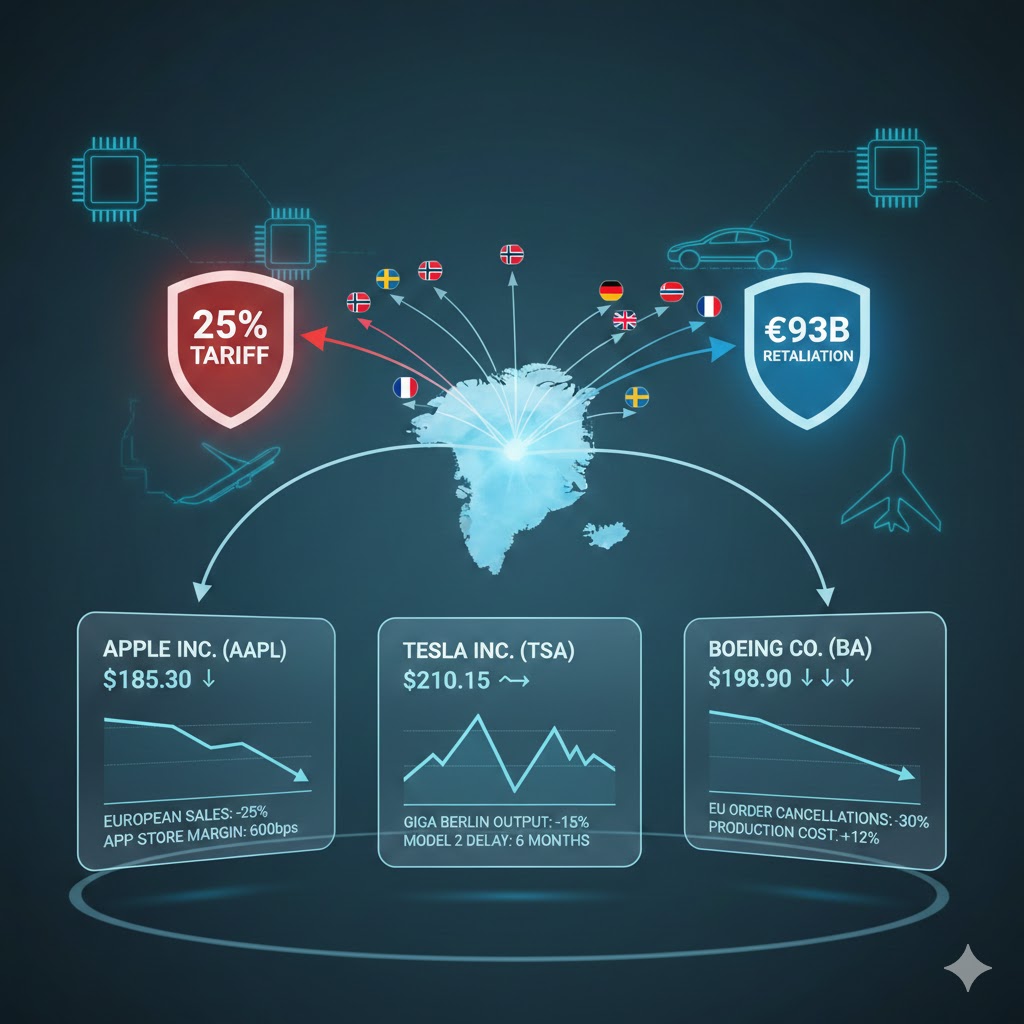
The geopolitical landscape was set ablaze on January 17, 2026, when President Donald Trump utilized his social media platform to issue a seismic trade ultimatum that has sent shockwaves through global markets. Invoking the “Safety, Security, and Survival of our Planet,” the President announced a 10% tariff on all goods imported from eight European nations—Denmark, Norway, Sweden, France, Germany, the United Kingdom, the Netherlands, and Finland—beginning February 1, 2026. This rate is scheduled to skyrocket to 25% by June 1, 2026, unless a deal is reached for the “complete and total purchase of Greenland.”

The rationale provided by the White House centers on the sudden “unknown” military maneuvers of these eight nations within the Danish autonomous territory. Trump’s post highlighted a 150-year-old American ambition to acquire the island, now escalated by the strategic necessity of the “Golden Dome” missile defense system. In immediate response, the European Union has signaled its intent to retaliate by targeting €93 billion ($101 billion) of U.S. goods and restricting American corporate access to the Single Market.

As the “Greenland Gambit” unfolds, the financial implications for U.S. equities are profound. By analyzing revenue exposure, supply chain vulnerabilities, and the specific retaliatory targets of the EU, three stocks emerge as the most exposed to this transatlantic trade war: Apple Inc. (AAPL), Tesla Inc. (TSLA), and The Boeing Company (BA).


Apple Inc. (AAPL): A Two-Front War on Margins and Market Access

[AAPL] stock faces a uniquely precarious situation. While Apple is often viewed through the lens of its Chinese manufacturing base, its European operations are the silent engine of its high-margin services and hardware growth. In fiscal year 2025, Europe accounted for approximately 25% of Apple’s total net sales, reaching nearly $100 billion. The EU’s threat to “restrict American companies from the bloc’s market” strikes directly at Apple’s most lucrative expansion area: the Digital Markets Act (DMA) compliant App Store and its burgeoning AI services.

The Apple (AAPL) stock price has historically been sensitive to trade disruptions, but the Greenland tariffs introduce a “circular” cost pressure. Apple imports a significant array of high-end components and specialized machinery from Germany and the Netherlands (specifically from lithography giant ASML partners) for its domestic R&D and limited U.S.-based assembly. A 25% tariff on these precision tools would inflate the capital expenditure required for Apple’s “Apple Silicon” development.

Financially, Apple’s balance sheet remains robust, with over $160 billion in cash and marketable securities as of their most recent quarterly filing. However, the 2026 guidance already factored in a 5% growth in European hardware sales driven by the “iPhone 17” cycle and the rollout of Apple Intelligence in local languages. If the EU retaliates with a 25% “digital sovereignty tax” or targeted luxury tariffs—a tactic used in previous trade disputes—Apple’s operating margins in the region, which currently hover around 38%, could contract by 400 to 600 basis points.

Furthermore, the “Greenland mission” cited by Trump involves nations that are home to Apple’s primary European data centers (Denmark and Sweden). Regulatory friction or “national security” audits by these governments in response to U.S. pressure could delay the deployment of Apple’s new “Private Cloud Compute” infrastructure. For investors monitoring AAPL stock, the primary risk is not just the cost of goods, but the potential for a “regulatory blockade” that halts the monetization of AI across the European continent.


Tesla Inc. (TSLA): The Giga Berlin Bottleneck and Retaliatory Targets

No company is more physically entrenched in the crosshairs of this dispute than Tesla. With Giga Berlin-Brandenburg serving as its primary European manufacturing hub, Tesla (TSLA) stock is exposed to both the U.S. import tariffs and the EU’s retaliatory list, which specifically mentions “vehicles” as a primary target for the €93 billion counter-strike.

According to Tesla’s 2025 annual report, the company has successfully ramped production at Giga Berlin to an annual run rate of 600,000 vehicles. However, the facility remains heavily dependent on specialized parts and power electronics imported from the United States, as well as the export of specialized Model Y variants back to the North American market to satisfy specific trim demands. The proposed 25% U.S. tariff on German-made goods would effectively end the viability of importing European-made Teslas into the U.S., while the EU’s retaliatory tariffs would hit Tesla’s U.S.-made Model S and Model X exports to Europe.

The Tesla (TSLA) stock price recently saw volatility following the announcement, as investors digested the impact on the “Model 2” (the $25,000 next-generation vehicle) development timeline. Tesla had planned for a simultaneous global rollout in 2026, with Giga Berlin playing a lead role in the European market entry. If trade barriers rise, Tesla may be forced to bifurcate its supply chain, a “de-globalization” move that would significantly increase the unit cost of its most important upcoming product.

From a market expansion perspective, Tesla’s “FSD (Full Self-Driving) 12” European pilot program, which was slated for a wide release in late 2026, could become a political pawn. The EU has indicated it may use its “anti-coercion instrument” to block the certification of U.S. autonomous driving software. Given that Tesla’s long-term valuation—often cited by bulls as being driven by AI and Robotaxis—is predicated on global software-as-a-service (SaaS) revenue, a lockout from the European market would be a devastating blow to the growth narrative of TSLA stock.

The Boeing Company (BA): The Aerospace “Trench War” with Airbus

Perhaps the most direct casualty of a Greenland-related trade war is The Boeing Company (BA). The EU’s retaliation list of €93 billion explicitly targets “aircraft,” a move designed to provide a competitive windfall for Boeing’s arch-rival, the European-consortium Airbus. For Boeing (BA) stock, which is currently in the midst of a fragile recovery following years of production setbacks and safety scrutinies, a trade war is the ultimate “black swan” event.

Boeing’s 2026-2027 backlog includes hundreds of orders from European carriers like Lufthansa (Germany), Air France-KLM (France), and Ryanair (Ireland). These airlines, many of which receive state support or operate within the high-regulation environment of the EU, would face immense political and financial pressure to cancel Boeing orders in favor of Airbus if a 25% retaliatory tariff is applied to U.S.-made aircraft.

Analysis of BA stock must account for the company’s “2026 Turnaround Plan,” which relies on increasing 737 MAX production to 50 per month and stabilizing the 787 Dreamliner line. European suppliers provide critical components for these airframes—for instance, French-based Safran provides the LEAP-1B engines for the 737 MAX. If Trump’s 25% tariff makes these engines prohibitively expensive to import into the U.S., Boeing’s production costs will spiral, potentially forcing the company to seek further debt financing or government subsidies, further diluting the Boeing (BA) stock price.

Moreover, the “Golden Dome” defense system mentioned by Trump suggests an escalation in military spending. While Boeing is a major defense contractor, the potential for being “blacklisted” from European defense procurement—such as future fighter jet competitions or refueling tanker contracts in the UK and Germany—could offset any gains from increased U.S. domestic defense spending. For those tracking BA stock, the threat of a “closed” European aerospace market represents a long-term structural risk that far outweighs short-term geopolitical posturing.


Conclusion: Navigating a New Era of “Arctic Real Estate” Economics

The confrontation over Greenland marks a departure from traditional trade disputes. By linking sovereign territory acquisition to commercial tariffs, the U.S. administration has introduced a level of unpredictability that markets are struggling to price. The €93 billion retaliation from Europe is not merely a threat; it is a calculated strike at the heart of the U.S. tech and industrial sectors.

For Apple, the risk lies in the “digital curtain” falling across Europe. For Tesla, it is the fragmentation of a once-unified global manufacturing strategy. For Boeing, it is the potential loss of the world’s second-largest aviation market to a domestic competitor. As February 1 approaches, the AAPL stock, TSLA stock, and BA stock tickers will serve as the primary thermometers for this freezing of transatlantic relations.
Apple (AAPL) and Alphabet (GOOGL) AI Partnership Shakes Up Tech Stocks: A Deep Dive into Market Reaction, Financials, and Long-Term Strategic Implications

On January 12, 2026, Apple Inc and Alphabet Inc (Google’s parent company) officially announced a multi-year strategic partnership in artificial intelligence, under which Apple’s next-generation Apple Foundation Models will be based on Google’s advanced AI Gemini models and cloud infrastructure. The agreement also confirms that future Apple Intelligence features — including a significantly upgraded and more personalized Siri voice assistant — will be powered by Google’s AI models. This marks a rare collaboration between two longstanding tech competitors and has resonated across global equity markets, particularly in AAPL stock and GOOGL stock.

Below, we provide a comprehensive finance-oriented analysis of this development, covering relevant stock pricing data, fundamental metrics from financial statements, strategic considerations around product development and AI adoption, as well as market sentiment. The purpose is to clarify how this high-impact AI news interacts with the valuation and strategic trajectories of these companies — without offering investment recommendations.


Current Trading Snapshot: AAPL Stock and GOOGL Stock

As of early U.S. trading on January 13, 2026:

Apple Inc (NASDAQ: AAPL)

  • AAPL stock price: $260.25 per share
  • Market capitalization: ~$3.005 trillion
  • PE ratio: 30.28
  • EPS: 6.59

Alphabet Inc (NASDAQ: GOOGL)

  • GOOGL stock price: $331.86 per share
  • Market capitalization: ~$2.938 trillion
  • PE ratio: 23.65
  • EPS: 10.13

These data points are reflective of mid-January 2026 markets, a period of active price discovery following the AI partnership announcement and broader interest in AI-related equities.


Strategic Context: Why the Apple-Google AI Deal Matters

Apple’s decision to base its future foundational AI models on Google’s Gemini represents a marked departure from its traditional preference for proprietary software systems. According to the companies’ joint statement, Apple “determined that Google’s AI technology provides the most capable foundation” for its next generation of Apple Foundation Models — a series of AI systems that underpin a growing suite of device intelligence features.

Traditionally, Apple has emphasized on-device processing and privacy in its technology stack — an approach that sets it apart from most cloud-based AI companies. However, Apple’s internal efforts to build advanced large language models (LLMs) have faced persistent technical and market speed challenges, leaving flagship products like Apple Intelligence and Siri without the breakthrough capabilities seen in competitor offerings.

This partnership can be viewed through several strategic lenses:

  1. AI Capability Gap: Apple’s own large-model efforts have lagged, necessitating external support for state-of-the-art performance.
  2. Privacy Preservation: The deal structure continues to honor Apple’s privacy commitments, with Apple Intelligence computations still processed on device or via Apple’s private cloud.
  3. Ecosystem Integration: Siri — long viewed as Apple’s weakest mainstream product — gets a substantive AI upgrade that could boost ecosystem stickiness.

Market Reaction: GOOGL and AAPL Stocks Across Exchanges

GOOGL stock price exhibited notable investor enthusiasm — driven in part by the partnership news and a broader AI surge — with the market valuing Alphabet above $4 trillion on certain intraday moves shortly after the announcement, according to multiple financial outlets.

This represents both a quantitative shift in valuation and a qualitative shift in investor perception of Alphabet’s role in the AI economy. Investors are increasingly framing Google not just as a search and advertising powerhouse but as a cornerstone AI infrastructure provider. The endorsement from Apple — a direct competitor in numerous markets — has been interpreted as a significant external validation of Google’s AI leadership.

By contrast, AAPL stock price did not see an extreme move at opening, which aligns with Apple’s historical pattern of measured stock reactions to strategic news, particularly when the news implies reliance on external technologies. The uptake of AI capabilities may improve Apple’s product competitiveness, but it also highlights a capability gap that Apple previously tried to bridge internally.


Financial Statements and AI Strategy Alignment

Apple Inc: Balancing Device Sales with Software Era Growth

Apple’s growth has traditionally been driven by premium hardware — iPhone, Mac, iPad, and wearables — coupled with expanding services revenue. Its fundamental financial profile (noting a PE ratio above 30) suggests that markets have priced in expected long-term earnings growth, much of which is tied to recurring revenue from services and ecosystem monetization.

For Apple, AI integration potentially amplifies:

  • Subscription revenue through value-added AI services (e.g., AI-enhanced Apple Music, Apple Fitness+).
  • Device attractiveness and replacement cycle strength via advanced Siri and device intelligence.
  • Competitive positioning against Android and other AI-enabled ecosystems.

However, if significant AI workload shifts toward Google’s infrastructure, Apple’s revenue capture in the AI value chain may remain limited compared to peers with native cloud or AI platform businesses.

Alphabet Inc: Monetizing AI at Scale

Google — as part of Alphabet — directly benefits from:

  • Cloud infrastructure usage tied to AI workloads.
  • Licensing and usage of Gemini models.
  • Enhanced ad-tech positioning via AI-driven search and analytics improvements.

GOOGL’s lower PE ratio (relative to Apple) reflects its mix of high-growth cloud and AI segments with more traditional advertising revenue, which may experience slower growth. However, the AI partnership with Apple could tilt this mix more toward recurring AI revenue streams, attracting a re-rating of valuation multiples over time.


Competitor and Market Landscape

Beyond AAPL and GOOGL, the AI arms race in tech stocks has had broader implications:

  • Nvidia remains a dominant play in AI hardware, with its GPUs powering much of the cloud compute layer. Although Nvidia isn’t directly involved in this Apple-Google deal, its AI ecosystem exposure has driven sustained enthusiasm in markets.
  • Microsoft and OpenAI rivals continue to compete for enterprise and consumer AI workloads, influencing tech stock correlations observed in late 2025 and early 2026.
  • Consumer Android OEMs that integrate Gemini into products have also helped expand Google’s ecosystem, further validating its AI platform.

The combined push by these companies has necessitated a recalibration of valuations across the tech sector, with investors placing increased emphasis on AI capability adoption rates and ecosystem lock-in effects.


Risks and Considerations

While the Apple-Google partnership offers synergistic benefits, several risk vectors bear monitoring:

  1. Execution Risk: Integrating sophisticated models across billions of Apple devices without degrading privacy or performance is non-trivial.
  2. Competitive Risk: Other ecosystem players (e.g., Microsoft/Anthropic) could accelerate competitive AI features faster than anticipated.
  3. Regulatory Risk: Tech antitrust scrutiny in the U.S. and EU may intensify scrutiny over deep integrations among major platform providers.

It’s also important to note that Apple could still pursue internal AI development in parallel, especially for later foundational models, which might reduce long-term reliance on any external partner.


Summary of Key Impacts

CompanyStrategic ShiftStock Impact (Short-Term)Long-Term Potential
Apple (AAPL)Outsourcing AI core models to Google GeminiModerate price response; stabilityImproved product AI leads to ecosystem stickiness, but reliance signals product development headwinds
Alphabet (GOOGL)Validation as AI infrastructure leaderStrong investor sentiment; market cap milestoneExpanded cloud and AI licensing revenue, broader ecosystem leverage

Conclusion

The Apple-Google multi-year AI partnership marks a pivotal strategic inflection point in the ongoing competition for AI leadership. For AAPL stock, it signals an acceleration in AI-enabled product evolution but also underscores Apple’s reliance on external AI expertise. For GOOGL stock, it may reinforce the company’s positioning as a foundational AI provider across technology ecosystems.

Investors and analysts will closely watch updates to Apple’s AI roadmap — particularly how Siri and Apple Intelligence improvements translate into user engagement — as well as Alphabet’s evolving monetization strategy for Gemini and cloud services. With both stocks now moving in an environment where AI capability and strategic alliances carry outsized influence on valuation multiples, tech equities could continue to reflect investor optimism around the long-term revenue implications of foundational AI adoption.