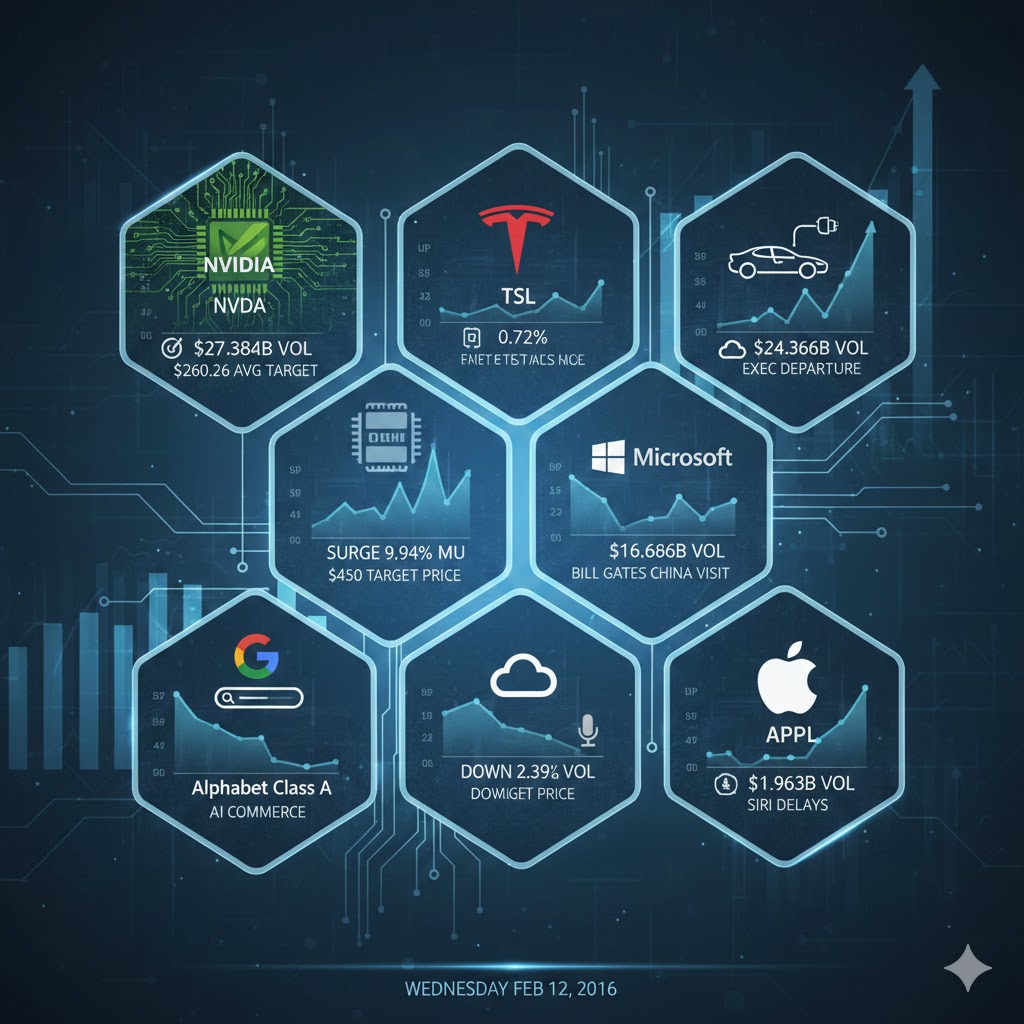
AAPL Stock Price

Top Stocks To Buy In Wednesday 2016-02-12

The No. 1 most actively traded U.S. stock on Wednesday was Nvidia(NASDAQ:NVDA), which closed up 0.80% with $27.384 billion in trading volume.

UBS raised its target price on Nvidia from $235 to $245.

In its latest report, Goldman Sachs lifted its earnings forecast for Nvidia’s fiscal fourth quarter of 2026 and maintained a $250 price target, emphasizing that revenue visibility for 2027 will be a key catalyst. Institutional ratings show that more than 90% of analysts assign a “Buy” or “Overweight” rating, with an average target price of $260.26, reflecting market optimism about AI computing demand. However, Goldman also warned of risks such as a slowdown in AI infrastructure investment and intensifying competition.

The No. 2 most actively traded stock was Tesla (NASDAQ:TSLA), which rose 0.72% on trading volume of $24.366 billion.

According to reports, Tesla Vice President Raj Jegannathan announced on LinkedIn on February 9 local time that he was leaving the company, ending his 13-year tenure. This marks the latest departure in a wave of executive exits from companies under Elon Musk. Previously, several core executives at Tesla and xAI had also stepped down.

Jegannathan wrote, “It’s not easy to summarize 13 years in one post. My journey at Tesla has been a continuous evolution. As I leave, I do so with gratitude and excitement for what lies ahead.”

The No. 3 most actively traded stock was Micron Technology (NASDAQ:MU), which surged 9.94% on trading volume of $19.165 billion.

On Wednesday, Morgan Stanley raised its target price on the stock from $350 to $450 while maintaining an “Overweight” rating. The new target is above Micron’s Wednesday closing price of $410.34 and aligns with the broadly bullish consensus among analysts. Public data show that the stock’s average analyst rating stands at 1.56 (Strong Buy).

In addition, during a speech at the Wolfe Research conference, Micron addressed rumors that it “might miss out on Nvidia’s new HBM4 orders,” stating that the supply-demand imbalance, with capacity in short supply, is expected to persist at least through 2028. The clarification helped lead a strong rebound in shares of several leading memory manufacturers.

The No. 4 most actively traded stock was Microsoft (NASDAQ:MSFT), which fell 2.15% on trading volume of $16.686 billion.

According to media reports, Bill Gates, chairman of the Gates Foundation, made a surprise appearance in Zhangjiang, Shanghai, on the evening of February 11 to attend an event titled “Action Creates Hope.”

This visit marked Gates’ return to China approximately two and a half years after his previous trip in June 2023.

In an interview, Gates directly addressed the controversy surrounding his relationship with Jeffrey Epstein. He clarified, “Between 2011 and 2014, I did have several dinners with Epstein, but there is really nothing new to add about that. I never had contact with any victims, nor did I ever visit his island.”

The No. 5 most actively traded stock was Alphabet Class A (NASDAQ:GOOGL), which declined 2.39% on trading volume of $14.066 billion.

According to reports, Google is introducing a new feature that allows consumers to purchase products directly when receiving AI-powered answers through its search engine and Gemini chatbot. This initiative is part of a broader strategy to monetize user engagement with artificial intelligence more directly.

In a letter to the advertising industry on Wednesday, the company said that its AI mode in Google Search is testing new ad formats that allow retailers and other advertisers to showcase products. Google also stated that users can now purchase items from Etsy and Wayfair directly within Gemini. The newly added “Direct Offers” feature in AI mode will enable brands to provide discounts to potential shoppers.

The No. 6 most actively traded stock was Apple (NASDAQ:AAPL), which rose 0.67% on trading volume of $13.963 billion.

Well-known technology journalist Mark Gurman reported that Apple’s long-planned upgrade to its Siri voice assistant has encountered setbacks in recent weeks of testing, which could delay the release of several highly anticipated features.

According to sources familiar with the matter, Apple had originally planned to introduce these new features in iOS 26.4, scheduled for release in March, but is now considering spreading them across future versions.

This means that at least some of the features could be postponed until iOS 26.5, expected in May, or even until iOS 27, set for release in September.
Memory and Gold Surge in Tandem: Blockbuster Earnings Ignite Storage Stocks, Gold Prices Soar, and Intel Rallies on Foundry Momentum

Strong earnings from memory industry leaders once again ignited market enthusiasm overnight, sending related stocks sharply higher. Micron Technology (NASDAQ:MU) rose more than 6%, Seagate Technology (NASDAQ:STX) surged nearly 20%, while Western Digital (NASDAQ:WDC) and SanDisk Corp (NASDAQ:SNDK) climbed about 10% each, all hitting record highs.

Storage giant Seagate Technology delivered a quarterly earnings report that far exceeded Wall Street expectations, with both revenue and profit posting significant growth. The company also reported record-high gross margin and operating margin. According to Seagate’s latest financial results, revenue for fiscal 2026 second quarter reached USD 2.825 billion, up 21.5% from USD 2.325 billion a year earlier. Non-GAAP earnings per share came in at USD 3.11, well above USD 2.03 in the prior-year period. Gross margin improved markedly to 42.2%, compared with 35.5% a year ago.

The company also guided for third-quarter revenue of USD 2.9 billion (plus or minus USD 100 million), above analysts’ expectations of USD 2.77 billion. Adjusted earnings per share are forecast at USD 3.40 (plus or minus USD 0.20), also exceeding the market consensus of USD 2.96. Seagate Chairman and CEO Dave Mosley said the company’s areal-density-driven product roadmap enables it to meet modern data centers’ demand for exabyte-scale storage solutions that combine performance and cost efficiency. As artificial intelligence applications expand data creation and economic value, this positioning is expected to generate long-term value for customers and shareholders.

SK hynix also reported its strongest quarterly performance in history, with fourth-quarter operating profit more than doubling year over year to KRW 19.2 trillion (USD 13.5 billion), beating the average analyst estimate of KRW 16.7 trillion. Revenue climbed to KRW 32.8 trillion. As a major supplier of high-bandwidth memory (HBM) for NVIDIA’s AI accelerators, SK hynix shares have roughly tripled since early September, with valuation expansion leading Asian technology stocks. The company also disclosed plans to cancel approximately USD 8.6 billion worth of treasury shares next month as part of efforts to enhance shareholder returns. It reiterated that it is considering a U.S. listing, though no decision has yet been made.

Previously, Sassine Ghazi, CEO of Synopsys, the global leader in EDA and semiconductor IP, said in an interview that the chip “shortage” would persist through 2026 and 2027. Ghazi noted that most of the world’s top manufacturers’ memory chips are currently flowing directly into AI infrastructure, while many other products also require memory, leaving those markets constrained by insufficient capacity. He added that Samsung Electronics, SK hynix, and Micron Technology (NASDAQ:MU), the world’s largest memory companies, are working to expand production, but achieving their capacity expansion goals will take at least two years—one of the key reasons the shortage is expected to persist.

“Right now is a golden period for memory companies,” Ghazi said, adding that rising memory prices mean consumer electronics companies may have to consider raising prices—a trend that is “already happening.”

Spot gold climbed close to USD 5,600 per ounce overnight, sending gold stocks broadly higher. Newmont (NYSE:NEM) rose nearly 4%, Agnico Eagle Mines (NYSE:AEM) gained more than 3%, Gold Fields (NYSE:GFI) jumped nearly 9%, and Harmony Gold (NYSE:HMY) surged over 7%, all reaching record highs.

Gold has already surged nearly 30% year to date on top of last year’s record rally, supported by rising geopolitical and economic uncertainty, expectations of U.S. rate cuts, and increased central bank purchases amid global de-dollarization trends. Citi sees gold potentially reaching USD 6,000 per ounce under a bull-case scenario, while Société Générale also forecasts prices at USD 6,000 per ounce this year, up from its December projection of USD 5,000.

Agnico Eagle Mines CEO Ammar Al-Joundi previously said: “No one knows how high gold prices could go next week or next month. The fundamental drivers behind gold’s rise are still there—government spending, plus the catalyst we experienced a few years ago when the Russia-Ukraine conflict broke out and Russia was removed from the SWIFT system.”

“And now there’s a new catalyst: the orderly world we live in seems to be becoming less orderly, which clearly has implications for currency markets—and gold plays a role in that,” he added. Al-Joundi noted that central banks in countries such as China are rethinking their allocations to U.S. Treasuries and increasing gold purchases. “With annual gold supply growth being minimal and new mines taking at least ten years to develop, he expects supply to remain tight. You won’t see a flood of gold entering the market,” he said.

Many analysts have attributed the unprecedented rally in gold and silver at the start of the new year partly to rising uncertainty surrounding the Federal Reserve’s political independence; however, Fed Chair Jerome Powell dismissed such concerns at his monetary policy press conference.

“It’s been said that we’re losing credibility, but that’s simply not the case. If you look at where inflation expectations are, our credibility is right where it should be,” Powell said. “We won’t get ‘overexcited’ about price movements in any particular asset, though we do monitor them.”

While the Fed’s neutral stance could pose a potential headwind for gold, many analysts do not see it as a major obstacle. Nitesh Shah, Head of Commodities and Macroeconomic Research at WisdomTree, told Kitco News that although Powell is comfortable keeping rates unchanged in the coming months, markets are already looking beyond May, when Powell may be replaced. “It’s quite possible that Powell will be succeeded by someone more inclined toward rate cuts,” Shah said. “That’s what gold is focused on.”

Powell also offered a measured view on geopolitical risks, noting that while uncertainty remains, oil prices have stayed relatively stable and the U.S. economy has withstood global trade volatility. Analysts pointed out that geopolitical uncertainty is another key driver behind gold’s sharp rise so far this month.

Amid multiple positive catalysts, Intel (NASDAQ:INTC) surged more than 11% overnight.

Following Apple (NASDAQ:AAPL), NVIDIA (NASDAQ:NVDA) is also planning to shift part of its chip manufacturing to Intel’s foundry business. NVIDIA is expected to collaborate with Intel on its Feynman architecture platform slated for launch in 2028.

According to a Wednesday report by DIGITIMES, supply chain sources revealed that NVIDIA will adopt a strategy of “small volume, lower-tier, non-core” cooperation with Intel. The GPU core chips will continue to be manufactured by TSMC (NYSE:TSM), while some I/O chips will use Intel’s 18A or its planned 14A process, which is scheduled for mass production in 2028, with final advanced packaging handled by Intel’s EMIB technology. Based on the proportion of advanced packaging, Intel could account for up to 25%, with TSMC taking about 75%.

After NVIDIA announced a USD 5 billion investment in Intel in September 2025, the latest plan involves collaboration with Intel on the Feynman architecture chips, the successor to the Rubin series. Supply chain sources said that under the Trump administration’s push for U.S. manufacturing and tariff pressures, major U.S. chipmakers had long discussed cooperation with Intel. However, as the 18A process did not meet customer expectations, the collaboration timeline is more likely to align with the 14A process reaching mass production in 2028. Intel CEO Lip-Bu Tan recently stated that two customers are currently evaluating the specifics of the 14A process.

In addition, according to SEC filings, Intel CFO David Zinsner purchased USD 249,985 worth of Intel shares at USD 42.5 per share on January 26, marking the first insider purchase since 2024.