As we navigate the opening weeks of January 2026, the narrative surrounding NFLX stock has shifted from a story of disruptive growth to one of institutional hegemony. Netflix, Inc. (NASDAQ: NFLX) finds itself at the center of a seismic realignment in the global media landscape, triggered by its massive $82.7 billion strategic acquisition of Warner Bros. Discovery’s streaming and studio assets. For global investors and market participants tracking the NFLX stock price, the current environment represents the dawn of “Streaming 2.0″—an era where scale, advertising precision, and live sports rights are the new currencies of dominance.
Financial Resilience: Analyzing the Q4 2025 Performance and Margin Expansion
The financial architecture of Netflix in 2026 reflects a company that has successfully optimized its unit economics while aggressively expanding its revenue base. According to the preliminary results for the fourth quarter of 2025, Netflix is expected to report revenue of approximately $11.97 billion, representing a 16.8% year-over-year increase. This growth is a direct result of the company’s “three-tier” monetization strategy: high-margin ad-supported memberships, premium 4K subscriptions, and the continued monetization of account sharing.
A critical metric for those monitoring NFLX stock is the operating margin, which reached a record 30% in mid-2025. While the heavy integration costs associated with the Warner Bros. acquisition have caused a temporary dip in GAAP net income—estimated at $2.36 billion for Q4 2025—the company’s free cash flow remains a fortress. In the third quarter of 2025 alone, Netflix generated $6.68 billion in free cash flow, an 11% increase year-over-year. This liquidity has enabled the company to fund its content slate, which now exceeds $17 billion annually, without relying on the high-interest debt markets that hampered competitors during the early 2020s.
As of January 9, 2026, the NFLX stock price closed at $89.44. While this reflects a significant retracement from the all-time high of $133.91 achieved in June 2025 (adjusted for the recent 10-for-1 stock split), the valuation remains robust. With a market capitalization of approximately $408.67 billion and a price-to-earnings (P/E) ratio of 46.46, the market is pricing in a “consolidation premium.” The stock’s current position, trading near its 52-week low of $82.11, suggests a period of price discovery as investors weigh the long-term synergies of the Warner merger against the short-term dilution and regulatory hurdles.
Business Development: The Warner Acquisition and the “Super-Aggregator” Strategy
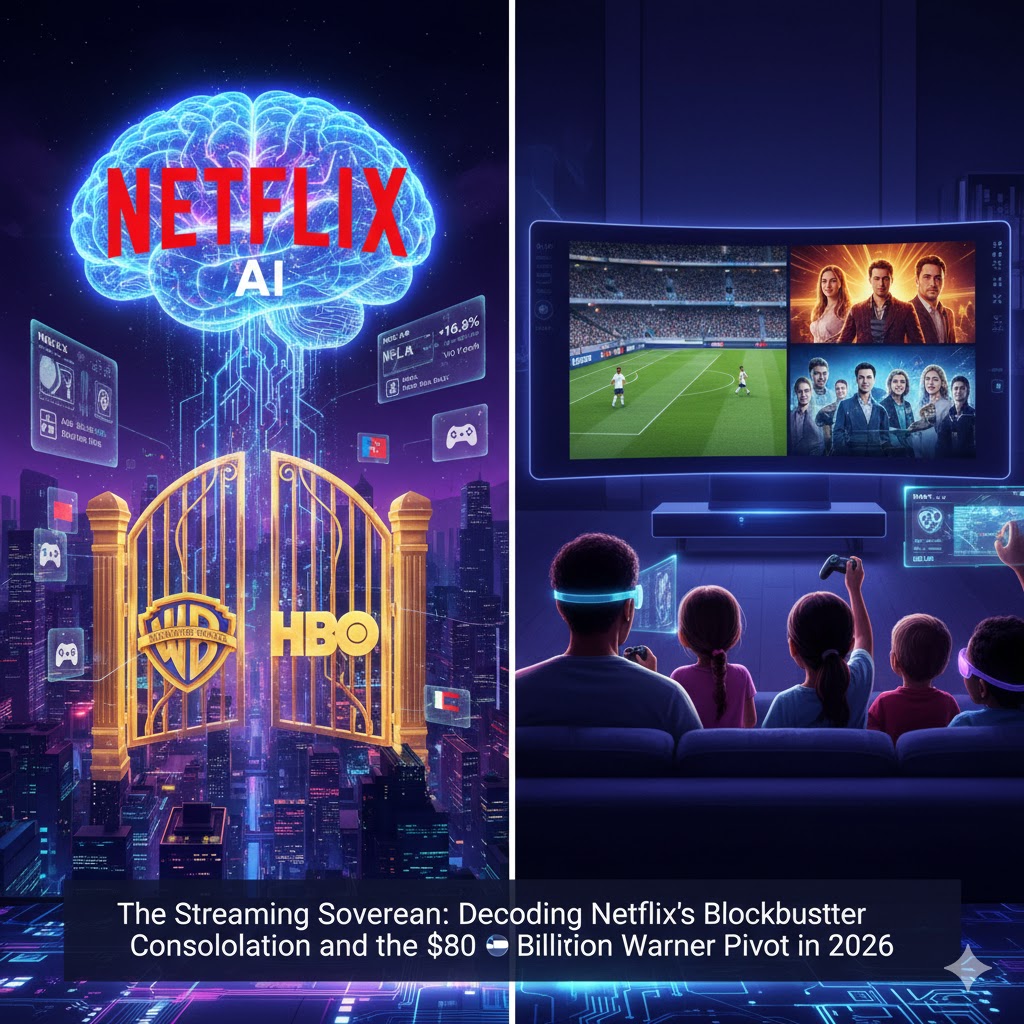
The most significant event for Netflix stock in recent history is the definitive agreement to acquire Warner Bros. Discovery. By incorporating HBO, DC Studios, and the deep Warner film library, Netflix has effectively ended the “streaming wars” by absorbing its most prestigious rival. This move transforms Netflix from a platform into a “Super-Aggregator,” offering a single destination for prestige dramas like House of the Dragon alongside global viral hits like Squid Game.
Strategically, the 2026 roadmap is focused on “Appointment Viewing.” The company is leveraging its newly acquired assets to build out a “Live & Sports” pillar. Following the record-breaking 27.5 million viewers for the Christmas 2025 NFL doubleheader, Netflix has secured exclusive global rights for a wider array of live events, including the full WWE archive and select Grand Slam tennis matches. This shift is designed to reduce churn—the industry’s primary profit killer—by providing reasons for users to log in daily rather than just for occasional binges.
Furthermore, the “Netflix Ads Suite” has matured into a $10 billion annual run rate business. By early 2026, the ad-supported tier reached 190 million monthly active users (MAUs). The platform now utilizes proprietary AI-driven “Pause Ads” and “Interactive Mid-rolls” that allow brands to engage with consumers in ways traditional linear TV never could. For analysts following NFLX stock, the growth of the AVOD (Advertising Video on Demand) segment provides a diversified revenue stream that is less sensitive to consumer price hikes.
Product and Technology: Gaming as a Service (GaaS) and Immersion
Beyond traditional video, Netflix’s product development in 2026 has doubled down on “Cloud Gaming.” The company has successfully transitioned from mobile-only games to a fully integrated Cloud Gaming service available on smart TVs and PCs. By leveraging its “Ontology” of user preferences, Netflix now recommends games based on a viewer’s favorite shows—for instance, an open-world DC Universe game developed by the newly integrated Warner studios is slated for a Q3 2026 release.
The technical infrastructure supporting this is “Apollo Orchestration,” a decentralized content delivery network that reduces latency for live sports and gaming. This technological moat is a key differentiator for Netflix stock, as it allows the company to maintain high-quality streams even in emerging markets with varying internet speeds. Additionally, the company is testing “Spatial Audio 2.0” and 8K streaming for its Premium tier, justifying its $24.99/month price point and driving higher Average Revenue Per Member (ARM).
Market Expansion: India, the Final Frontier, and Global Arbitrage
While the US and Canada (UCAN) markets have reached a level of maturity, Netflix’s expansion strategy is increasingly focused on “Global Content Arbitrage.” By producing high-quality content in lower-cost markets like Korea, Spain, and India, and distributing it globally, Netflix achieves a production efficiency that legacy Hollywood studios struggle to match.
India remains the “crown jewel” of the 2026 expansion plan. Following a massive investment in local language originals and a specialized “Mobile+Ad” tier, Netflix has seen a 40% growth in its Indian subscriber base over the last 12 months. The acquisition of Warner assets further strengthens this position, bringing a vast library of dubbed content that appeals to the diverse Indian demographic. In Europe, the company is navigating the Digital Markets Act (DMA) by opening up its “Netflix Ads” API to third-party DSPs like The Trade Desk, a move that has accelerated ad revenue growth in the UK and Germany.
Future Outlook: The Road to a Trillion-Dollar Media Utility
As we look toward the remainder of 2026, the trajectory of NFLX stock will be defined by three critical factors: the successful closing of the Warner merger, the scalability of the live sports ad business, and the maintenance of operating discipline. Management has guided for 2026 revenue to potentially exceed $55 billion if the integration proceeds as planned.
The NFLX stock price continues to reflect the company’s status as a “media utility.” Much like a power or water company, Netflix has become a non-discretionary expense for hundreds of millions of households. With its cash flow increasingly used for share repurchases and R&D rather than just survival, the company is positioning itself to be the first media-native trillion-dollar entity.
While risks remain—including regulatory scrutiny over the Warner deal and the rising costs of sports rights—the fundamental story of Netflix in 2026 is one of unrivaled scale. The company has moved beyond being a “streamer” to being the definitive operating system for global entertainment. For those who have followed the journey of Netflix stock from a DVD-by-mail service to a global hegemon, the current pivot represents the most ambitious chapter yet.