The high-stakes game of technological “cat and mouse” between Washington and Beijing has entered a volatile new chapter. In early January 2026, reports surfaced via The Information that the Chinese government has issued a “deliberately vague” directive to its domestic tech titans, effectively putting the brakes on the mass acquisition of NVIDIA Corporation (NVDA)’s highly coveted H200 artificial intelligence chips.
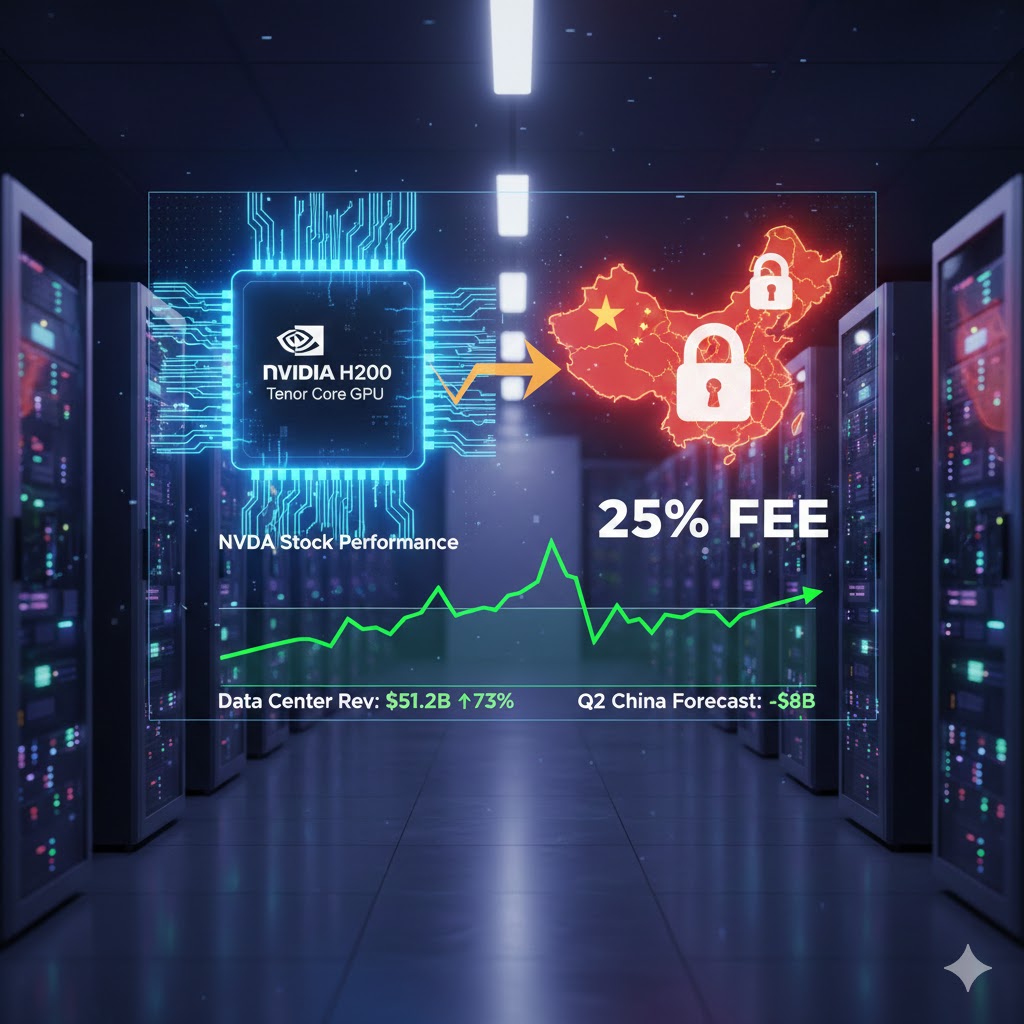
According to sources familiar with the matter, Beijing has signaled that it will only approve the purchase of the H200 under “special circumstances,” such as for use in university research and development laboratories. This subtle but significant policy shift comes just weeks after the Trump administration reportedly authorized the export of these chips to China, albeit with a 25% “revenue-sharing” fee payable to the U.S. government.
For investors monitoring NVDA stock, the news represents a double-edged sword: while the H200 is officially “unbanned” by the U.S., it is now being “soft-blocked” by the very market that accounts for a massive portion of its global demand. This article dives deep into the financial mechanics, product roadmaps, and geopolitical pressures surrounding NVIDIA stock price and its peers as the industry navigates this silicon stalemate.
The Geopolitical Squeeze: Why the H200 Matters
The H200 Tensor Core GPU is the successor to the legendary H100 and represents a quantum leap in AI training and inference capabilities. It is the first GPU to feature HBM3e memory, providing a massive boost in bandwidth and capacity required for the latest Large Language Models (LLMs). For Chinese tech giants like Alibaba (BABA), Tencent (TCEHY), and ByteDance, the H200 is not just a luxury; it is a necessity to remain competitive with Western peers like OpenAI and Google.
However, the NVDA stock narrative is currently being written in the halls of government. Beijing’s recent directive to prioritize domestic alternatives—such as Huawei’s Ascend 910C series—is a clear attempt to foster semiconductor self-reliance. By restricting the H200 to “research use,” China is effectively preventing its commercial giants from building massive clusters that would further cement NVIDIA’s dominance within its borders.
The market reaction has been one of cautious observation. NVDA stock price has historically been sensitive to China-related headlines. In late 2025, when rumors of the H200 export approval first surfaced, NVDA stock surged sharply, climbing from the $170 range to nearly $190 in a matter of weeks. However, the latest restrictions from Beijing have introduced a “policy risk discount” that analysts are now struggling to quantify.
Financial Deep Dive: NVIDIA’s Revenue at Risk
To understand the impact of the H200 restrictions, we must look at the hard data. NVIDIA’s Fiscal Year 2026 has already been a rollercoaster. In its Q1 FY2026 earnings report, the company announced:
- Total Revenue: $44.1 billion (up 69% year-over-year).
- Data Center Revenue: $39.1 billion (up 73% year-over-year).
- Gross Margin: 71.3% (non-GAAP, excluding specific H20 charges).
The sting, however, lay in the China segment. NVIDIA disclosed that it was unable to ship approximately $2.5 billion in revenue during Q1 due to evolving export controls. Furthermore, the company projected a potential loss of $8 billion in revenue for Q2 FY2026 as it navigates the transition from the downgraded H20 chips (which Beijing recently banned for state-funded projects) to the newly permitted H200.
Table 1: NVDA Stock Price Performance & Key Financial Metrics (Est. Jan 2026)
| Metric | Q1 FY2026 (Actual) | Q3 FY2026 (Actual) | Current Status (Jan 14, 2026) |
| NVDA Stock Price | ~$130.87 (Post-Q4) | ~$180 – $200 | $184.86 (as of Jan 9) |
| Data Center Revenue | $39.1 Billion | $51.2 Billion | Growing |
| China Revenue % | ~15-20% (Historical) | Fluctuating | Under Pressure |
| Gross Margin | 61.0% (GAAP) | ~73% (Target) | Stabilizing |
The current NVDA stock price of $184.86 reflects a market that has priced in immense growth in the U.S. and Europe but remains skeptical of the “China recovery.” If the H200 were allowed to flow freely, analysts estimate it could represent a $50 billion annual opportunity. Without it, NVIDIA must rely on its “Blackwell” B200 and the upcoming “Rubin” architecture to maintain its record-breaking momentum elsewhere.
Strategic Countermoves: Upfront Payments and Product Pivots
NVIDIA is not standing still while the superpowers bicker. In a bold financial move reported in January 2026, NVIDIA has reportedly shifted its commercial terms for Chinese clients. The company now mandates full upfront payment for H200 orders, with no options for refunds or cancellations.
This “cash-and-carry” policy serves a vital purpose for NVDA stock stability:
- Risk Transfer: It moves the financial risk of a sudden government ban from NVIDIA’s balance sheet to the Chinese customers.
- Inventory Management: It ensures that every H200 produced has a committed buyer, preventing the $5.5 billion inventory write-down seen in late 2025 when the H20 was abruptly restricted.
- Capital Efficiency: Upfront cash bolsters NVIDIA’s already massive cash reserves, currently estimated to be in the tens of billions, allowing for continued R&D in the Blackwell and Rubin cycles.
Furthermore, NVIDIA is reportedly developing a “China-specific” version of the Blackwell architecture, likely to be dubbed the B20 or B30. However, the lesson from the H200 is clear: even if Washington says “Yes,” Beijing might say “Wait.”
The Domestic Rivalry: Impact on Chinese Tech Stocks
The H200 restrictions do not just affect NVIDIA; they ripple through the entire ecosystem of Chinese tech stocks. Companies like Alibaba (BABA stock) and Baidu (BIDU stock) are in a race to build the most capable LLMs.
If they are restricted to buying domestic chips (like Huawei’s Ascend 910C) while their Western counterparts (OpenAI, Microsoft, Meta) use NVIDIA’s B200 and H200, the “intelligence gap” could widen. This creates a valuation ceiling for BABA stock and BIDU stock, as investors fear their AI services will eventually fall behind in efficiency and performance.
| Stock Code | Company Name | Impact of H200 Restrictions |
| NVDA | NVIDIA Corp. | Revenue volatility; shift to non-China markets. |
| BABA | Alibaba Group | Potential slowdown in cloud AI scaling. |
| AMD | Advanced Micro Devices | Possible beneficiary if MI300 chips face fewer hurdles. |
| SMIC | Semiconductor Mfg. Int’l | Potential “forced” growth as local firms seek domestic alternatives. |
Analysis of the “Blackwell” Buffer
The primary reason NVDA stock has not plummeted on the news of Beijing’s restrictions is the overwhelming demand for the newer Blackwell (B200) architecture in the rest of the world. At the most recent Consumer Electronics Show (CES) in January 2026, CEO Jensen Huang noted that Blackwell demand is “staggering,” with supply already sold out well into late 2026.
For the NVDA stock price to break past its current resistance level and reach the psychological $200 mark, the company needs to demonstrate that its dependency on the Chinese market is diminishing. In 2023, China accounted for nearly 25% of data center revenue; by early 2026, that figure has trended closer to 10-15% as NVIDIA successfully diversifies into “Sovereign AI” projects in the Middle East, Japan, and India.
The Blackwell B200 offers:
- 5x the performance of the H100 in training.
- 30x the performance for LLM inference workloads.
- Significantly lower energy consumption per parameter.
Even if the H200 remains a “special circumstance” item in China, the global appetite for Blackwell serves as a powerful insurance policy for NVDA stock investors.
Technical Outlook: NVDA Stock Price and Market Sentiment
As we look at the chart for NVIDIA stock, the $180 to $185 range has become a critical zone of consolidation.
- Support Level: $170.00 (The “Trump Approval” baseline).
- Resistance Level: $206.88 (The 52-week high reached in November 2025).
If the “special circumstances” for H200 purchases in China turn out to be more flexible than feared—for instance, if large-scale commercial cloud providers like Alibaba and ByteDance are eventually granted “research” status for their massive labs—we could see a scenario where NVDA stock surged sharply once again.
Conversely, if Beijing mandates a strict 1:1 ratio of domestic-to-foreign chip purchases (a policy currently rumored to be under consideration), NVIDIA’s margins in the region could face further compression due to the logistical complexity and potential 25% fee burden.
Conclusion: The Strategic Importance of Staying Ahead
NVIDIA’s story in 2026 is one of managing success amidst chaos. The report from The Information regarding the H200 restrictions is a reminder that in the world of high-tech, politics is just as important as floating-point operations.
For NVDA stock, the path forward is clear: maintain a relentless product cycle. By the time China fully masters the production of H200-equivalent chips, NVIDIA aims to have the “Rubin” architecture—featuring the ultra-fast NVLink 6 and HBM4 memory—already dominating the global market.
The “vague” directives from Beijing are a tactical pause, not a permanent wall. NVIDIA’s financial health, characterized by record-breaking data center revenue ($51.2 billion in the latest quarter) and a dominant 90%+ share of the AI training market, suggests that the company is well-equipped to weather the storm. Investors will be watching the February 2026 Lunar New Year shipment window closely to see if the first batch of H200s actually crosses the border.
The H200 may be a restricted asset in China today, but for NVIDIA stock, the “intelligence revolution” is a global game—and NVIDIA is still the one holding the most powerful pieces on the board.