NVDA Stock Price

Memory and Gold Surge in Tandem: Blockbuster Earnings Ignite Storage Stocks, Gold Prices Soar, and Intel Rallies on Foundry Momentum

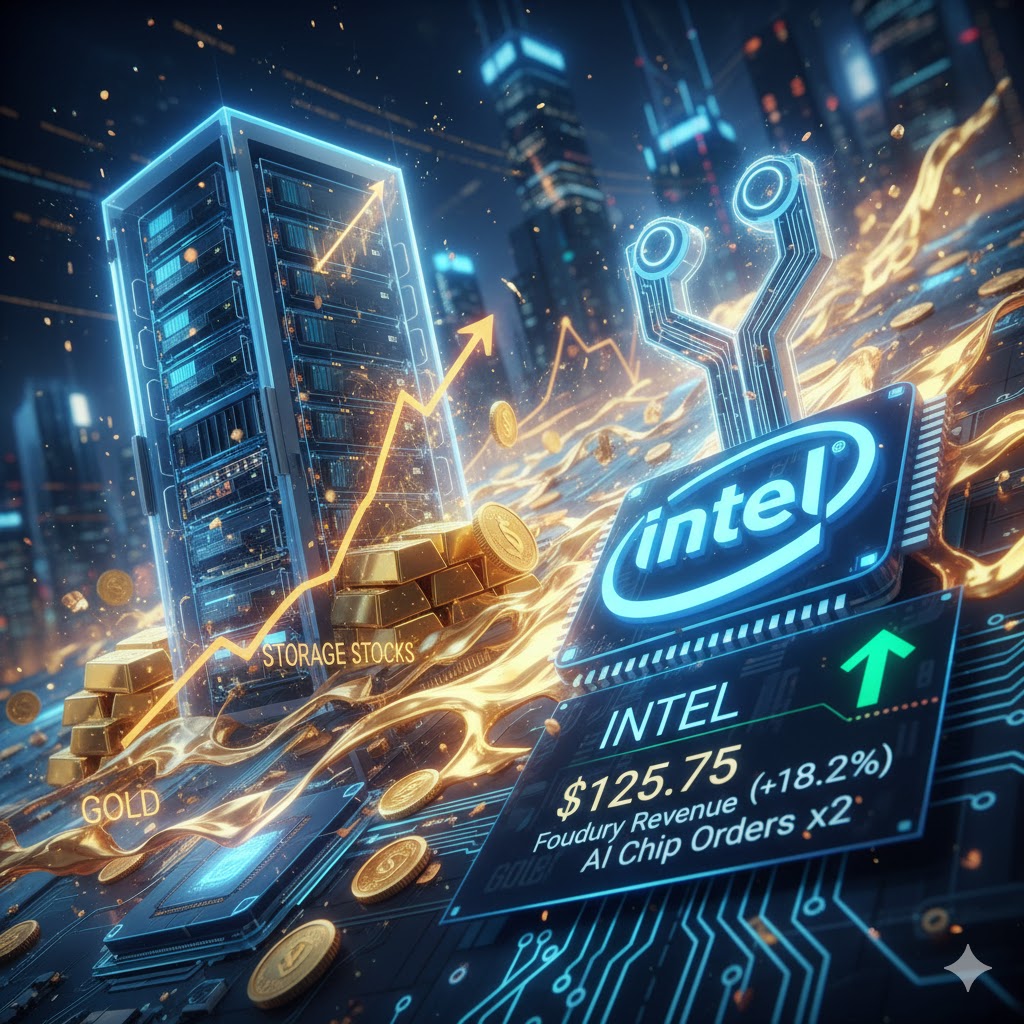
Strong earnings from memory industry leaders once again ignited market enthusiasm overnight, sending related stocks sharply higher. Micron Technology (NASDAQ:MU) rose more than 6%, Seagate Technology (NASDAQ:STX) surged nearly 20%, while Western Digital (NASDAQ:WDC) and SanDisk Corp (NASDAQ:SNDK) climbed about 10% each, all hitting record highs.

Storage giant Seagate Technology delivered a quarterly earnings report that far exceeded Wall Street expectations, with both revenue and profit posting significant growth. The company also reported record-high gross margin and operating margin. According to Seagate’s latest financial results, revenue for fiscal 2026 second quarter reached USD 2.825 billion, up 21.5% from USD 2.325 billion a year earlier. Non-GAAP earnings per share came in at USD 3.11, well above USD 2.03 in the prior-year period. Gross margin improved markedly to 42.2%, compared with 35.5% a year ago.

The company also guided for third-quarter revenue of USD 2.9 billion (plus or minus USD 100 million), above analysts’ expectations of USD 2.77 billion. Adjusted earnings per share are forecast at USD 3.40 (plus or minus USD 0.20), also exceeding the market consensus of USD 2.96. Seagate Chairman and CEO Dave Mosley said the company’s areal-density-driven product roadmap enables it to meet modern data centers’ demand for exabyte-scale storage solutions that combine performance and cost efficiency. As artificial intelligence applications expand data creation and economic value, this positioning is expected to generate long-term value for customers and shareholders.

SK hynix also reported its strongest quarterly performance in history, with fourth-quarter operating profit more than doubling year over year to KRW 19.2 trillion (USD 13.5 billion), beating the average analyst estimate of KRW 16.7 trillion. Revenue climbed to KRW 32.8 trillion. As a major supplier of high-bandwidth memory (HBM) for NVIDIA’s AI accelerators, SK hynix shares have roughly tripled since early September, with valuation expansion leading Asian technology stocks. The company also disclosed plans to cancel approximately USD 8.6 billion worth of treasury shares next month as part of efforts to enhance shareholder returns. It reiterated that it is considering a U.S. listing, though no decision has yet been made.

Previously, Sassine Ghazi, CEO of Synopsys, the global leader in EDA and semiconductor IP, said in an interview that the chip “shortage” would persist through 2026 and 2027. Ghazi noted that most of the world’s top manufacturers’ memory chips are currently flowing directly into AI infrastructure, while many other products also require memory, leaving those markets constrained by insufficient capacity. He added that Samsung Electronics, SK hynix, and Micron Technology (NASDAQ:MU), the world’s largest memory companies, are working to expand production, but achieving their capacity expansion goals will take at least two years—one of the key reasons the shortage is expected to persist.

“Right now is a golden period for memory companies,” Ghazi said, adding that rising memory prices mean consumer electronics companies may have to consider raising prices—a trend that is “already happening.”

Spot gold climbed close to USD 5,600 per ounce overnight, sending gold stocks broadly higher. Newmont (NYSE:NEM) rose nearly 4%, Agnico Eagle Mines (NYSE:AEM) gained more than 3%, Gold Fields (NYSE:GFI) jumped nearly 9%, and Harmony Gold (NYSE:HMY) surged over 7%, all reaching record highs.

Gold has already surged nearly 30% year to date on top of last year’s record rally, supported by rising geopolitical and economic uncertainty, expectations of U.S. rate cuts, and increased central bank purchases amid global de-dollarization trends. Citi sees gold potentially reaching USD 6,000 per ounce under a bull-case scenario, while Société Générale also forecasts prices at USD 6,000 per ounce this year, up from its December projection of USD 5,000.

Agnico Eagle Mines CEO Ammar Al-Joundi previously said: “No one knows how high gold prices could go next week or next month. The fundamental drivers behind gold’s rise are still there—government spending, plus the catalyst we experienced a few years ago when the Russia-Ukraine conflict broke out and Russia was removed from the SWIFT system.”

“And now there’s a new catalyst: the orderly world we live in seems to be becoming less orderly, which clearly has implications for currency markets—and gold plays a role in that,” he added. Al-Joundi noted that central banks in countries such as China are rethinking their allocations to U.S. Treasuries and increasing gold purchases. “With annual gold supply growth being minimal and new mines taking at least ten years to develop, he expects supply to remain tight. You won’t see a flood of gold entering the market,” he said.

Many analysts have attributed the unprecedented rally in gold and silver at the start of the new year partly to rising uncertainty surrounding the Federal Reserve’s political independence; however, Fed Chair Jerome Powell dismissed such concerns at his monetary policy press conference.

“It’s been said that we’re losing credibility, but that’s simply not the case. If you look at where inflation expectations are, our credibility is right where it should be,” Powell said. “We won’t get ‘overexcited’ about price movements in any particular asset, though we do monitor them.”

While the Fed’s neutral stance could pose a potential headwind for gold, many analysts do not see it as a major obstacle. Nitesh Shah, Head of Commodities and Macroeconomic Research at WisdomTree, told Kitco News that although Powell is comfortable keeping rates unchanged in the coming months, markets are already looking beyond May, when Powell may be replaced. “It’s quite possible that Powell will be succeeded by someone more inclined toward rate cuts,” Shah said. “That’s what gold is focused on.”

Powell also offered a measured view on geopolitical risks, noting that while uncertainty remains, oil prices have stayed relatively stable and the U.S. economy has withstood global trade volatility. Analysts pointed out that geopolitical uncertainty is another key driver behind gold’s sharp rise so far this month.

Amid multiple positive catalysts, Intel (NASDAQ:INTC) surged more than 11% overnight.

Following Apple (NASDAQ:AAPL), NVIDIA (NASDAQ:NVDA) is also planning to shift part of its chip manufacturing to Intel’s foundry business. NVIDIA is expected to collaborate with Intel on its Feynman architecture platform slated for launch in 2028.

According to a Wednesday report by DIGITIMES, supply chain sources revealed that NVIDIA will adopt a strategy of “small volume, lower-tier, non-core” cooperation with Intel. The GPU core chips will continue to be manufactured by TSMC (NYSE:TSM), while some I/O chips will use Intel’s 18A or its planned 14A process, which is scheduled for mass production in 2028, with final advanced packaging handled by Intel’s EMIB technology. Based on the proportion of advanced packaging, Intel could account for up to 25%, with TSMC taking about 75%.

After NVIDIA announced a USD 5 billion investment in Intel in September 2025, the latest plan involves collaboration with Intel on the Feynman architecture chips, the successor to the Rubin series. Supply chain sources said that under the Trump administration’s push for U.S. manufacturing and tariff pressures, major U.S. chipmakers had long discussed cooperation with Intel. However, as the 18A process did not meet customer expectations, the collaboration timeline is more likely to align with the 14A process reaching mass production in 2028. Intel CEO Lip-Bu Tan recently stated that two customers are currently evaluating the specifics of the 14A process.

In addition, according to SEC filings, Intel CFO David Zinsner purchased USD 249,985 worth of Intel shares at USD 42.5 per share on January 26, marking the first insider purchase since 2024.

One Year into Trump’s Return: S&P 500 Gains Nearly 16%. Amidst a Midterm Election Year, How Should Investors Hedge and Position Themselves?

A 16% rise in one year—this is the gain recorded by the S&P 500 Index (.SPX) during Donald Trump’s first year back in the Oval Office.

However, behind this seemingly stellar figure lies a “rollercoaster” journey for Wall Street, characterized by sharp corrections intertwined with historic highs. This past year has proven one thing to investors: even in the face of sweeping policy shifts, the market possesses a powerful ability to digest change. But as we enter a volatile 2026, the market’s resilience will face even sterner tests.

As the “Trump 2.0” era enters a Midterm Election year, what should investors watch for? Which sectors are poised to benefit? This article provides an in-depth breakdown.

A Bull Market Amidst Turmoil: The Quality of the 16% Gain

Since Donald Trump was sworn in as the 47th President of the United States on January 20, 2025, the U.S. stock market has demonstrated remarkable pressure resistance. Although Trump announced his “Liberation Day” tariff policies on April 2, triggering market tremors, investors were quick to adopt a “buy the dip” strategy. This pattern, dubbed “The TACO Trade” by some market participants, reflects a new consensus: the administration’s aggressive policy proclamations may not necessarily translate into lasting market damage.

From a historical perspective, a 16% gain is impressive, outperforming the historical median of 9% for a president’s first year since 1929. However, it is not the “strongest in history.” In comparison, the S&P 500 rose 16.4% during President Biden’s first year, while Trump’s own first term in 2017 saw a surge of 23.7%.

For those who originally expected Trump’s second term to be “extremely bullish” for the markets, this year has been full of challenges.

Chris Maxey, Managing Director and Chief Market Strategist at Wealthspire Advisors, described it this way: “The first year of Trump’s return has seen news coming at us like water from a firehose.” He noted that the most important lesson investors have learned over the past year is to “stay patient.” Overinterpreting political headlines often leads to portfolio errors rather than gains.

There were widespread fears that Trump’s volatile tariff policies would ignite a global trade war, reignite inflation, or push the economy into recession. To date, these worst-case scenarios have not materialized. While some tariff policies still await a final ruling from the Supreme Court, the S&P 500 has set 42 record closing highs since last January, while the Dow Jones and Nasdaq have refreshed their records 23 and 36 times, respectively.


2026 Outlook: The Shadows of Midterm Elections and Geopolitics

As the calendar turns to 2026, investors may find it difficult to maintain their high levels of optimism. The market is entering a “Midterm Election Year,” which is traditionally the weakest performing year of a presidential term. Historical data shows that since 1948, the S&P 500 has averaged a gain of only 4.6% in the second year of a presidency.

Adding to the concern, the start of 2026 has been anything but peaceful. In the first half of January alone, the market faced a series of geopolitical and policy shocks:

  • Venezuela Turmoil: U.S. military action led to the arrest of Venezuelan leader Nicolás Maduro.
  • Greenland Controversy: Trump reiterated threats to take over or purchase Greenland.
  • U.S.-Iran Tensions: Relations between the two nations have tightened once again.
  • Federal Reserve Crisis: A criminal investigation targeting current Fed Chair Jerome Powell has raised serious concerns regarding central bank independence.

Particularly noteworthy are Trump’s actions last week, which dominated investment circles—specifically regarding tariff policies and the selection of the next Fed Chair.

  • Tariff Policies: According to CCTV reports, on Saturday (Jan 17), President Trump announced that effective February 1, 2026, a 10% tariff will be imposed on all goods exported to the U.S. from Denmark, Norway, Sweden, France, Germany, the UK, the Netherlands, and Finland. Effective June 1, 2026, this rate will increase to 25%. The stated reason for these tariffs is the opposition of these nations to U.S. control of Greenland, further escalating the dispute over the island’s future.
  • Fed Chair Uncertainty: Trump hinted last Friday that Kevin Hassett might not become the new Fed Chair, following Hassett’s repeated calls for the Fed to cut interest rates aggressively. As Hassett likely remains Director of the National Economic Council (NEC), the race has essentially narrowed to a “three-way battle”: BlackRock’s Rick Rieder vs. former Fed Governor Kevin Warsh and current Governor Christopher Waller. The latter two possess extensive central banking experience and represent more traditional choices compared to Rieder’s market-oriented background.

Soochow Securities suggests that in 2026, Trump will exhaust all available political resources—including trade policy under White House authority, fiscal policy under Congressional power, and monetary policy via the Fed—to prepare for the final “exam” of his political career: the Midterm Elections.

Trump’s strategy for the midterms consists of three complementary pillars that form the primary trading theme for 2026:

  1. Trade Policy: Trump may escalate tariff conflicts to divert domestic tension, gain votes, pressure the Fed to cut rates, and generate fiscal revenue.
  2. Monetary Policy: A new Fed Chair is expected to take office in May 2026. Markets anticipate “oversized” rate cuts that exceed economic necessity. This “Fed Put” is expected to replace “TACO” as a hedge against tariff shocks, with loose monetary policy boosting the economy and stocks.
  3. Fiscal Policy: Rate cuts and tariffs will provide funding for fiscal expansion. In the second half of 2026, Trump is expected to introduce broad fiscal policies to build momentum for the midterms.

For capital markets, these three policies will weave a combination of recurring tariffs and “double easing” (fiscal and monetary). This may shift the U.S. economy from a soft landing back into expansion, but it also carries significant upside risks for inflation in late 2026 and beyond.

Market Implications:

  • Tariff Volatility: Risk appetite will likely follow a mean-reversion, “sell high, buy low” strategy.
  • Double Easing: Global equities, commodities, and other risk assets will benefit from the dual tailwinds of liquidity and fundamentals on an annual basis.
  • Fed Leadership Change: Excessive rate cuts may lead to lower U.S. interest rates and weakened credit, favoring Gold while putting downward pressure on the US Dollar Index and 2-year Treasury yields. Combined with fiscal expansion, the 10-year Treasury yield is expected to remain volatile.

Which Opportunities Deserve Close Attention in the Trump Era?

Since taking office, Trump’s every word and action has deeply influenced the U.S. market. Insight into and alignment with government investment logic is not just about capturing opportunities—it is a necessary strategy for risk mitigation.

Market consensus suggests that the following four sectors—Resources, Power/Energy, Space Exploration, and Semiconductors—are most likely to benefit from the “Trump 2.0” era.

Specific Companies to Watch:

  • Semiconductors: Nvidia (NVDA), Broadcom (AVGO), AMD (AMD), Micron (MU).
  • Rare Earths: MP Materials (MP), TMC the metals (TMC), USA Rare Earth (USAR), Critical Metals (CRML).
  • Lithium: Rio Tinto (RIO), SQM (SQM), Albemarle (ALB), Lithium Americas (LAC).
  • Uranium: Cameco (CCJ), Uranium Energy (UEC), Centrus Energy (LEU), Energy Fuels (UUUU).
  • Copper: Southern Copper (SCCO), Freeport-McMoRan (FCX).
  • Graphite: NOVONIX (NVX), Nouveau Monde Graphite (NMG), Westwater Resources (WWR).
  • Antimony/Beryllium: Nova Minerals (NVA), United States Antimony (UAMY), Materion (MTRN).
  • Space Exploration: Rocket Lab (RKLB), AST SpaceMobile (ASTS), EchoStar (SATS.US), GE Aerospace (GE), RTX Corp (RTX), Boeing (BA), Lockheed Martin (LMT).
  • Nuclear Power: Oklo Inc (OKLO), BWX Technologies (BWXT), NuScale Power (SMR), NANO Nuclear Energy (NNE).
  • Batteries/Storage: Tesla (TSLA), Bloom Energy (BE), QuantumScape (QS), Eos Energy (EOSE).
  • Grid & Storage: GE Vernova (GEV), Vistra Energy (VST.), AES Corp (AES), Fluence Energy (FLNC).

Additionally, Morgan Stanley released a “National Security Index” focusing on four key areas: Rare Earths & Strategic Metals, Batteries & Energy Storage, Lithium, and Nuclear & Uranium. These companies are the core drivers of the currently trending “Trump Trade.”