In the highly fragmented landscape of value-based apparel retail, few names carry as much cultural weight in urban communities as Citi Trends, Inc. (NASDAQ: CTRN). On December 2, 2025, the company released its Citi Trends Financial Report for the third quarter of fiscal year 2025, a document that served as a defining proof point for the brand’s multi-year “Repair, Execute, and Optimize” strategic framework. Amidst a broader retail environment characterized by cautious discretionary spending, the Q3 results provided a vivid snapshot of a retailer that is successfully leaning into its niche. For investors tracking CTRN stock, the quarter was marked by a significant revenue “beat” that sent the stock surging in pre-market trading, yet it also revealed the complexities of a business still fine-tuning its profitability engine.
The Statistical Pivot: Analyzing the $197 Million Revenue Breakthrough
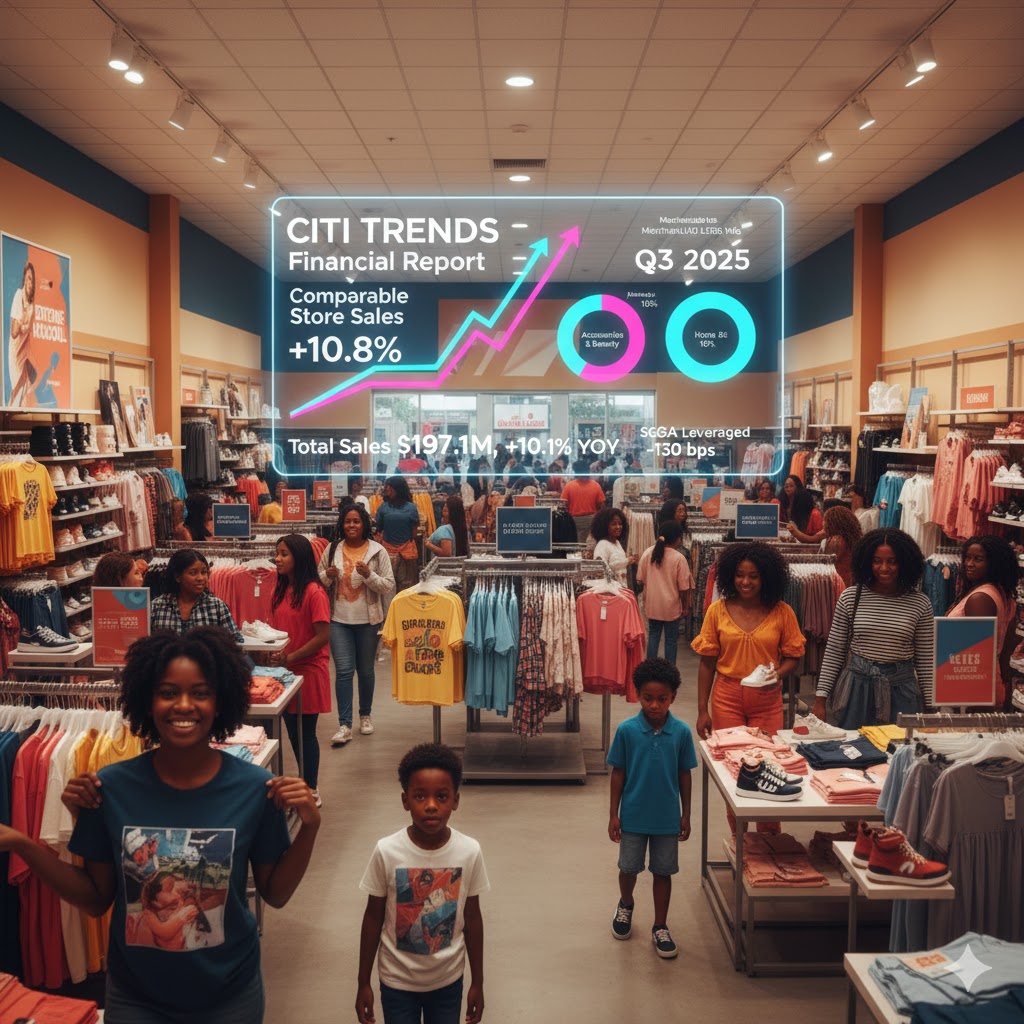
The data presented in the Citi Trends Earnings call for the period ended November 1, 2025, was defined by an impressive top-line acceleration. The company reported total sales of $197.1 million, a 10.1% increase compared to the $179.1 million recorded in the third quarter of 2024. This figure not only surpassed the company’s internal targets but also beat the analyst consensus of $187.3 million by a wide margin. To appreciate the magnitude of this growth, one must look at the comparable store sales (comp sales), which grew by 10.8%—marking the fifth consecutive quarter of positive comp performance.
This revenue surge was driven by a triad of operational improvements: increased foot traffic, larger average basket sizes, and higher conversion rates. Management attributed this “trifecta” of success to a refined three-tiered merchandise assortment strategy. By balancing high-trend fashion, opportunistic off-price deals, and “extreme value” branded products, Citi Trends has successfully captured a larger share of the wallet from its core demographic—African American families living in urban and secondary markets. The back-to-school season was particularly robust, with the Children’s and Men’s divisions leading the charge.
On the profitability front, however, the results were more nuanced. The company reported a net loss of $6.9 million, or a basic loss per share of $0.86. While this was a slight improvement over the $7.2 million loss in the prior year, it missed the consensus estimate of a $0.79 loss per share. The discrepancy between the revenue beat and the EPS miss was primarily due to a 90-basis-point contraction in gross margin, which landed at 38.9%. This decline was largely a result of the “pull-forward” of freight expenses from the fourth quarter—a strategic move to balance the workload at distribution centers ahead of the high-stakes holiday season.
The Efficiency Engine: SG&A Leverage and the $82 Million Projection
A critical component of the Citi Trends Financial Report was the company’s ability to achieve operating leverage even while growing its cost base. Selling, General, and Administrative (SG&A) expenses for the quarter were $79.3 million, up from $74.7 million in the previous year. However, on a rate basis, adjusted SG&A expenses leveraged by 130 basis points. This means that for every dollar of revenue generated, Citi Trends is becoming more efficient at managing its overhead.
The increase in absolute SG&A spend was largely due to two factors: the costs associated with processing a significantly higher volume of sales and $3.2 million in incremental incentive compensation—a direct result of the company’s improved financial trajectory. For investors in CTRN stock, this is a “good” type of expense growth, as it indicates that the company is rewarding its leadership team for meeting aggressive performance targets.
Looking ahead to the fourth quarter, management has projected SG&A expenses to be approximately $82 million. This increase reflects the peak hiring and marketing spend associated with the holiday season. The goal for 2026 is to continue this leveraging trend, with a target of 60 to 90 basis points of annual SG&A improvement as the company approaches its goal of mid-to-high single-digit operating margins.
Strategic Real Estate: Remodels and the “Store of the Future”
A major pillar of the Citi Trends Earnings story is the aggressive modernization of its physical footprint. During the third quarter, the company remodeled 24 stores and opened 3 new locations, ending the period with a total of 593 stores. These remodels are not merely cosmetic; they are designed to optimize the flow of traffic and highlight the “extreme value” and “branded” categories that are currently driving the highest margins.
The data suggests that remodeled stores are consistently outperforming the rest of the chain in terms of sales density and customer satisfaction scores. For fiscal year 2025, the company is on track to remodel a total of 60 stores. This “store-within-a-store” strategy—where specific zones are dedicated to accessories, beauty, and home lifestyle—has allowed Citi Trends to diversify its revenue streams. In Q3, Accessories & Beauty accounted for 15% of total sales, while Home & Lifestyle reached 10%. By reducing the reliance on pure apparel, Citi Trends is building a more resilient, year-round business model.
Inventory management also remained a bright spot. Merchandise inventory at the end of the quarter was $123.5 million, a 3.1% decrease compared to Q3 2024. Despite the lower overall inventory levels, average store inventory was actually up 4.5%, reflecting a faster supply chain and a more strategic “in-season” buying approach. This improved inventory turnover is a key driver of the 230-basis-point gross margin expansion forecast for the full year 2025.
Financial Health: The $51 Million Cash Fortress
One of the most compelling aspects for anyone analyzing CTRN stock is the company’s pristine balance sheet. Citi Trends ended the third quarter with $51.1 million in cash and cash equivalents, and notably, zero debt. The company has a $75 million credit facility that remains entirely untapped. In an era where high interest rates have crippled many small-cap retailers with heavy debt loads, Citi Trends’ “debt-free” status provides it with an enormous competitive advantage and significant strategic flexibility.
This liquidity allowed the company to raise its full-year EBITDA guidance to a range of $10 million to $12 million. This represents a staggering $21 million to $25 million improvement compared to the full year 2024. For a company with a market capitalization of approximately $400 million, this swing in EBITDA is a powerful indicator of the “turnaround” narrative taking hold.
Outlook and CTRN Stock Price Prospective
As of January 12, 2026, the CTRN stock price is trading at approximately $48.43 on the NASDAQ. The stock has been on a remarkable tear over the past few months, rising from a 52-week low of $16.82 to its current levels, which are near its 52-week high of $49.50. The market’s reaction to the December 2nd report was overwhelmingly positive; while the EPS was a slight miss, the 10.8% comp sales growth and the raised full-year guidance were seen as clear evidence that the company is winning market share.
From a valuation perspective, CTRN stock is currently trading at a Price-to-Sales (P/S) ratio of approximately 0.49x. While this is a step up from the distressed levels of 2024, it still represents a significant discount compared to other off-price retailers like TJX Companies or Ross Stores, which often trade at P/S ratios of 1.5x to 2.0x. This “valuation gap” suggests that if Citi Trends can demonstrate a consistent return to GAAP profitability in 2026, there is still substantial room for the stock to re-rate higher.
Technically, the stock is in a confirmed bull market. It is trading well above its 50-day and 200-day moving averages. The immediate resistance level is at the $50.00 psychological mark. A break above $50.00 could open the door for a move toward the $60.00 range, especially if the Q4 holiday results—which the company will report in March—show continued comp sales momentum. However, investors should remain mindful of the “choppy” nature of profitability; the stock has a high beta and can be sensitive to broader economic data regarding consumer credit and employment in urban centers.
Conclusion: The Polished Urban Powerhouse
The December 2nd Citi Trends Financial Report marks a turning point for the Savannah-based retailer. By focusing on its core multicultural customer base and executing a disciplined real estate and merchandise strategy, Citi Trends has transformed from a struggling survivor into a high-growth urban powerhouse. While the road to absolute GAAP profitability still has some hurdles—particularly regarding margin stabilization—the underlying trajectory of the business is undeniably positive.
For investors, CTRN stock represents a high-conviction play on the resilience of the value-conscious consumer. With a debt-free balance sheet, a $10 million+ EBITDA run rate, and a “store of the future” that is clearly resonating with shoppers, Citi Trends is well-positioned to continue its ascent in 2026. The “urban value surge” is no longer just a headline; it is a fundamental reality for this uniquely positioned retailer.