The U.S. energy sector, which has surged strongly over the past few months, climbed to a record high on Wednesday as rising geopolitical uncertainty prompted investors to bet on higher oil prices. The S&P 500 Energy Index rose 2.4% to close at 750.17, making it the best-performing sector in the S&P 500. Shares of major oil producers rose alongside WTI crude prices as tensions between the U.S. and Europe over the Greenland issue fueled market uncertainty.
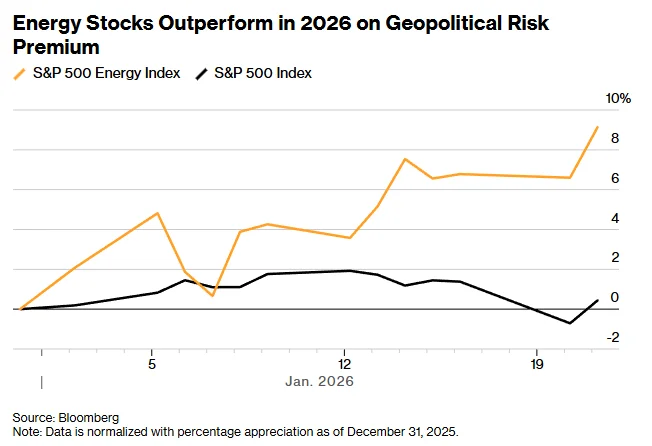
Energy Stocks Outperform in 2026 Due to Geopolitical Risk Premiums
“Geopolitical pressures involving Venezuela, Ukraine, and Greenland are maintaining a modest risk premium for oil prices,” said Vincent Piazza, an analyst at Bloomberg Intelligence. “In this context, $60 per barrel for WTI crude remains a critical threshold.”
At the same time, natural gas companies such as EQT Corporation (EQT), Expand Energy (EXE), and Coterra Energy (CTRA) stood out this week due to an expected Arctic blast covering two-thirds of North America starting this week and continuing into the next. Piazza noted, “Despite rising natural gas production, cold weather across the eastern half of the U.S. should boost domestic sentiment, while freezing temperatures in Europe will support seaborne gas benchmarks.”
Oil and gas stocks have been on a steady upward trajectory since last April, gradually recovering from the “tariff shock” triggered by Donald Trump that month. However, this rally accelerated significantly in early December when the U.S. increased pressure on Venezuela and Russia. Subsequently, at the start of 2026, Trump’s pledge to revitalize the Venezuelan energy industry—following the forceful apprehension of President Nicolás Maduro—further drove shares of major oil producers higher.
The recent strength in energy stocks marks a sharp reversal for the sector. In 2025, the index rose only 5%, significantly lagging behind the S&P 500’s 16% gain, as the sector struggled to recover from tariff-related headwinds. In the week following Trump’s announcement of massive tariffs on trading partners in early April last year, the sector plummeted 20%. It was not until January 5 of this year, following U.S. intervention in Venezuela, that the energy benchmark finally returned to the levels seen before the April tariffs.
Due to the widening geopolitical risk premium, Wall Street institutions have turned more positive on the outlook for oil. Citigroup recently raised its short-term benchmark forecast for Brent crude to $70 per barrel. However, the biggest cloud hanging over the industry remains the looming risk of a supply glut, which could put downward pressure on crude prices.
Support for oil prices also came from the International Energy Agency (IEA), which upwardly revised its oil demand forecast for 2026. WTI crude prices rose as much as 2.1% on Wednesday before paring gains after Trump reiterated his desire to control Greenland but stated he did not intend to use military force. As of press time, WTI crude was down 0.23% at $60.54 per barrel.
Barclays analyst Betty Jiang noted that while cash returns from upstream oil companies remain solid despite recent macroeconomic volatility, they still face risks. “The oil market backdrop has become more complex due to a rising—and potentially unsustainable—geopolitical risk premium,” Jiang said.