The global capital markets witnessed a localized explosion of volatility and growth on Monday, January 12, 2026, as the intersection of blockchain infrastructure and artificial intelligence reached a new fever pitch. Investors tracking the IREN stock price and the broader Cipher Mining stock performance saw what many are calling a “Great Decoupling”—where these firms are no longer valued merely on the price of digital assets, but on their strategic possession of power-connected land and high-performance computing (HPC) capacity.
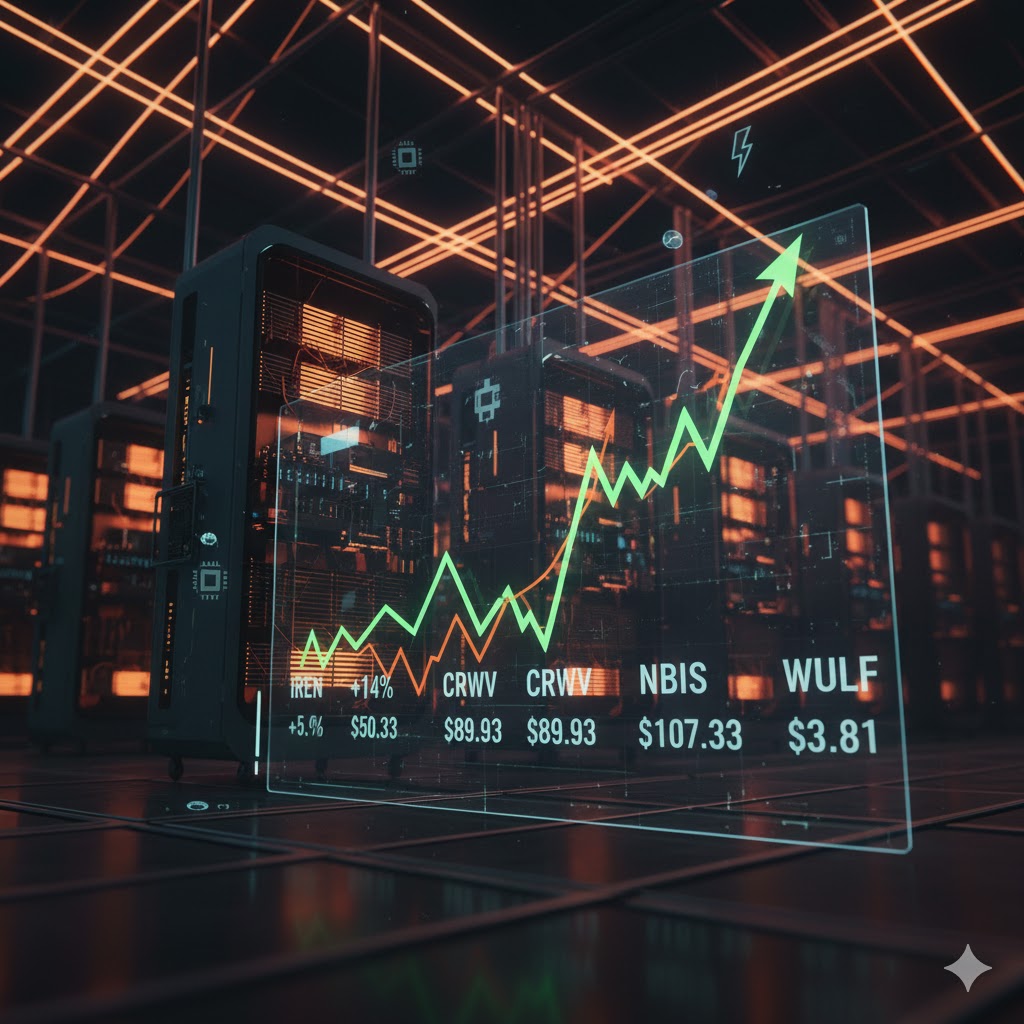
The session was defined by staggering gains. IREN limited stock led the pack with a massive jump of over 11%, followed closely by the “Neocloud” frontrunners: CoreWeave stock skyward by 14% and Nebius stock surging 10%. Established infrastructure plays like TeraWulf stock and Cipher Mining stock also posted gains exceeding 5%, as the market re-evaluated the sheer scarcity of grid-connected, industrial-grade power in a world starved for AI compute.
IREN Limited: The $9.7 Billion Catalyst Redefining the Horizon
The primary engine behind the recent IREN stock surge is a transformation that has essentially turned a high-efficiency miner into a Tier-3 equivalent hyperscale partner. When IREN Limited (IREN) released its fiscal first quarter 2026 results, the figures were nothing short of historic. The company reported record revenue of $240.3 million, a 355% increase compared to the previous year. While the core of this revenue still flows from its high-uptime Bitcoin mining operations, the real value driver—and the reason for the IREN stock price trajectory—is the landmark $9.7 billion AI cloud contract inked with Microsoft.
This contract isn’t just a pilot; it’s a phased deployment that is expected to generate an average annualized recurring revenue (ARR) of $1.94 billion. To support this, IREN is accelerating the construction of its “Horizon” 1-4 data centers at the Childress site, adding 200MW of critical IT load designed specifically for liquid-cooled high-performance training clusters. The company’s vertically integrated model, where it owns the land, the power systems, and the data center architecture, allows it to bypass the typical supply chain delays plaguing traditional cloud providers.
Financially, the company has bolstered its position to fund this multi-billion dollar buildout. IREN reported a record net income of $384.6 million for the quarter, largely aided by unrealized gains on financial instruments and a disciplined approach to GPU financing. With over $1.8 billion in cash and cash equivalents, the company is aggressively targeting an AI Cloud ARR of $3.4 billion by the end of calendar year 2026. For investors, the IREN stock story is now a race for capacity: can they deploy their planned 140,000 GPUs fast enough to satisfy the “insatiable” demand of their hyperscale partners?
TeraWulf Inc.: The Zero-Carbon Power Play Capturing Google’s Gaze
TeraWulf (WULF) has long marketed itself as the “ESG-friendly” miner, but in 2026, that environmental focus has become a critical strategic advantage rather than just a branding exercise. On Monday, TeraWulf stock rose over 5% to reach a price of $13.79, as investors focused on the company’s ability to secure large-scale, zero-carbon power in a regulatory environment that is increasingly hostile to carbon-heavy data centers.
The centerpiece of the TeraWulf stock price rally is the massive expansion at the Lake Mariner facility in New York. Following a regulatory win that cleared the site for increased industrial use, TeraWulf secured $1.3 billion in financing to accelerate its “Abernathy” AI data center project. A significant portion of this momentum stems from a strategic partnership with Google, which has reportedly provided an $1.8 billion lease backstop and taken a 14% equity stake in the firm.
From an operational standpoint, TeraWulf is currently building out its “CB-5” building, which will add 160 MW of critical IT load dedicated to AI and HPC hosting. This move is part of a broader plan to pivot away from pure-play Bitcoin mining, with management projecting that existing leases will drive a 505% annual EBITDA growth through 2027. While the company still faces deep accounting losses due to heavy upfront CapEx, the market is increasingly valuing TeraWulf stock based on its 2.6 GW development pipeline. In the current energy-starved market, a grid-connected site with an existing substation is a “gold mine” that warrants a premium multiple.
Cipher Mining: Operational Precision and the Black Pearl Vanguard
Cipher Mining (CIFR) has earned a reputation for being the “surgical” player in the sector, focusing on best-in-class unit economics and lean operations. This discipline was rewarded on January 12 as Cipher Mining stock moved up over 5%. The current Cipher Mining stock price of approximately $16.63 reflects a company that is successfully transitioning into its second major growth phase: the “Black Pearl” era.
In its recent business updates, Cipher confirmed that the Black Pearl facility has reached full operational capacity, pushing the company’s self-mining hashrate to a staggering 23.6 EH/s. However, the focus of the Cipher Mining Financial Report has shifted toward the “Stingray” expansion—a 100MW site scheduled for energization in the third quarter of 2026. This site is being designed from day one to be “compute-neutral,” meaning it can toggle between Bitcoin mining and AI hosting based on which offers the highest yield per megawatt.
Financially, Cipher is one of the few miners showing a path to consistent positive cash flow from operations. By maintaining a cost of production well below industry averages, the company has been able to self-fund much of its expansion. Its recent acquisition of a 200 MW site in Ohio further extends its development runway. For those tracking Cipher Mining stock, the key metric for 2026 will be the company’s ability to monetize its 2.5 GW pipeline by securing a Tier-1 hyperscale hosting tenant, similar to the deals seen by IREN and CoreWeave.
CoreWeave: The Specialized Neocloud Titan Surging Toward Dominance
The term “Neocloud” has become synonymous with CoreWeave (CRWV), the specialized GPU provider that saw its stock soar 14% to approximately $80.14 in Monday’s trading. CoreWeave is no longer just an alternative to AWS or Azure; for many AI labs, it is the primary choice due to its “bare-metal” GPU performance and its priority access to NVIDIA’s latest Blackwell architecture.
The CoreWeave stock surge is backed by a financial profile that is almost unprecedented for a mid-market infrastructure firm. The company entered 2026 with a $55.6 billion revenue backlog, a figure that grew by 271% year-over-year. This backlog is fueled by multi-year, multi-billion dollar contracts with the likes of Meta Platforms and OpenAI. Management has signaled that it intends to double its capital expenditure in 2026 compared to 2025, aiming to bring more data center capacity online to meet a demand that currently “far exceeds available capacity.”
For investors, the CoreWeave stock price is a pure play on the scale of the AI training market. With access to 2.9 gigawatts of power, CoreWeave is in a league of its own regarding infrastructure scale. Analysts anticipate the company could reach an annual revenue run rate of $12 billion to $13 billion by the end of 2026. While the company is currently free-cash-flow negative due to its aggressive buildout, its EBITDA margins have stabilized above 60%, suggesting that once the initial CapEx mountain is climbed, the business will be an incredibly high-margin cash machine.
Nebius Group: From European Search Roots to Global AI Infrastructure
Nebius (NBIS), the other half of the “Neocloud” power duo, surged 10% on Monday, with the Nebius stock price hovering around $97.93. The company has undergone a total metamorphosis, shedding its legacy search engine assets to become a focused AI cloud provider with deep roots in Europe and a growing footprint in the United States.
The bull case for Nebius stock centers on its ambitious 2026 targets. The company is aiming for an Annualized Run Rate (ARR) of $7 billion to $9 billion by the end of 2026, a massive jump from its sub-$1 billion status just a year prior. To achieve this, Nebius is deploying the NVIDIA “Vera Rubin” NVL72 platform—among the first globally to do so—and is targeting 2.5 gigawatts of contracted power by the end of next year.
Nebius distinguishes itself through its “full-stack” approach. It doesn’t just rent out GPUs; it provides an integrated software environment validated against NVIDIA reference architectures, allowing AI researchers to deploy complex models “out of the box.” This software layer allows Nebius stock to command a higher multiple than pure-play hardware lessors. With a 217% gain over the past year, the stock is a high-beta favorite for investors who believe that the future of the cloud is not general-purpose, but specifically tailored for the “agentic AI” era.
Conclusion: The Infrastructure Supercycle of 2026
The collective movement of IREN stock, TeraWulf stock, and the Neocloud giants marks the beginning of a multi-year infrastructure supercycle. We are moving out of the “experimental” phase of AI and into the “deployment” phase, where the limiting factor is no longer code, but the physical world: power, land, and cooling.
As the IREN stock price and Nebius stock price continue to lead the market, the narrative for 2026 is clear. The winners will be the companies that can bridge the gap between digital assets and physical infrastructure. Whether through IREN’s massive Microsoft partnership or TeraWulf’s zero-carbon New York expansion, these firms are building the factories of the 21st century. While the capital requirements are staggering and the execution risks are real, the $55 billion backlog at CoreWeave serves as a clear signal that the world is ready to pay for the compute these “miners turned titans” provide.