In a year defined by ambitious public offerings and technological milestones, BETA Technologies, Inc. (NYSE: BETA) — a vertically integrated electric aircraft developer — released its third quarter 2025 financial results on December 4, 2025, marking the company’s first quarterly earnings report since going public. The BETA Financial Report reveals a company at a pivotal transitional phase: from private‑funded engineering and prototyping toward scaled operations and commercial aircraft deliveries. Investors tracking BETA stock price behavior and BETA Technologies Earnings will find this report richly detailed with financial analysis, customer and revenue trends, cost structures, operating performance, product development dynamics, strategic collaborations, and market positioning.
While electric aviation remains early‑stage, BETA’s results — even if marked by net losses — provide insight into how the business is evolving beyond prototypes into revenue‑generating commercial and defense applications. Understanding the financial and operational complexity beneath the surface is critical for gauging how the company’s strategy may unlock future opportunities in electric vertical take‑off and landing (eVTOL) and electric conventional takeoff and landing (eCTOL) aircraft markets.
This analysis explores the detailed components of the earnings — including revenue drivers and cost behavior — and illuminates how product strategy and market development initiatives are shaping BETA’s business direction. It also delves into risk factors, capital allocation, structural changes after its IPO, and how these dimensions feed into expectations for the BETA stock price over the coming quarters.
I. Context: BETA Technologies and Its Business Model
BETA Technologies was founded in 2017 in Burlington, Vermont, by aerospace entrepreneur Kyle Clark. The company designs, develops, and manufactures electric aircraft platforms, propulsion systems, charging infrastructure, and aircraft components aimed at applications in cargo, logistics, medical transport, defense, and passenger aviation. Its product lineup includes models like the CX300 production aircraft, the ALIA VTOL (A250) electric vertical takeoff and landing aircraft, and an expanding network of charging and propulsion technologies that serve both internal needs and external customers.
Central to BETA’s strategy is a vertically integrated model — combining aircraft design, electric propulsion systems, flight control technologies, batteries, and charging networks — that seeks to capture value across the entire lifecycle of electric aircraft. This broad integration also supports recurring revenue opportunities in aftermarket services and component sales.
In November 2025, BETA completed its initial public offering (IPO) on the New York Stock Exchange under the ticker symbol “BETA”, pricing its shares at $34.00 for an aggregate valuation exceeding $7 billion in an upsized offering that raised over $1 billion in net proceeds.
Since going public, the company’s BETA stock price has fluctuated around the IPO price, with investors reacting to earnings results, industry developments, and macroeconomic trends in aviation and electric mobility. As of early 2026, the BETA stock price was trading in the high‑$20s to low‑$30s range, reflecting both optimism and caution as the company transitions toward commercialization.
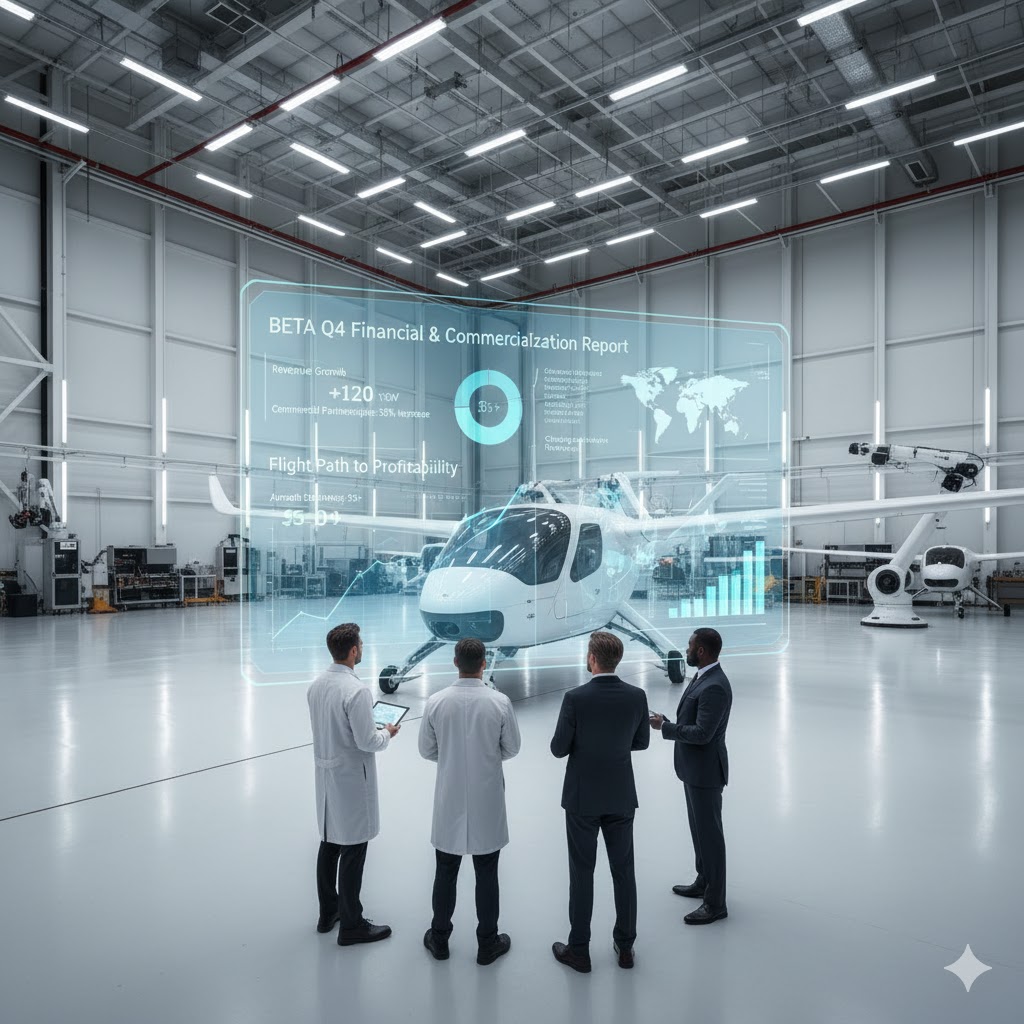
II. BETA Technologies’ December 4, 2025 Earnings Report — Financial Results Deep Dive
The December 4 BETA Financial Report — essentially the company’s third quarter 2025 filings — includes comprehensive financial statements and management’s discussion of results. Although BETA’s earnings results were framed within the broader context of technological development and industry pioneering, there are several specific data points reflecting operational realities.
Revenue Performance and Composition
BETA’s revenues during the quarter — broken into product revenues (e.g., aircraft, propulsion systems, ground support equipment) and service revenues (e.g., engineering services, consulting, charging network usage) — showed measurable growth versus the prior year period:
- Product revenues increased year‑over‑year largely due to new contracts with commercial customers for electric propulsion motors, batteries, flight control systems, and ground support equipment (“GSE”), with several million dollars of incremental revenues.
- Service revenues rose significantly, reflecting ongoing and new engineering and consulting contracts with customers supporting research and development activities, priority access to charging infrastructure, and an increase in U.S. government contracts.
This revenue growth, though relatively modest in absolute dollars compared with established aviation OEMs, is notable because it reflects commercial activity and contract execution in an industry phase where many peers remain subsidized by grants or private financing. The improved revenue mix — with a higher proportion of recurring service revenues and ongoing commercial product sales — suggests the company is beginning to see traction beyond one‑off prototype work.
Gross margin behavior — an important indicator of scalability and cost control — also improved. Both product and service revenue margins rose due to more favorable contract mixes in the period, indicating that BETA is capturing better‑structured business through longer‑term engagements and higher‑value services.
Cost Structure and R&D Investments
On the cost side, BETA’s financial statements reveal significant investments in research and development (R&D) — a hallmark of deep technology ventures. R&D expenses increased notably both quarter‑over‑quarter and year‑over‑year as the company advances its electric aircraft, battery systems, motors, flight control technologies, and charging infrastructure:
- For the quarter ended September 30, 2025, R&D expenses were several million dollars higher than the year‑ago period, primarily driven by professional fees, labor costs, depreciation of new production facilities, and heavier investment in prototype production and certification activities.
- Year‑to‑date, R&D spending escalated further as BETA pushed forward production tooling, testing regimes, and certification processes — essential steps for obtaining regulatory approvals and delivering aircraft at scale.
This increase in R&D outlays is not unusual for aerospace startups at BETA’s stage. However, it does materially widen the net loss position in the period’s financial results, which is in line with expectations for a company transitioning from development to early commercialization.
General and administrative (G&A) costs also climbed significantly, driven by headcount expansion, professional services fees, and stock‑based compensation costs tied to scaling organizational capacity. While these increases put pressure on near‑term profitability, they are strategically aligned with scaling operations, expanding commercial activities, and supporting a newly public corporate structure.
Non‑Operating Items and Capital Structure Effects
The earnings report also reflects financial items associated with BETA’s capital structure changes:
- A loss on issuance of convertible preferred stock was recorded due to the difference between fair value and aggregate proceeds, tied to Series C and Series C‑1 preferred stock issuances during the period prior to the IPO. This non‑cash loss impacts reported net income but does not directly affect operating cash flows.
- Interest expense modestly increased due to timing of borrowings and a sale‑leaseback transaction, while interest income was buoyed by higher average cash and liquidity balances generated from the IPO proceeds.
Together, these items illustrate the dual forces shaping BETA’s financial results: capital market transactions (such as preferred stock and IPO effects) influencing one‑off accounting impacts, and core operating economics driven by revenue‑cost interactions.
Cash Flow and Liquidity Position
One of the most critical aspects of BETA’s financial health, especially for a public aerospace technology firm, is cash flow and liquidity. As reported in the filings:
- Operating cash use remained negative, reflecting continued investment in R&D, manufacturing scale‑up, and support for commercialization activities.
- Investing cash flows were also negative, primarily due to capital expenditures on production tooling, charging infrastructure expansion, and facility improvements.
- Financing activities contributed net cash inflows, overwhelmingly comprised of IPO proceeds and preferred stock financing, which expanded the company’s cash runway significantly.
At quarter end, BETA reported more than $687 million in cash and equivalents, a substantial liquidity position given its stage of operations and near‑term capital needs. This buffer provides the company with resources to fund certification efforts, expand production capacity, and advance go‑to‑market activities without imminent external financing — though the company acknowledges reliance on capital markets and possible dilution if additional funding is raised.
Balance Sheet Strength and Capitalization Trends
Since completing its IPO in early November 2025 at a $34 per share price, BETA’s capitalization structure has evolved:
- The public equity base expanded considerably, with Class A common stock issuance generating net proceeds of over $1.1 billion.
- The company’s share count, including common and super‑voting shares, reflects a governance structure where founders and key insiders retain significant voting influence — a factor that can shape strategic decisions and investor expectations.
From a balance sheet perspective, the infusion of IPO capital significantly alleviates near‑term funding pressure but also raises investor expectations for tangible progress toward aircraft certification, order backlogs, and nascent commercial revenue streams.
III. Analysis of Changes and Their Business Impacts
Understanding why specific financial changes occurred — and what they mean for the company — is essential for interpreting the BETA Financial Report and anticipating future business performance.
Revenue Dynamics: Commercial Contracts vs. Transitional Projects
BETA’s revenue increase in the third quarter was driven by new commercial contracts for electric propulsion motors, battery systems, flight controls, and GSE, combined with expanded service revenues from engineering and consulting engagements. The pattern suggests a shift from prototype‑centric revenue (e.g., one‑off military or demonstration projects) toward repeatable commercial work, which is critical for sustainable growth.
The increased proportion of service revenues — particularly from engineering contracts and priority charging access — indicates that customers and partners are engaging with BETA not just as a technology provider but as a strategic collaborator. This collaborative revenue, while smaller in scale today, could be foundational for future recurring revenue models tied to maintenance, fleet services, and charging network usage.
Cost Behavior: Scaling R&D and Production Readiness
R&D costs rose in both the quarter and year‑to‑date periods, a reflection of the company’s efforts in multiple lines of advanced development:
- Scaling prototype development
- Constructing production tooling
- Investing in battery, electric motor, flight control, and charging system technologies
- Preparing for future certification pathways
This elevated R&D intensity is typical for aerospace ventures moving through layers of technological validation and regulatory hurdles. While it suppresses near‑term operating margin, it directly builds the company’s intellectual property and production readiness — both essential for future revenue growth and competitive differentiation.
Simultaneously, increases in G&A expenses reflect the transition to a publicly traded corporate infrastructure with external reporting requirements, investor relations activities, and expanded corporate governance — all of which add to current administrative costs but lay the groundwork for institutional investor participation and operational discipline.
IV. Strategic Initiatives and Market Position
Financial results are only one dimension of BETA’s business, especially in a capital‑intensive industry where technical progress and strategic partnerships matter as much as quarterly earnings.
1. Product Development and Certification Milestones
BETA’s most visible products — the ALIA VTOL (A250) and CX300 production aircraft — have achieved key developmental milestones, including FAA special airworthiness certification and demonstration flights involving human passengers. This progress is foundational for moving from prototype validation into commercial delivery cycles across cargo, logistics, and passenger segments.
Certification efforts are costly and time‑consuming, but their completion would unlock significant new revenue opportunities and validate the company’s engineering roadmap, potentially distinguishing BETA within the broader eVTOL and electric aviation landscape.
2. Charging Infrastructure and Enabling Technologies
Beyond selling aircraft, BETA is developing a network of electric aviation charging systems — a capital‑intensive but strategically critical infrastructure layer that will support electric flight operations at airports, vertiports, and logistics hubs. This charging ecosystem, coupled with propulsion and battery technologies, positions BETA to capture revenue across multiple value streams beyond aircraft sales.
3. Defense and Government Collaborations
The company’s involvement with U.S. Army and Air Force programs — including aircraft testing and logistical evaluations of eVTOL missions — aligns with broader defense interest in electric aviation. These collaborations provide both financial support and technology validation, and can nurture long‑term contracts spanning military, medevac, and emergency logistics applications.
4. Commercial Partnerships and Order Backlog
Commercial engagements with aerospace customers — including orders for components or completed aircraft — signal BETA’s growing presence within an industry that still has relatively few electric aircraft OEM players. Partnerships with established aerospace firms and governmental bodies help diversify revenue streams and enhance the company’s ecosystem footprint as it scales production.
V. Risks and Competitive Landscape
Even with promising momentum in technology and public markets, BETA Technologies is navigating several critical risks that influence both its financial trajectory and BETA stock dynamics:
1. Capital Intensity and Operating Cash Flow
Despite a strong IPO cash buffer, the company continues to operate at a net loss with significant negative operating cash flow as of the third quarter. Continued R&D, infrastructure build‑out, and production scaling imply ongoing capital requirements that may necessitate future equity or debt funding rounds, with attendant dilution or leverage risks.
2. Regulatory and Certification Hurdles
Achieving regulatory certification for electric aircraft across jurisdictions is complex, fragmented, and time‑consuming. Delays or additional requirements could push commercialization timelines and defer revenue recognition.
3. Competition in eVTOL and Electric Aircraft
BETA is not alone in the eVTOL and electric aircraft arena. Peers like Joby Aviation, Archer Aviation, and other early‑stage entrants compete for market share, talent, supplier capacity, and regulatory attention. Competitive dynamics could pressure pricing, talent allocation, or partnership opportunities.
4. Customer Concentration and Contract Risks
Financial filings noted significant customer concentration in accounts receivable among several customers representing large portions of revenue or receivables balances. While this is common in early‑stage industrial companies, a concentrated customer base can increase revenue volatility if contracts are delayed or canceled.
5. Volatility and Stock Market Perception
Publicly traded stocks in nascent industries are often volatile as market sentiment oscillates with news flow, regulatory developments, and macroeconomic shifts. Therefore, BETA stock price may experience sharp movements based on incremental news or shifts in risk appetite among investors.
VI. Outlook: What the Future May Hold for BETA Technologies and Its Stock
Looking ahead, several factors will likely influence BETA Technologies Earnings performance and how the BETA stock price evolves:
Progress Toward Commercial Deliveries
Commercialization remains BETA’s most critical milestone. Successful certification and first deliveries of electric aircraft — especially to paying customers in cargo, logistics, and medical transport markets — would represent a turning point for revenue growth and financial profile.
Scaling Production and Cost Efficiency
As production tooling and manufacturing capacity expand, per‑unit costs may decline, enabling more competitive pricing and improved gross margins over time. Efficient scale‑up will be key to moving from heavy R&D outlays to commercial profitability.
Charging Infrastructure Adoption
Expanding electric charging infrastructure across geographies, supported by partnerships with airports, governments, and logistics firms, could stimulate broader adoption of electric aviation and create recurring revenue streams from charging and maintenance services.
Partner and Defense Contract Leverage
Long‑term contracts with defense agencies and strategic industrial partners may provide stable revenue bases and reduce volatility associated with private capital cycles.
Investor Perception and Valuation Re‑Rating
Given that BETA stock began trading in late 2025, its valuation today reflects both excitement around electric aviation’s potential and uncertainty about commercialization execution. Future earnings beats, milestones, order announcements, or policy developments (e.g., incentives for electric aviation infrastructure) could influence investor perception and lead to re‑rating of the stock price.
VII. Conclusion: BETA Technologies — Technical Progress Meets Commercial Transition
The December 4 BETA Financial Report offers a rich portrait of a deeply technical aerospace company transitioning toward commercialization. While challenges remain — including capital intensity, certification timing, and competitive pressure — the company’s revenue growth, strategic contracts, expanded product portfolio, and public market debut represent meaningful inflection points.
For observers of BETA stock, the narrative is one of building and proving, not simply reporting quarterly profit. The detailed financial data — from revenue composition and cost behavior to cash flow and balance sheet strength — underscores a company investing in long‑term industry leadership. Meanwhile, progress on product, infrastructure, and partnerships suggests a multi‑layered growth strategy spanning aircraft sales, enabling technologies, and service ecosystems.
The journey ahead implicates not only quarterly earnings performance but broader macro trends in electrification, sustainability, and aviation innovation. As BETA continues to integrate its technology stack, scale production, and deepen market engagements, the evolving financial results and strategic execution will remain central to how the market interprets its story and how BETA stock price trends over time.