SpaceX Plans 2027 Launch of Gen2 Starlink Satellites, Aiming for 5G-Level Experience

In recent filings submitted to the Federal Communications Commission (FCC), SpaceX revealed plans to launch its second-generation cellular Starlink system in 2027. The project aims to deliver “substantially enhanced” satellite-to-cell services, providing a connectivity experience comparable to terrestrial 5G networks.

This technological leap is closely tied to a pivotal acquisition finalized last September. SpaceX entered into an agreement with EchoStar (SATS) to acquire its wireless radio spectrum resources for approximately $17 billion to upgrade its cellular Starlink services. The transaction is expected to close by November 30, 2027, allowing SpaceX to assume EchoStar’s obligation to pay approximately $2 billion in cash interest on its debt. Filings indicate that while SpaceX has the option to complete the acquisition early, it would incur significantly higher costs.

Last autumn, SpaceX CEO Elon Musk stated that realizing this service requires a “roughly two-year timeframe.” He noted that the primary challenges are twofold: first, smartphone manufacturers must complete hardware adaptations to integrate EchoStar spectrum chips supporting the 1.9GHz and 2GHz bands; second, SpaceX must launch next-generation satellites capable of utilizing this additional spectrum. This includes a proposed new constellation of 15,000 satellites currently awaiting FCC approval.

Achieving 5G-Level Direct-to-Cell by 2027 with a 100-Fold Capacity Increase

SpaceX currently offers its first-generation cellular Starlink service in the U.S. through a partnership with T-Mobile US (TMUS). While this technology provides essential data connectivity—including video calling, messaging, and app access—in areas with weak cellular coverage, its available bandwidth remains limited.

In contrast, the planned second-generation cellular Starlink system is expected to deliver a connection experience approaching that of terrestrial 5G networks. In technical documents, SpaceX pointed out that the total capacity of the next-generation system will be more than 100 times greater than that of the first-generation network, with data throughput capabilities increasing by over 20 times.

David Goldman, SpaceX’s Vice President of Satellite Policy, along with two other executives, stated in the filing:

“But this is just the beginning: SpaceX has invested in spectrum resources that will allow it to launch a substantially enhanced second-generation direct-to-device system in 2027.”

This statement suggests that the company is shifting its resources and focus toward the second-generation system. The new generation is anticipated to achieve significant breakthroughs in coverage, connection speed, and system capacity, aiming to align satellite communication services with the performance of terrestrial mobile networks.

If this rollout proceeds as planned, it will strengthen SpaceX’s competitive advantage in the satellite communications market and pose a direct challenge to both traditional telecommunications providers and emerging low-Earth orbit (LEO) constellation operators. As the 2027 window approaches, the progress of spectrum integration and system R&D will remain the critical variables determining the success of this strategy.
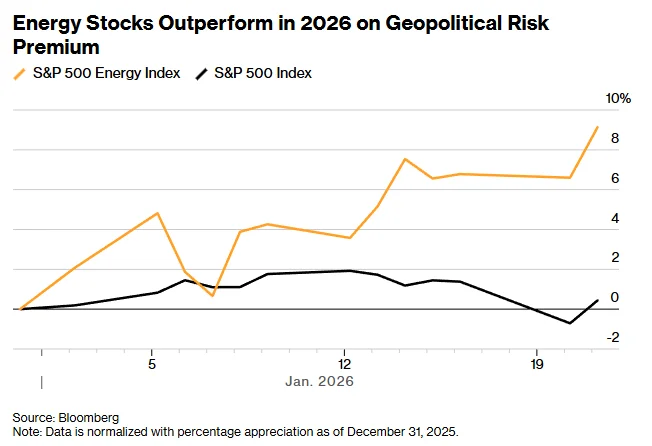
Out of the Tariff Shadow! U.S. Energy Stocks Staging a Massive Rally in 2026 as Geopolitical Risks Ignite a Sector Frenzy

The U.S. energy sector, which has surged strongly over the past few months, climbed to a record high on Wednesday as rising geopolitical uncertainty prompted investors to bet on higher oil prices. The S&P 500 Energy Index rose 2.4% to close at 750.17, making it the best-performing sector in the S&P 500. Shares of major oil producers rose alongside WTI crude prices as tensions between the U.S. and Europe over the Greenland issue fueled market uncertainty.

Energy Stocks Outperform in 2026 Due to Geopolitical Risk Premiums

“Geopolitical pressures involving Venezuela, Ukraine, and Greenland are maintaining a modest risk premium for oil prices,” said Vincent Piazza, an analyst at Bloomberg Intelligence. “In this context, $60 per barrel for WTI crude remains a critical threshold.”

At the same time, natural gas companies such as EQT Corporation (EQT), Expand Energy (EXE), and Coterra Energy (CTRA) stood out this week due to an expected Arctic blast covering two-thirds of North America starting this week and continuing into the next. Piazza noted, “Despite rising natural gas production, cold weather across the eastern half of the U.S. should boost domestic sentiment, while freezing temperatures in Europe will support seaborne gas benchmarks.”

Oil and gas stocks have been on a steady upward trajectory since last April, gradually recovering from the “tariff shock” triggered by Donald Trump that month. However, this rally accelerated significantly in early December when the U.S. increased pressure on Venezuela and Russia. Subsequently, at the start of 2026, Trump’s pledge to revitalize the Venezuelan energy industry—following the forceful apprehension of President Nicolás Maduro—further drove shares of major oil producers higher.

The recent strength in energy stocks marks a sharp reversal for the sector. In 2025, the index rose only 5%, significantly lagging behind the S&P 500’s 16% gain, as the sector struggled to recover from tariff-related headwinds. In the week following Trump’s announcement of massive tariffs on trading partners in early April last year, the sector plummeted 20%. It was not until January 5 of this year, following U.S. intervention in Venezuela, that the energy benchmark finally returned to the levels seen before the April tariffs.

Due to the widening geopolitical risk premium, Wall Street institutions have turned more positive on the outlook for oil. Citigroup recently raised its short-term benchmark forecast for Brent crude to $70 per barrel. However, the biggest cloud hanging over the industry remains the looming risk of a supply glut, which could put downward pressure on crude prices.

Support for oil prices also came from the International Energy Agency (IEA), which upwardly revised its oil demand forecast for 2026. WTI crude prices rose as much as 2.1% on Wednesday before paring gains after Trump reiterated his desire to control Greenland but stated he did not intend to use military force. As of press time, WTI crude was down 0.23% at $60.54 per barrel.

Barclays analyst Betty Jiang noted that while cash returns from upstream oil companies remain solid despite recent macroeconomic volatility, they still face risks. “The oil market backdrop has become more complex due to a rising—and potentially unsustainable—geopolitical risk premium,” Jiang said.