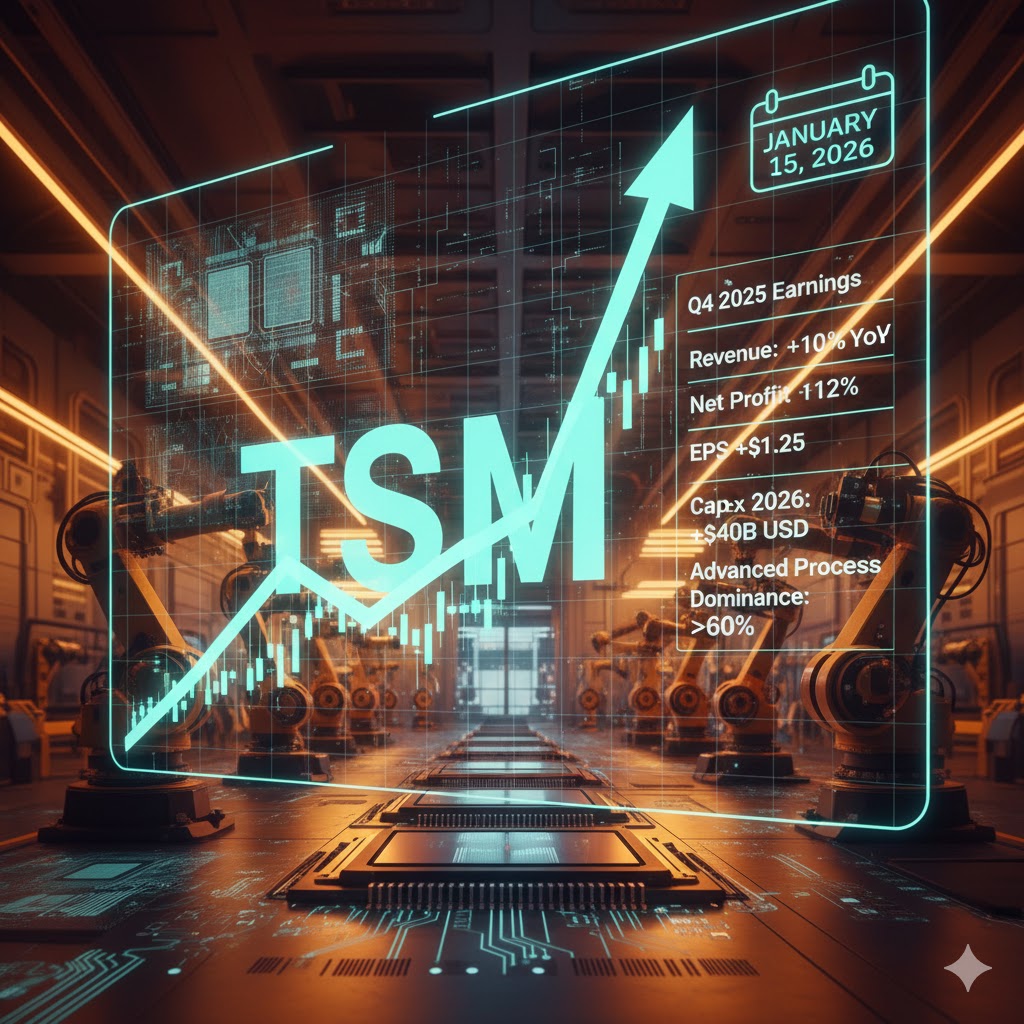
On January 15, 2026, Taiwan Semiconductor Manufacturing Company Limited (NYSE: TSM) delivered fourth-quarter 2025 earnings that significantly outpaced expectations, reinforcing its dominant position in the semiconductor supply chain and highlighting the structural shift toward artificial intelligence (AI)-driven compute demand. Across global markets, TSMC’s results not only turned heads in Wall Street circles but also provided a compendium of data points that offer insight into secular trends reshaping the broader technology landscape.
The following analysis synthesizes the financial results, business drivers, strategic initiatives, and implications for future performance of TSMC’s earnings — with a particular focus on how these factors are likely to influence TSM stock and TSM stock price dynamics, as well as how investors and industry participants might interpret this information under evolving macro and industry contexts.
Financial Highlights: Growth, Margins, and Profitability
While TSMC’s full earnings release has not yet been published in English regulatory feeds, sources pulling from contemporaneous market summaries and crowd-sourced financial results suggest a powerful performance for Q4 2025:
- Revenue: ~US $33.73 billion, a 25.5% year-over-year increase.
- Net Income: ~US $16.29 billion — roughly 40.6% YoY growth.
- Gross Margin: ~62.3%, up substantially on a YoY basis.
- EPS: Approximately US $0.63, up around 40% YoY.
- Free Cash Flow: ~US $11.89 billion, up nearly 48.8% YoY.
These performance figures not only beat consensus projections but also suggest that TSMC’s scale and pricing power — particularly in advanced process technologies — are translating into strong margin expansion and robust cash generation. This combination is crucial for fueling future capex, R&D, and shareholder return capacity while maintaining leadership in an industry defined by steep investment requirements.
Revenue and Business Segment Trends
Breaking down TSMC’s revenue by customer platform and end market reveals a pronounced structural shift. While full official segmentation by TSMC has yet to be widely distributed, reliable secondary reporting suggests that:
- High-Performance Computing (HPC) now accounts for a majority share (about 55%) of revenue and shows steady growth.
- Smartphone demand — another significant revenue contributor — exhibited double-digit YoY growth (~11%).
- Other categories (Internet of Things, automotive, etc.) collectively contribute smaller but meaningful chunks.
The implication is clear: TSMC’s revenue base is shifting toward AI-related compute and high-performance applications, which have higher ASPs (average selling prices) and often involve more advanced nodes (e.g., 5 nm, 3 nm). This mix shift supports higher margins and reduces reliance on more cyclical end markets like consumer electronics alone.
Profitability and Efficiency Metrics
Margins, efficiency, and cash flow dynamics in TSMC’s earnings speak to operational discipline at scale:
- A gross margin above 62% is notable in the semiconductor manufacturing sector, where capital intensity often squeezes profitability.
- A sharp increase in free cash flow (~48.8% YoY) suggests that TSMC is converting revenue growth into durable cash generation — critical for funding its massive capital budget.
- Efficiency metrics, such as reductions in accounts receivable and inventory turnaround days, highlight improved working capital management.
The combination of operational leverage and demand tailwinds from AI and HPC customers likely underpins this profitability improvement, even in a year marked by broader macroeconomic uncertainties.
Strategic Drivers: AI Compute Demand and Advanced Nodes
The semiconductor manufacturing industry is being reshaped by AI compute demand, and TSMC sits squarely at the core of this trend. Several strategic drivers help to explain the company’s fiscal performance and future prospects:
1. AI-Led Demand Surge:
The proliferation of generative AI, datacenter expansion, and advanced workloads has fueled demand for leading-edge silicon produced predominantly by TSMC — especially for customers like NVIDIA, Apple, and various cloud service providers. This shift toward advanced logic technologies (e.g., N3, N5, and beyond) results in higher margins and higher ASPs, contributing materially to revenue growth and profitability expansion.
2. R&D and Process Leadership:
TSMC’s continued investment in leading process technologies — including 3 nm production and early engagements in 2 nm research — gives it a technological moat that competitors find hard to breach. Maintaining this lead requires significant capex but positions the company to capture premium demand from high-growth computing end markets.
3. Diversified Customer Base:
While Apple and NVIDIA are among its largest customers, TSMC’s revenue is spread across a broad range of technology firms, strengthening resilience to demand swings in any single segment. This diversification is valuable in periods of cyclical softness in certain categories (like smartphones) while benefiting from structural growth elsewhere.
Strategic Initiatives: Capex, Global Footprint Expansion
A recurring theme in the TSMC narrative — and one reinforced by earnings reactions in the market — is the company’s capital investment strategy:
- Aggressive capex plans aimed at scaling capacity for advanced nodes globally (including in the U.S. and Taiwan) are a priority, even as these projects demand substantial upfront investment.
- Expansions in Arizona and other overseas facilities help diversify geopolitical risk and ensure closer proximity to key customers — though they may exert short-term pressure on capex intensity.
- Infrastructure investments align with the long lead times required for semiconductor fabs, underscoring that TSMC’s growth trajectory is tied to multi-year commitments rather than quarter-to-quarter cycles.
Crucially, these investments are not merely scale plays — they represent strategic positioning within the global technology ecosystem, particularly as nations seek to localize semiconductor production for reasons of supply chain security and competitiveness.
Competitive Landscape and Industry Context
While TSMC’s results are impressive, they should be viewed in the context of macro headwinds and competitive dynamics:
- Geopolitical risks, particularly export controls and cross-strait tensions, remain an undercurrent that could influence manufacturing footprints, investment decisions, and customer commitments.
- Competition from Samsung and other foundries exists, but TSMC’s technological lead provides a defensible position. That said, sustaining this lead requires sustained investment and execution excellence.
In the broader industry context, TSMC is widely regarded as a bellwether for semiconductor capital expenditures and demand trends. Its performance often precedes or mirrors shifts in technology investment cycles, making its earnings events especially scrutinized by markets and analysts alike.
Impact on TSM Stock and Market Sentiment
The immediate market reaction to TSMC’s earnings was positive, with U.S.-listed shares climbing sharply following the release.
Investors and market participants frequently cite the following as reasons for positive sentiment:
- Beating revenue and margin expectations, which signals robust underlying demand dynamics.
- Strong profitability growth that supports ongoing investments and potentially future shareholder returns.
- AI demand tailwinds that are expected to persist across multiple years.
Analysts and institutional investors have also raised price targets and affirmed TSMC’s position as a foundational AI infrastructure play, reinforcing broader confidence in TSM stock price momentum.
Forward Outlook: Trends, Risks, and Scenario Considerations
Looking ahead, several themes are likely to shape TSMC’s performance and investor perceptions:
1. Continued AI & HPC Expansion:
The secular shift toward AI compute suggests that TSMC will likely continue benefiting from strong demand for advanced nodes, with HPC revenue potentially becoming an even larger share of total revenue over time.
2. Capital Deployment:
Ongoing capex, while a near-term cash demand, lays the groundwork for future revenue expansion. How effectively TSMC deploys this capital and manages costs will influence margins in the coming years.
3. Macroeconomic and Geopolitical Factors:
Global economic trends, supply chain policies, and trade dynamics all remain risk factors. TSMC’s diversified footprint and strategic investments may mitigate some risks, but uncertainty persists.
4. Competitive Dynamics:
Maintaining technological leadership will be critical — and costly. TSMC’s R&D and manufacturing execution must continue to outpace rivals to sustain premium pricing and market share.
Concluding Perspective: Structural Growth Beneath the Numbers
TSMC’s Q4 2025 results reflect more than a cyclical earnings beat — they highlight a company at the center of a multi-year structural shift in technology demand. The combination of AI-driven compute growth, premium process technology share, and operational efficiency gains underscores TSMC’s capacity to generate robust profitability even amid broader industry volatility.
The TSM stock and TSM stock price reaction suggests that investors value this positioning, while the broader financial metrics affirm TSMC’s role as a cornerstone of the semiconductor ecosystem. With rising global demand for advanced chips and ongoing strategic investments, revenue and earnings growth are poised to continue shaping industry narratives well into 2026 and beyond.
In sum, the data tell a story of durable growth, expanding margins, and strategic investment, positioning TSMC uniquely in a landscape where compute power remains the primary currency of innovation — even as external pressures and competitive challenges persist.