The global technology distribution landscape has undergone a tectonic shift over the last twenty-four months, moving from a period of pandemic-induced supply chain chaos to an era defined by the rapid-fire deployment of artificial intelligence (AI) and hybrid cloud infrastructure. At the center of this transformation stands TD SYNNEX (SNX), a distribution titan that recently unveiled a fiscal performance that has left analysts and market participants recalibrating their long-term models. On January 8, 2026, the company released a TD SYNNEX Financial Report that did more than just beat expectations; it established a new baseline for what scaled technology orchestration looks like in a high-interest-rate environment.
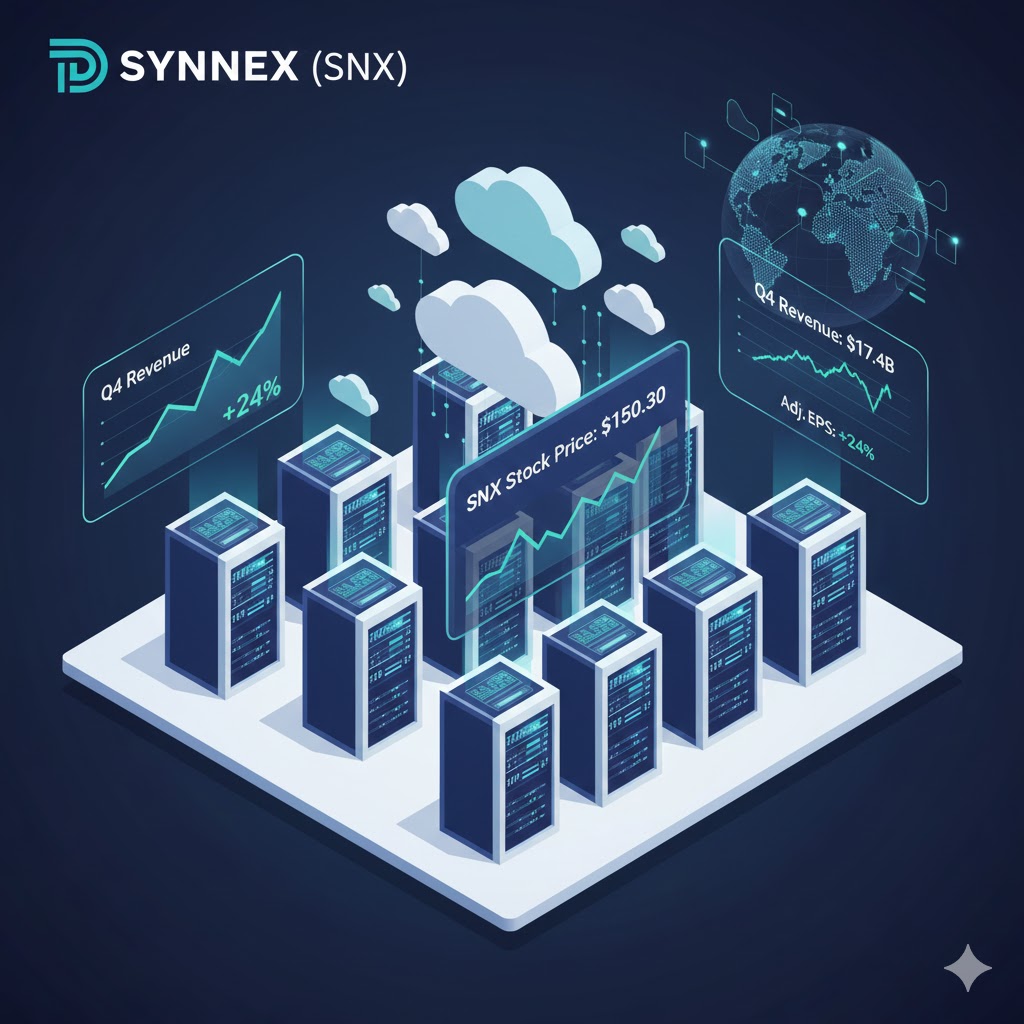
For those tracking SNX stock, the fiscal 2025 fourth-quarter results were a masterclass in operational leverage and strategic pivot. The company reported record revenue of $17.4 billion, a year-over-year increase of 9.7%. This figure was notably above the high end of management’s previous guidance, signaling a demand environment for advanced IT solutions that is far stickier than many macro-skeptics had predicted. While the top-line growth is impressive, the real story lies in the non-GAAP diluted earnings per share, which surged by 24% to reach $3.83, comfortably outpacing consensus estimates.
Deciphering the Revenue Surge: Advanced vs. Endpoint Solutions
The momentum behind TD SYNNEX stock is largely fueled by a bifurcation in the IT spending cycle. Throughout fiscal 2024 and 2025, the industry witnessed a relative cooling in “Endpoint Solutions”—the business of laptops, mobile devices, and peripherals—following the post-pandemic saturation. However, the Q4 report suggests that this segment is stabilizing, while “Advanced Solutions”—the high-value domain of data centers, cloud security, and AI servers—has entered a hyper-growth phase.
In the most recent quarter, Advanced Solutions revenue grew by approximately 17%, a significant acceleration that management attributes to the massive capital expenditures being funneled into AI-ready infrastructure. This isn’t just about selling more boxes; it is about the complexity of the sale. As companies move beyond the “experimentation” phase of generative AI and begin deploying enterprise-grade models, the need for specialized hardware—high-performance GPUs, low-latency networking, and massive storage arrays—has skyrocketed. TD SYNNEX has positioned itself as the critical intermediary capable of managing the logistics, financing, and technical integration of these massive projects.
This shift toward complex solutions has a direct impact on the SNX stock price, which has shown a tendency to trade at a premium when the mix shifts toward high-margin services. The Q4 results highlighted that gross billings reached a staggering $24.3 billion, a 14.7% increase year-over-year. The gap between revenue and gross billings is an essential metric for TD SYNNEX, as it reflects the increasing volume of “as-a-service” and software sales where revenue is recognized on a net basis. This trend toward high-value, recurring revenue streams is a key pillar of the company’s 2026 strategy.
The Hyve Factor: A Strategic Growth Engine
One cannot analyze TD SYNNEX (SNX) Earnings without a deep dive into Hyve Solutions. As a wholly-owned business unit focused on the design and integration of large-scale data center solutions for hyperscale customers, Hyve has become the company’s “secret weapon.” In the fourth quarter, Hyve’s revenue reportedly increased by over 50% year-over-year, benefiting from the global race to build out the physical infrastructure that powers the AI revolution.
The integration of Hyve into the broader TD SYNNEX ecosystem provides a unique competitive advantage. While traditional distributors might struggle with the capital-intensive nature of hyperscale projects, TD SYNNEX utilizes its massive balance sheet and global logistics footprint to de-risk these endeavors. The growth in Hyve is particularly important for the TD SYNNEX Financial Report because it provides a counter-cyclical hedge against fluctuations in the PC market. When enterprise IT budgets for hardware refresh cycles are tight, hyperscale spending on cloud and AI infrastructure often remains robust, providing a steady floor for the company’s consolidated results.
Operational Efficiency and the “MAP” Legacy
The impressive bottom-line growth seen in the recent earnings is not merely a byproduct of higher sales; it is the result of relentless cost discipline. Following the merger of Tech Data and SYNNEX, the company embarked on an ambitious synergy program that has consistently outperformed targets. Non-GAAP operating income in Q4 rose to $497 million, an 18% increase compared to the prior year.
This efficiency is reflected in the non-GAAP operating margin, which expanded to 3.5% for the quarter. While a 3.5% margin might seem slim in the software world, in the low-margin, high-volume world of technology distribution, this represents a significant achievement and a testament to the company’s scale. Management has successfully leveraged its digital transformation initiatives—including the “PartnerFirst” portal—to automate routine transactions, allowing the sales force to focus on complex, high-margin consultative sales.
For investors monitoring SNX stock, the company’s ability to manage SG&A (Selling, General, and Administrative) expenses is a critical indicator of health. In Q4, non-GAAP SG&A expenses were $698 million, or roughly 3% of gross billings. By keeping overhead relatively flat while gross billings grow at a double-digit pace, TD SYNNEX is demonstrating “positive operating leverage,” a scenario where every incremental dollar of revenue contributes disproportionately to the bottom line.
Capital Allocation: Balancing Growth and Shareholder Returns
A standout feature of the January 8 report was the company’s robust cash flow and its subsequent return to shareholders. TD SYNNEX generated $1.4 billion in free cash flow during fiscal 2025, meeting its goal of 95% net income to free cash flow conversion. This level of cash generation provides management with a “fortress” balance sheet, allowing for a balanced approach to capital allocation.
During the fourth quarter, the company returned $209 million to stockholders through a combination of $173 million in share repurchases and $36 million in dividends. The announcement of a 9% increase in the quarterly dividend to $0.48 per share serves as a vote of confidence from the Board of Directors. For long-term holders of TD SYNNEX stock, this consistent return of capital, coupled with a share count that is steadily declining, creates a “compounding effect” on earnings per share that can drive the stock price higher even in periods of moderate revenue growth.
Strategic Roadmap for 2026: The AI “Game Plan”
Looking ahead, TD SYNNEX is not resting on its laurels. The company recently launched its “AI Game Plan” program, a comprehensive enablement suite designed to help its hundreds of thousands of channel partners accelerate their own AI adoption. This is a strategic move to “pull” demand through the channel. By educating partners on how to sell AI solutions—ranging from edge computing to cybersecurity for LLMs (Large Language Models)—TD SYNNEX ensures that it remains the preferred partner for vendors like NVIDIA, Microsoft, and Dell.
Furthermore, the company is expanding its footprint in high-growth regions, particularly the Asia-Pacific and Japan (APJ) markets. In the Q4 report, revenue from the APJ segment grew by over 24%, driven by cloud expansion and digital transformation projects in fast-growing economies. This geographic diversification is essential for mitigating risks associated with a potential slowdown in any single market, such as North America or Europe.
Analyzing the SNX Stock Price Trends
The market’s reaction to the TD SYNNEX (SNX) Earnings has been characterized by a “healthy consolidation.” On the day of the release, January 8, the SNX stock price experienced some volatility, closing at $147.60. However, it quickly regained ground, trading around $150.30 by January 12. This price action suggests that the market had already priced in a strong quarter, and investors were perhaps looking for even more aggressive guidance for the first quarter of fiscal 2026.
Technically, the stock is trading within a well-defined upward channel. Its 52-week range of $92.23 to $167.76 shows that SNX has been one of the standout performers in the tech sector over the past year. With a current Price-to-Earnings (P/E) ratio of approximately 16.3x, the stock appears attractively valued compared to the broader technology sector, which often trades at multiples exceeding 25x. The dividend yield of 1.28%, while modest, provides a solid income component for a growth-oriented tech play.
Risks and Headwinds to Monitor
Despite the glowing TD SYNNEX Financial Report, no investment is without risk. The company itself noted potential headwinds in its earnings call, specifically regarding component costs. Rising prices for DRAM and NAND flash memory could potentially compress margins in the Endpoint Solutions segment if the company cannot fully pass those costs on to customers. Additionally, while the PC refresh cycle is expected to kick in as Windows 10 reaches end-of-life and “AI PCs” gain traction, any delay in this cycle could weigh on organic growth in the coming quarters.
Macroeconomic factors also loom large. While the “soft landing” scenario currently dominates market sentiment, any resurgence in inflation that leads to higher-for-longer interest rates could increase the cost of financing the massive inventory required to run a global distribution business. TD SYNNEX manages this through sophisticated hedging and inventory management, but a sudden shift in global trade policy or currency volatility (especially given their significant international exposure) remains a wildcard.
The Verdict: A Compelling Convergence of Value and Growth
In conclusion, the fiscal 2025 fourth-quarter results for TD SYNNEX paint a picture of a company at the top of its game. By successfully navigating the transition from a hardware-centric distributor to a solutions-oriented technology orchestrator, TD SYNNEX has carved out a high-moat position in the tech ecosystem. The record revenue, significant margin expansion, and aggressive shareholder returns highlighted in the TD SYNNEX (SNX) Earnings provide a solid foundation for the year ahead.
For those watching SNX stock, the narrative is no longer just about the “recovery” from the PC slump. It is about the company’s role as the indispensable backbone of the AI era. With a median 12-month analyst price target of $177.00, there is a consensus that the stock still has significant room for appreciation. As the “AI Game Plan” takes hold and the integration of high-margin services continues to mature, TD SYNNEX is well-positioned to deliver sustained value. The journey of the SNX stock price in 2026 will likely be defined by the company’s ability to maintain its operational excellence while capturing an even larger slice of the global AI infrastructure spend. In a world increasingly defined by digital complexity, the orchestrator is king, and currently, TD SYNNEX wears the crown with record-breaking confidence.