On December 4, 2025, ULTA Beauty, Inc. (NASDAQ: ULTA) — the largest specialty beauty retailer in the United States — released its third quarter fiscal 2025 earnings, delivering a powerful performance that outpaced expectations and reaffirmed its leadership in the cosmetics and beauty sector. The company also raised its full‑year outlook, citing robust consumer demand for cosmetics, skincare, and related services during the important holiday season. These results — encapsulated in the ULTA Financial Report — not only provide insights into the company’s current health but also offer a lens into the beauty retail landscape amid shifting consumer preferences and intensifying competition.
In this comprehensive analysis, we explore Ulta Beauty’s earnings in detail, including top‑line and bottom‑line performance, revenue drivers, margin dynamics, strategic initiatives such as loyalty programs and services expansion, emerging product trends, competitive pressures, and how all these elements may shape future performance and influence the ULTA stock price — while integrating key financial data and broader business context.
Executive Summary: Earnings Beat and Raised Outlook
Ulta reported third quarter fiscal 2025 results that beat Wall Street expectations and lifted investor confidence, at least initially:
- Revenue grew strongly, with net sales increasing around 13% year‑over‑year to approximately $2.9 billion — outpacing analyst forecasts and demonstrating resilient consumer demand.
- Earnings per share (EPS) exceeded expectations, with reported EPS of $5.14 (better than the $4.60 consensus), marking another consecutive beat.
- Management raised its full‑year sales and profit guidance, underscoring confidence in the ongoing holiday season rebound.
- Despite solid fundamentals, Ulta Beauty stock displayed mixed short‑term price reactions immediately around the announcement — showing that strong earnings can sometimes be offset by market sentiment or valuation concerns.
These headline results serve as a starting point for a deeper exploration of the drivers behind growth, the structural forces shaping Ulta’s performance, and how strategic priorities and competitive dynamics might influence the company’s future trajectory.
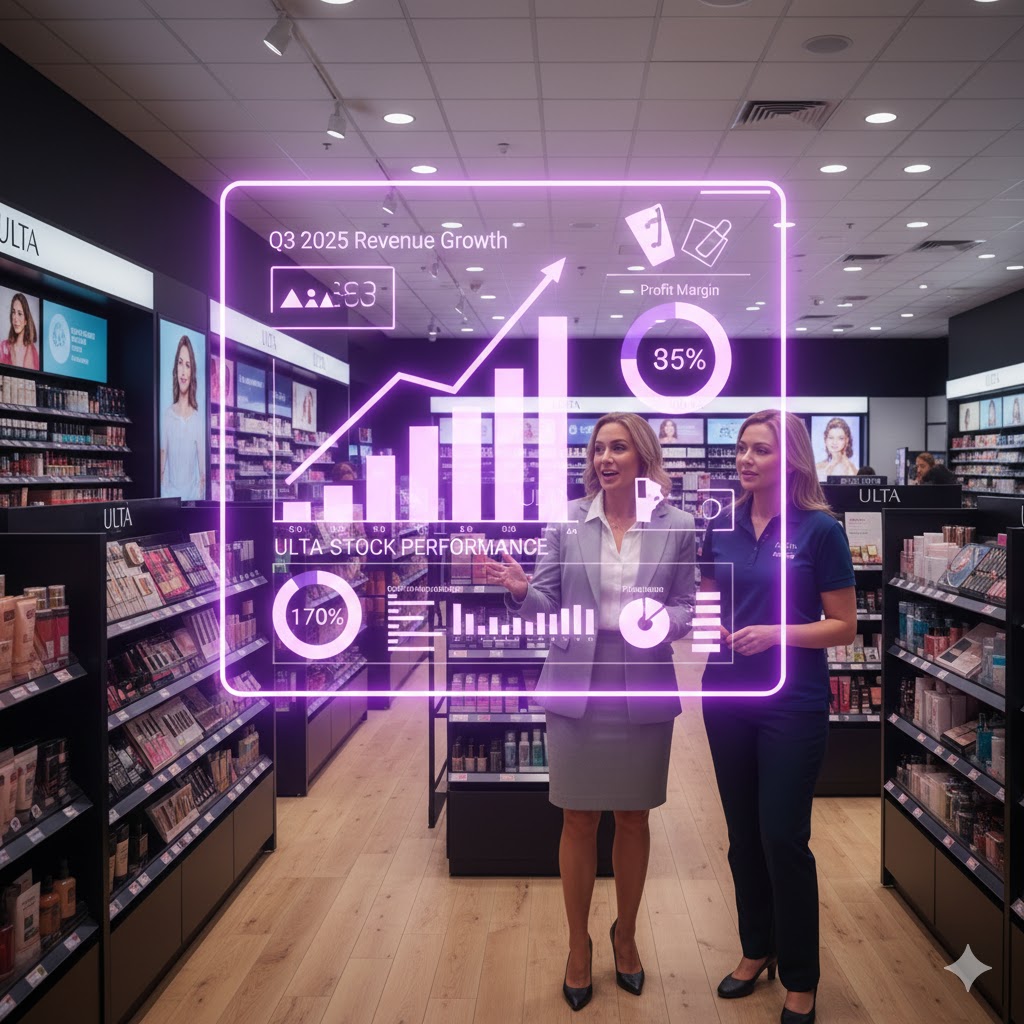
Understanding the Revenue Growth
Net Sales and Comparable Store Performance
Ulta’s Q3 revenue of approximately $2.9 billion represented a 12.9% increase year‑over‑year, a substantial acceleration relative to the broader retail environment where many discretionary categories see slower growth.
This growth can be attributed to several factors:
- Strength in core beauty categories, including makeup, skincare, hair care, and fragrance, which benefited from both traffic increases and higher average transaction values.
- Loyalty program effectiveness, which historically drives a disproportionate share of Ulta’s sales due to repeat purchasing behaviors (with estimates historically indicating that loyalty members account for the vast majority of revenue).
- Omni‑channel sales performance, where in‑store experiences, online channels, and digital services complemented each other to capture broader consumer demand.
Comparable store sales — a key indicator of organic growth — likely contributed meaningfully to the topline strength, reflecting both renewed customer interest and effective merchandising strategies responding to current beauty trends.
Revenue by Category and Channel Dynamics
Although Ulta does not always break down every category in detail in its earnings press release, industry insights and investor commentary suggest several meaningful trends:
- Cosmetics and fragrance sales rebounded strongly, partially driven by seasonal demand and holiday shopping behavior where these categories traditionally see elevated purchases.
- Skincare outperformed as consumers increasingly prioritize wellness‑oriented beauty products, including anti‑aging and treatment‑centric brands.
- Salon services continued to bolster traffic and attach rates, serving as a differentiator relative to many e‑commerce or pure‑product competitors.
Meanwhile, online and digital sales are playing an increasingly important role, with Ulta’s integrated omnichannel presence helping it capture customers who begin their journey online but complete purchases in physical stores, or vice versa.
Profitability, Margins, and Expense Controls
Revenue growth was joined by improved profitability, driven by both gross margin expansion and disciplined operating expense management.
Gross Margin Expansion
Retail gross margins can fluctuate based on product mix, pricing strategies, and supplier promotions. For Ulta:
- The expansion in cosmetics — generally higher‑margin categories — alongside strong performance in services likely improved overall margin profiles.
- Ulta’s ability to maintain pricing discipline, particularly in key prestige beauty categories, contributed to elevated gross margins relative to peers.
- Exclusive brand partnerships and loyalty program incentives also enhanced attach rates on higher‑margin items.
Combined, these structural improvements helped support operating leverage as sales grew faster than certain cost components.
Operating Expenses and Leverage
While sales grew in the mid‑teens, operating expense increases were more tempered:
- SG&A expenses increased but were offset by higher productivity and leverage on fixed costs.
- Marketing and digital investments, while strategically important, were balanced with cost‑efficiency gains in other areas such as supply chain logistics and staff optimization.
- Store operating cost efficiencies — achieved through continued productivity initiatives — helped maintain operating margin expansion despite investments in new customer acquisition.
Overall, the company’s operating margins improved, reflecting a better mix of high‑margin business and disciplined cost control.
Strategic Initiatives: Loyalty, Services, and Marketplace Expansion
Ulta’s performance is not just a function of demand; it reflects deliberate strategic actions to grow market share and deepen customer engagement.
Loyalty Program and Customer Retention
The Ulta Beauty Rewards loyalty program — one of the largest and most engaged in U.S. retail — remains a key competitive advantage, with a significant portion of revenue historically generated by loyalty members.
These customers tend to:
- Spend more per visit, as loyalty members receive points and rewards that encourage repeat purchases.
- Respond strongly to targeted promotions and exclusive product launches, which drive both frequency and basket size.
- Exhibit higher lifetime value relative to non‑members, insulating Ulta stock revenue against cyclical volatility.
This deep bond with consumers underpins resilient same‑store sales and supports premium pricing strategies in categories like prestige beauty.
Expansion of Services and Client Experience
Ulta’s salon services — haircuts, styling, and related beauty treatments — are more than ancillary offerings; they drive traffic and reinforce the brand’s holistic beauty destination positioning.
These services:
- Increase in‑store dwell time, which historically correlates with higher retail sales.
- Provide recurring revenue streams independent of pure product sales.
- Differentiate Ulta from e‑commerce competitors lacking physical experiences.
Investments in training, salon quality, and service consistency have reinforced this part of Ulta’s value proposition and likely contributed to the Q3 performance.
Marketplace and Digital Growth
Ulta has also been advancing its marketplace ecosystem and digital capabilities, expanding product assortment and enticing third‑party brands to broaden customer choice.
The development of the Ulta Beauty Marketplace has:
- Increased selection without significant inventory risk.
- Enabled partnerships with emerging brands that attract digitally native consumers.
- Complemented loyalty and analytics initiatives that tailor promotions and offerings to specific customer segments.
These are long‑term strategic investments that may not fully show up in quarterly metrics, but they build durable competitive advantages over time.
Competitive Dynamics and Industry Context
Ulta operates in a competitive ecosystem that includes traditional retailers, pure‑play e‑commerce platforms, and specialty competitors like Sephora. Competitive factors impacting the company — and by extension Ulta Beauty stock — include:
1. Retail Landscape Pressures
While Ulta continues to post credible growth, broader retail conditions have seen shifts in discretionary spending patterns, especially in beauty and wellness:
- Consumer spending on beauty products can be sensitive to macroeconomic conditions, including employment trends and disposable income levels.
- E‑commerce competitors often run aggressive pricing and promotions that can compress margins.
- Social‑media‑driven brands with direct‑to‑consumer models can capture share, especially among younger demographics.
Ulta’s omnichannel strategy and strong loyalty ecosystem help counter some of these pressures, but execution across digital channels remains critical.
2. Competitive Brand Mix and Exclusives
Ulta has historically competed by offering both mass and prestige brands, including exclusive products not available through other retail outlets. This brand mix:
- Encourages store traffic because consumers can access a broad range of beauty products under one roof.
- Supports higher average ticket sizes through prestige and niche offerings.
However, competitive threats — such as retailers expanding their own beauty assortments, or partnerships between beauty brands and large e‑commerce platforms — require Ulta to continually innovate its product mix and secure exclusive arrangements.
3. Geographical and Demographic Reach
With over 1,400 stores across the U.S. — plus growing digital penetration — Ulta has built a significant footprint, but international expansion remains relatively limited compared to some fast‑fashion or global beauty platforms.
The company’s scale gives it negotiating power with brands and deep insights into consumer trends, but it also faces the challenge of maintaining relevance across diverse demographic segments.
Balance Sheet Highlights and Capital Allocation
The ULTA Financial Report also reflects strong financial discipline:
- Solid balance sheet metrics, including manageable debt levels and robust liquidity, provide flexibility for strategic investments.
- Share repurchases — Ulta has continued to buy back shares, returning capital to shareholders and enhancing per‑share metrics. According to reporting, share repurchases in Q3 were meaningful, reflecting confidence in long‑term performance.
- Dividend considerations remain limited — Ulta historically does not pay a dividend — but capital allocation tends to prioritize growth investments and return of capital via buybacks.
This conservative balance sheet provides cushion against volatility and supports longer‑term strategic initiatives.
Ulta Beauty Stock Price Trends and Market Reaction
Current Valuation and Recent Price Action
As of early January 2026, ULTA stock price was trading in the mid‑$660 range — a significant level that reflects both recent earnings performance and broader market dynamics. According to available quotes, the stock was approximately $666.18 at market close on January 7, 2026, up modestly over prior sessions.
This price level implies that Ulta’s strong Q3 performance and raised guidance helped maintain growth momentum. However, the stock’s reaction has been mixed, with occasional pullbacks even after earnings beats — suggesting that investors are balancing optimism about Ulta’s execution with caution about competitive pressures and macroeconomic influences.
Valuation Versus Peers
Ulta typically trades at a premium relative to broad retail indices due to its leadership position and consistent earnings growth. Analysts have issued a range of price targets both above and below current levels, with some bullish calls reflecting confidence in Ulta’s strategy and several neutral or cautious calls highlighting competitive risks.
Notably, UR analysts from TD Cowen and others have upgraded price targets following strong earnings, with some raising targets into the $700+ range — indicating that there is still perceived upside against conservative scenarios.
Strategic Outlook: Where Ulta Is Headed
Ulta’s future growth prospects hinge on several strategic vectors that are highly interconnected:
1. Loyalty Program and Data Insights
Ulta’s loyalty program remains one of its strongest assets, generating repeat visits and enabling targeted promotions. Continued investments in data analytics will likely improve personalization, increase customer lifetime value, and offer deeper insights into consumer behavior — all crucial in a competitive environment.
2. Omni‑Channel Integration
Seamless integration between brick‑and‑mortar and digital touchpoints enhances convenience and boosts overall engagement. Ulta’s digital ecosystem — including its mobile app, online store, and in‑store services — is designed to capture both spontaneous and planned purchases.
3. Marketplace and Exclusive Brand Expansion
Expanding the product marketplace and securing exclusive brand partnerships can diversify the product portfolio and create differentiation versus competitors. This strategy may boost profit margins while attracting new customer segments.
4. Geographic Diversification
While Ulta’s core strength remains in the U.S., selective international expansion — particularly in markets with strong beauty consumption cultures — could unlock long‑term growth opportunities.
5. Services and Experience Enhancement
As beauty retail becomes increasingly experiential, Ulta’s salon services and in‑store experiences will continue to be significant drivers of traffic and attachment rates.
Risks and Challenges on the Horizon
No analysis is complete without acknowledging potential headwinds:
Competitive Intensity
Ulta faces strong competition from retailers such as Sephora (LVMH), Amazon, and emerging direct‑to‑consumer beauty brands. These competitors often leverage digital marketing, influencer partnerships, and aggressive pricing strategies.
Consumer Spending Sensitivity
Beauty is discretionary spend; shifts in consumer confidence, inflationary pressures, or shifts in spending priorities could dampen demand patterns.
Supply Chain and Inventory Management
Efficient supply chain execution and inventory management will be critical as Ulta balances high‑demand items with seasonal trends and evolving brand mix demands.
Valuation Considerations
Even with strong earnings performance, ULTA stock can experience volatility due to broader market conditions or shifts in investor sentiment toward retail stocks.
Conclusion: Ulta Beauty’s Strategic Resurgence
The Ulta Beauty Earnings report of December 4, 2025 showcased a retailer that not only exceeded third quarter expectations but also demonstrated strategic execution capable of driving sustainable growth. With strong revenue gains, raised guidance, expanded margins, and an omnichannel play that leverages loyalty and in‑store experiences, Ulta has validated key aspects of its “Ulta Beauty Unleashed” strategy — a long‑term blueprint designed to capture market share and deepen customer engagement.
While Ulta Beauty stock has occasionally shown short‑term volatility even after positive earnings, its fundamentals — strong same‑store sales, robust loyalty membership economics, and strategic investments in digital and marketplace capabilities — underpin a competitive positioning that is resilient in the face of evolving consumer preferences and competitive pressures.
Looking ahead, success will likely depend on the company’s ability to maintain traffic gains, innovate product offerings, expand loyalty value, and optimize its footprint in both physical and digital realms. For investors, these earnings add to a multi‑year story of disciplined growth, brand loyalty, and adaptive strategy — all key components shaping the long‑term narrative for ULTA stock price performance.