The semiconductor landscape has entered a period of intense structural shift, and at the heart of this transformation lies a legacy titan reclaiming its throne. As of the second week of January 2026, Intel Corporation (INTC) has become the focal point of Wall Street’s renewed appetite for domestic chip manufacturing and AI infrastructure. On January 13, Intel stock experienced a robust trading session, closing with significant gains that carried over into a high-octane pre-market session the following morning. By the early hours of Wednesday, January 14, INTC stock was once again trending higher, climbing more than 3% in pre-market activity as investors positioning themselves for the high-stakes fourth-quarter 2025 earnings report scheduled for release next week.
The current momentum is not merely a technical bounce; it is a fundamental re-rating. The INTC stock price has been bolstered by a confluence of positive analyst upgrades, breakthrough manufacturing milestones, and a supply-demand imbalance that favors the Santa Clara-based giant. This article dives deep into the metrics, the roadmap, and the market dynamics that have caused INTC stock to surge sharply in recent sessions.
The Catalyst: Sold-Out Server Capacity and the KeyBanc Upgrade
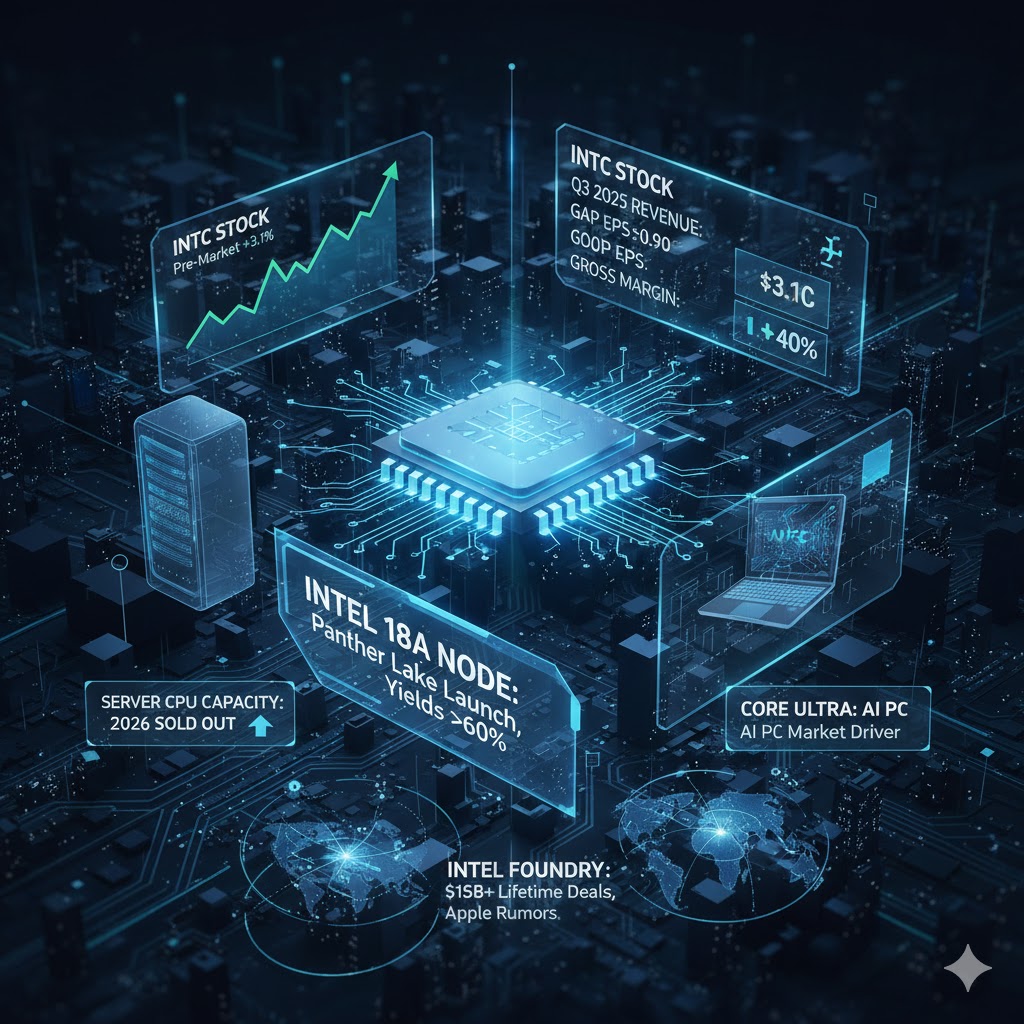
The primary driver behind the recent vertical move in Intel stock was a major rating upgrade from KeyBanc Capital Markets. Analysts John Vinh and Ryan Rosumny elevated the stock to “Overweight” with a target price of $60, a level not seen in years. The justification for this bullishness is rooted in tangible data: Intel has reportedly sold out its server CPU capacity for nearly the entirety of 2026. This is a staggering turnaround for a company that was once accused of losing its server dominance to competitors like AMD and NVIDIA.
The logic is simple: the global hunger for AI compute has moved beyond GPUs. As hyperscalers and enterprise data centers build out their AI clusters, the demand for high-performance server CPUs to manage data flow and general-purpose workloads has skyrocketed. With supply remaining tight, Intel is now in a position to implement price hikes of 10% to 15% on its flagship Xeon processors. This pricing power, combined with full utilization of its fabrication plants, suggests that the upcoming earnings report could provide much stronger guidance for 2026 than previously modeled by the consensus.
Manufacturing Mastery: The 18A Node is No Longer a Myth
For the past three years, the “Intel 18A” process node was the centerpiece of CEO Pat Gelsinger’s turnaround plan—but it was also the greatest source of investor skepticism. That skepticism appears to be evaporating. At CES 2026, Intel formally launched the Core Ultra Series 3, code-named “Panther Lake,” the first consumer product built on the 18A process.
The success of Panther Lake is a watershed moment for Intel Corporation stock. Built using RibbonFET (gate-all-around transistors) and PowerVia (backside power delivery), the 18A node represents the first time in over a decade that Intel has a legitimate claim to manufacturing leadership over TSMC. Internal reports and analyst “checks” suggest that 18A yields have crossed the 60% threshold, which is the magic number required for high-volume manufacturing. This de-risks the company’s entire 2026 roadmap, which includes the highly anticipated Clearwater Forest server chips scheduled for the first half of this year.
Financial Health: A Balance Sheet in Transition
Analyzing the Intel stock price requires a look at the fiscal discipline the company has maintained throughout its expensive “IDM 2.0” transition. In the third quarter of 2025, Intel reported revenue of $13.7 billion, surpassing analyst expectations. Perhaps more importantly, the company swung back to a GAAP profit of $0.90 per share, a massive recovery from the heavy losses sustained in the previous year.
| Financial Metric (Q3 2025) | Result | Significance |
| Total Revenue | $13.7 Billion | 6% sequential growth; beating guidance. |
| Gross Margin (Non-GAAP) | 40% | Improving due to favorable product mix and efficiency. |
| Operating Cash Flow | $2.5 Billion | Supporting the $18B annual CapEx plan. |
| Cash & Equivalents | $30.9 Billion | Fortress balance sheet with support from U.S. CHIPS Act. |
The company has successfully slashed its operating expenses, targeting a reduction to $17 billion in 2025 and $16 billion in 2026. This leaner structure means that every dollar of incremental revenue from the sold-out server market will fall more heavily to the bottom line, providing the “EPS beat” potential that short-sellers have come to fear.
The Foundry Business: Securing the “Big Three”
One of the most significant reasons INTC stock surged sharply recently is the rumor—now gaining credibility—that Apple has signed on as a future customer for Intel Foundry. While TSMC remains Apple’s primary partner, Intel’s 18A node and its advanced EMIB-T packaging are attractive alternatives for secondary Mac and iPad chips, as well as the custom ASICs being developed by Google, Meta, and Amazon.
Intel Foundry’s expected lifetime deal value has crossed the $15 billion mark. If the company can prove it can build chips for its rivals as efficiently as it builds them for itself, Intel is on track to become the world’s second-largest foundry by 2030. The market is beginning to value Intel not just as a chip designer, but as a “national champion” manufacturing utility, which typically commands a different, more stable valuation multiple.
AI PC: The Next Growth Engine
While data centers get the headlines, the Client Computing Group (CCG) remains Intel’s bread and butter. The “AI PC” is no longer a marketing buzzword; it is a replacement cycle driver. With Windows 10 reaching the end of its life and Windows 11/12 demanding integrated NPUs (Neural Processing Units), Intel’s Core Ultra lineup is seeing rapid adoption.
At CES 2026, Intel showcased over 200 laptop designs powered by its latest silicon. These chips offer up to 4.5x higher throughput on vision-based AI models compared to previous generations. For investors in Intel stock, this represents a “sticky” revenue stream that protects the company’s market share against ARM-based competitors.
Market Sentiment and Technical Outlook
Technically, Intel stock has broken out of a multi-year consolidation pattern. The heavy volume accompanying the January 13 rally indicates institutional accumulation—”big money” is moving back into the stock. Traders are looking at the $50 psychological level as the next major resistance, but the real story is the “fear of missing out” (FOMO) regarding the Q4 earnings call.
Investors are betting that Intel’s management will not only confirm the server sell-out but also provide an update on the progress of Fab 52 in Arizona. Any confirmation that the 18A ramp is ahead of schedule could lead to a parabolic move in the INTC stock price.
Conclusion
As we look toward next week’s earnings release, Intel stands at a unique crossroads. The company has moved from the “survive” phase to the “thrive” phase of its turnaround. With manufacturing leadership back in sight, a sold-out server inventory, and a leaner, more profitable organizational structure, the bull case for Intel stock has never been more coherent in the post-pandemic era.
While the semiconductor industry is notoriously cyclical and fraught with geopolitical risk, Intel’s positioning as the primary Western foundry and a leading AI infrastructure provider makes it a critical barometer for the entire tech sector in 2026. The pre-market gains seen on January 14 may just be the prologue to a much larger chapter in the company’s storied history.