In a decisive move citing national security, the Trump administration has formally proclaimed new tariffs on specific advanced semiconductors and laid the groundwork for potentially sweeping future tariffs on the sector.
Full Text of Key Proclamation Directives
On January 14, President Donald J. Trump signed a proclamation “to address the threat to the national security posed by imports of semiconductors, semiconductor manufacturing equipment, and derivatives.” The action is taken under Section 232 of the Trade Expansion Act of 1962.
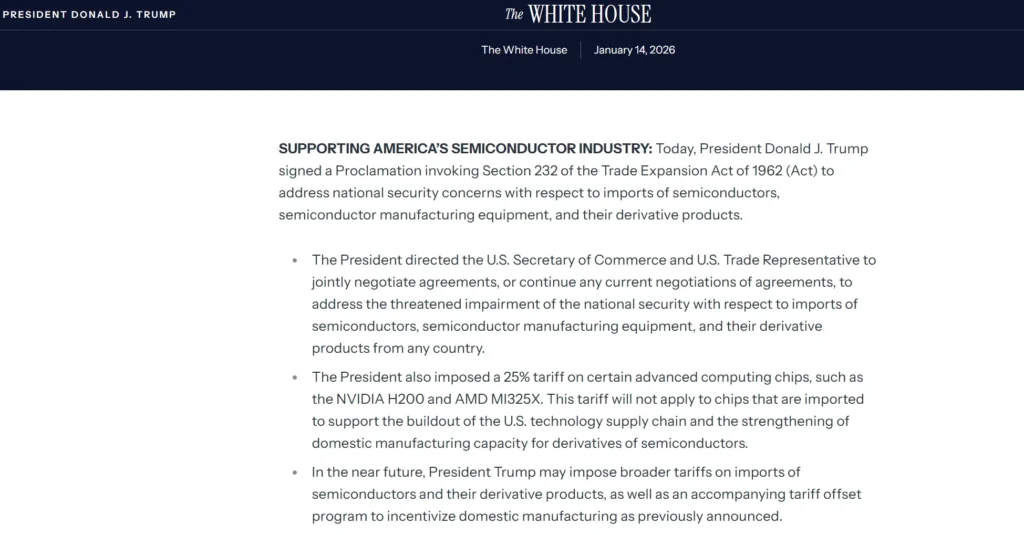
SUPPORTING AMERICA’S SEMICONDUCTOR INDUSTRY: Today, President Donald J. Trumpsigned a Proclamation invoking Section232of the Trade Expansion Act of 1962(Act) toaddress national security concerns with respect to imports of semiconductors,semiconductor manufacturing equipment, and their derivative products.
The President directed the U.S. Secretary of Commerce and U.S. Trade Representative tojointly negotiate agreements, or continue any current negotiations of agreements, toaddress the threatened impairment of the national security with respect to imports ofsemiconductors, semiconductor manufacturing equipment, and their derivativeproducts from any country.
The President alsoimposed a25% tariff on certain advanced computing chips, such asthe NVIDIA H200 and AMD Ml325X. This tariff will not apply to chips that are importedto support the buildout of the U.S. technology supply chain and the strengthening ofdomestic manufacturing capacity for derivatives of semiconductors.
In the near future, President Trump may impose broader tariffs on imports ofsemiconductors and their derivative products, as well as an accompanying tariff offsetprogram to incentivize domestic manufacturing as previously announced.
National Security Rationale and Policy Foundation
The proclamation is rooted in a completed Department of Commerce Section 232 investigation, which “found that the quantities and circumstances of imports of semiconductors, semiconductor manufacturing equipment, and derivatives threaten to impair the national security.”
It elaborates on this finding, stating: “The capacity of the United States to produce semiconductors, certain semiconductor manufacturing equipment (such as advanced lithography and etch tools), and derivatives is inadequate to meet domestic demand. This results in the United States relying on foreign resources to meet domestic demand. Semiconductors are essential to the United States’ economic, industrial, and military strength, and supply chain disruptions from import dependency could undermine U.S. industrial and military capabilities.”
The administration frames this action as part of a consistent “America First” trade policy. The proclamation notes, “President Trump has used Section 232 tariffs on numerous occasions to guard against threats to our national security and strengthen manufacturing sectors vital to our national and economic security, including steel, aluminum, copper, automobiles, and lumber.”
Analysis: Targeted Impact and Market Implications for Nvidia(NVDA) and AMD(AMD)
The immediate market impact is precisely targeted by the proclamation’s text.
Direct Tariff Application: The explicit 25% tariff on specific flagship data center/AI chips (Nvidia H200, AMD MI325X) creates a direct cost barrier for imports of these finished products for end-users in the U.S. market. This could pressure the gross margins for Nvidia and AMD on sales of these specific SKUs into the United States if they cannot fully pass the cost to customers.
Critical Exemption Clause: The exemption for chips “imported for the purpose of supporting the construction of the U.S. technical supply chain and strengthening domestic manufacturing capacity” is a pivotal detail. It suggests that major U.S. cloud hyperscalers (e.g., Google, Amazon, Microsoft) or AI companies importing these chips to build and operate U.S.-based data center infrastructure may qualify for exemption, potentially shielding a significant portion of core demand.
Uncertainty from Broader Threat: The signaled intent for “broader tariffs on imports of semiconductors and derivatives in the near future” introduces a layer of strategic uncertainty that outweighs the current targeted measure. Investors will be highly sensitive to any signals regarding the scope and rate of potential future tariffs, which could affect a much wider range of products and significantly disrupt complex global semiconductor supply chains.
Stock-Specific Outlook: In the near term, the targeted nature of the current tariff and the key supply chain exemption may limit severe financial impact. However, both companies’ stocks (NVDA, AMD) will likely face heightened volatility and investor scrutiny based on perceptions of their ability to navigate the policy shift, leverage the exemption, and manage potential escalations. The long-term thesis now inextricably includes a new variable: the cost and strategic shape of U.S.-centric versus globalized supply chains.
The ultimate financial impact hinges on the interpretation of the exemption and the scale of any future tariffs, making close monitoring of U.S. Customs guidance and subsequent administration announcements critical.
The energy sector experienced a robust upswing in recent trading sessions, closely mirroring a notable intraday rally in global crude oil benchmarks, West Texas Intermediate (WTI) and Brent. This bullish momentum translated into widespread gains across U.S. oil and gas equities, with Devon Energy stock leading the charge, climbing over 4%. ConocoPhillips stock followed with a gain exceeding 3%, while industry behemoths Chevron stock, Exxon Mobil stock, and Occidental Petroleum stock each advanced more than 2%. This synchronized movement underscores the sector’s continued sensitivity to underlying commodity price fluctuations, but also invites a deeper examination of the individual company fundamentals, strategic trajectories, and unique value propositions that distinguish these players within the broader rally. A closer analysis of the financials, strategic priorities, and operational developments of Devon Energy (DVN), ConocoPhillips (COP), Chevron (CVX), Exxon Mobil (XOM), and Occidental Petroleum (OXY) reveals a nuanced landscape where disciplined capital allocation, strategic acquisitions, and energy transition positioning are as critical to investor sentiment as the day’s move in oil prices.
Devon Energy Corp. (DVN): A Focused Operator Capitalizing on Shareholder Returns The impressive surge of over 4% in Devon Energy stock highlights its appeal as a pure-play on U.S. onshore production coupled with a highly shareholder-friendly capital return policy. Devon’s financial strategy has been a model of discipline in the post-pandemic era. The company utilizes a fixed-plus-variable dividend framework, directly linking a portion of its shareholder returns to quarterly cash flow generation. This means that in periods of strong oil and gas prices and operational efficiency, as witnessed recently, investors can expect substantial variable dividend payouts alongside the base dividend. Analyzing its latest quarterly report reveals a financial profile geared towards high-margin production. Devon has actively streamlined its portfolio, focusing on its high-return core assets in the Delaware Basin, Eagle Ford, and Anadarko Basin. This focus is evident in its strong operating cash flow margins. For instance, in a recent quarter, Devon might report operating cash flow surpassing $2 billion, enabling significant debt reduction, robust capital expenditures within cash flow, and the distribution of its variable dividend. The rise in the DVN stock price is a direct reflection of the market rewarding this transparent and return-focused financial model, especially when commodity prices provide a tailwind.
From a business development and planning perspective, Devon’s strategy is decidedly conservative and returns-oriented. The company has emphasized a “maintenance-plus” capital expenditure program, aiming to keep production relatively flat or growing modestly while prioritizing free cash flow generation over aggressive volume growth. This restraint is a key differentiator and is positively received by investors seeking exposure to oil prices without the associated risks of unchecked capital spending. There is minimal talk of large-scale, transformative M&A; instead, the focus is on small, bolt-on acquisitions within its core operating areas to enhance scale and operational efficiency. On the product and development front, Devon is not engaged in “new product” development in a traditional sense but is continuously advancing its operational techniques. This includes optimizing well completion designs, implementing advanced data analytics for drilling, and improving midstream logistics to reduce costs and enhance recovery rates. Its market expansion is geographic only in the context of deepening its hold within its existing premier basins. The company’s commitment to its dividend framework and a strong balance sheet (evidenced by a declining net debt-to-EBITDA ratio) are the central pillars of its investment case. The recent upward move in Devon Energy stock signals confidence that the company will continue to be a premier vehicle for returning capital to shareholders during a strong commodity cycle, making its stock performance a leveraged play on both oil prices and operational execution.
ConocoPhillips (COP): The Disciplined Giant with a Global Portfolio The gain of over 3% for ConocoPhillips stock reflects its status as a large, diversified, and meticulously managed independent exploration and production (E&P) company. ConocoPhillips runs a global portfolio spanning the Lower 48 states, Alaska, Canada, Europe, Asia-Pacific, and the Middle East. This geographic diversification provides a natural hedge against regional price or operational disruptions. Financially, COP is a cash flow powerhouse. Its strategy, dubbed the “Triple Mandate,” focuses on generating strong returns on capital employed, achieving a low cost of supply, and delivering a compelling shareholder return. Its quarterly financials consistently demonstrate this: robust operating cash flow (often exceeding $5 billion in strong quarters), disciplined capital spending aligned with a moderate growth profile, and substantial returns to shareholders through a growing base dividend and a sizable share repurchase program. The increase in the COP stock price is a testament to the market’s appreciation for this predictable, financially resilient model. The company’s breakeven price is among the lowest in the industry, thanks to its high-quality asset base, which includes massive, low-decline projects like the Alaska North Slope and the Montney and Surmont assets in Canada, alongside its tier-one U.S. shale position in the Permian and Eagle Ford.
ConocoPhillips’s business development has been characterized by strategic, transformative acquisitions that immediately enhance scale and economics. The landmark acquisition of Concho Resources in 2021 solidified its dominance in the Permian Basin. More recently, the acquisition of Shell’s Permian assets further cemented this position. Its plan is to integrate these acquisitions efficiently, realize synergies, and high-grade the combined portfolio. Unlike some peers, COP has been clear that it sees its future firmly in oil and gas, leveraging its scale and efficiency to be a last-standing low-cost producer even in a decarbonizing world. Its “energy transition” plan is pragmatic, focusing on projects to reduce the emissions intensity of its operations (like methane monitoring and electrification) and investing in early-stage low-carbon technologies, such as hydrogen and carbon capture, through its venture capital arm. However, its core investment and growth capital remain overwhelmingly directed towards its hydrocarbon portfolio. Product development is centered on optimizing its vast resource base, including advancing major projects like Willow in Alaska. Market expansion is primarily about maximizing value from its existing global footprint and leveraging its trading and marketing arm to capture arbitrage opportunities. The strength in ConocoPhillips stock indicates investor confidence in its disciplined capital allocation, its ability to generate massive free cash flow across cycles, and its strategic positioning as a consolidator in the Permian Basin, making it a core holding for broad-based energy exposure.
Chevron Corp. (CVX) & Exxon Mobil Corp. (XOM): Integrated Majors Balancing Tradition and Transition The parallel gains of over 2% for both Chevron stock and Exxon Mobil stock highlight the renewed investor interest in the integrated supermajors, entities that encompass the entire value chain from upstream production to refining, chemicals, and marketing. Their recent outperformance is not solely a crude price play; it reflects a broader reassessment of their financial discipline and strategic redirection. Financially, both companies emerged from the 2020 price crash with a renewed commitment to capital restraint and shareholder returns. Chevron, for instance, has prioritized its dividend as sacrosanct and supplemented it with share buybacks. Its recent quarterly earnings often showcase strong downstream and chemical earnings complementing upstream performance, providing cash flow stability. Exxon Mobil, after a period of significant capital spending, has dramatically curtailed its outlays, focusing on high-return short-cycle projects, particularly in the Permian and Guyana. Its new corporate plan emphasizes structural cost reductions and a debt reduction target, which has restored its balance sheet strength. The rise in CVX stock price and XOM stock price signals approval of this more shareholder-centric, less growth-at-all-costs approach. Their immense scale and integrated models provide a relative cushion during volatility, as weak upstream margins can sometimes be offset by strong refining cracks or chemical margins.
Strategically, Chevron and Exxon are navigating the energy transition in different, yet increasingly clear, ways. Chevron has outlined a strategy focused on “lower carbon intensity” oil and gas, investing in renewable fuels, carbon capture, and hydrogen, with a stated goal to grow these lower-carbon businesses profitably. Its acquisition of Renewable Energy Group was a significant bet on biofuels. Exxon Mobil, after facing investor pressure, has significantly increased its commitment to lower-carbon solutions, establishing a Low Carbon Solutions business focused on carbon capture and storage (CCS)—where it claims a leading position—and biofuels. However, both companies continue to assert the long-term necessity of oil and gas, investing heavily in giant, low-cost upstream projects like Exxon’s Guyana-Stabroek block and Chevron’s Tengizchevroil expansion in Kazakhstan. These projects are pillars of their future production and cash flow. In terms of market expansion, their global downstream and chemical footprints are being optimized rather than massively expanded, with a focus on high-performing assets. The recent stock strength suggests the market is beginning to value their potential to be “all-energy” companies—entities that can generate enormous cash from hydrocarbons to fund both shareholder returns and selective investments in emerging energy technologies, positioning them as enduring giants rather than dinosaurs. The performance of Chevron stock and Exxon Mobil stock reflects a belief that they have adapted their strategies to meet both current cash return demands and future energy mix realities.
Occidental Petroleum (OXY): A Unique Story of Debt, Dividends, and Direct Air Capture The more than 2% climb in Occidental Petroleum stock tells a more complex story, intertwined with its past, its prominent investor, and its controversial future vision. Occidental carries the legacy of its pre-pandemic acquisition of Anadarko Petroleum, which left it with a heavy debt burden. Therefore, its recent financial narrative has been dominated by debt reduction. Its quarterly reports are scrutinized for progress on this front, and the company has made substantial headway, using strong cash flows from its high-quality Permian Basin and Gulf of Mexico assets, as well as its leading chemical (OxyChem) business, to rapidly pay down debt. The recent initiation of a modest quarterly dividend and a share repurchase program marked pivotal turning points, signaling a shift from pure survival to returning capital. The movement in the OXY stock price is sensitive to oil prices due to its leveraged balance sheet history, but also uniquely influenced by its ambitious low-carbon ventures. The company’s association with Warren Buffett’s Berkshire Hathaway, a major shareholder, adds a layer of market attention and perceived stability.
Occidental’s business development plan is bifurcated. In the near to medium term, it is an E&P and chemicals company focused on optimizing its Permian resources (where it is a leader in carbon-neutral oil through its sequestration initiatives) and generating free cash flow. Its longer-term vision, however, is arguably the most distinctive in the industry. Through its subsidiary 1PointFive, Occidental is aggressively pursuing the commercialization of Direct Air Capture (DAC) technology, aiming to build multiple large-scale plants to remove carbon dioxide directly from the atmosphere. This is not merely an R&D project; the company has secured investment partners and offtake agreements, including a significant deal with Amazon. This positions OXY not just as an oil producer, but as a potential future leader in the carbon management ecosystem. This high-risk, high-potential venture divides investor opinion. From a market expansion perspective, its hydrocarbon growth is focused on the Permian and enhanced oil recovery (which synergizes with its CO2 expertise), while its “new product” development is literally the scaling of DAC technology. The recent positive movement in Occidental Petroleum stock likely reflects a combination of higher oil prices improving its core business cash flow and growing, albeit cautious, optimism about the potential scalability and economics of its DAC projects, setting it apart as a highly speculative yet strategically unique player in the energy space.
In conclusion, the broad-based advance in Devon Energy stock, ConocoPhillips stock, Chevron stock, Exxon Mobil stock, and Occidental Petroleum stock is rooted in a favorable oil price environment, but sustained by distinct corporate fundamentals. Devon excels in direct shareholder returns; ConocoPhillips in global portfolio discipline and cash generation; Chevron and Exxon in integrated resilience and evolving transition strategies; and Occidental in debt reduction and a pioneering carbon capture ambition. Their collective performance signals a market that is selectively rewarding energy companies that demonstrate capital discipline, clear strategic pathways, and attention to shareholder returns, while also beginning to ascribe value to credible long-term positioning within the evolving global energy landscape. Their individual trajectories will be determined not just by the price of crude, but by their execution on these very specific financial and operational blueprints in the quarters ahead.